CHSE Odisha Class 11 Psychology Unit 2 Perceptual Process Objective Questions

Odisha State Board CHSE Odisha Class 11 Psychology Solutions Unit 2 Perceptual Process Objective Questions.

CHSE Odisha 11th Class Psychology Unit 2 Perceptual Process Objective Questions

Multiple Choice Type Questions.

Question 1.
Perception is a ________.
(a) Mental process
(b) Physical process
(c) Motor skill
(d) Psychophysiological process.
Answer:
(a) Mental process

Question 2.
Illusions are _________.
(a) False perception
(b) Wrong perception
(c) wrong belief
(d) none of these
Answer:
(b) Wrong perception

Question 3.
Hallucination mostly occurs in people suffering from:
(a) Hysteria
(b) Paranoia
(c) Schizophrenia
(d) Myopia
Answer:
(d) Myopia

Question 4.
One of the processes involved in the formation of a concept is:
(a) Classification
(b) Association
(c) Environment
(d) Generalisation
Answer:
(d) Generalisation

Question 5.
One’s ability to distinguish five details is called:
(a) Attention
(b) Sensation
(c) Visual Activity
(d) Apperception
Answer:
(c) Visual Activity

CHSE Odisha Class 11 Psychology Unit 2 Perceptual Process Objective Questions

Question 6.
Perception of figure and ground is a function of:
(a) Past experience
(b) Structure of the nervous system
(c) Sensation pattern
(d) Insightful learning
Answer:
(b) Structure of the nervous system

Question 7.
The monocular cue to distance in the perspective diagram is:
(a)Terial perspective
(b) Linear Perspective
(c) Gradient of texture
(d) None of the above.
Answer:
(a)Terial perspective

Question 8.
Pilots usually rely mere on their instruments than on their perception on because of:
(a) Lack of any motion perception
(b) His movement perception
(c) The illusion of induced movements of objects
(d) Rules of the flight manual
Answer:
(a) Lack of any motion perception

Question 9.
Illusion is a perception:
(a) Wrong
(b) False
(c) Correct
(d) Apperception
Answer:
(a) Wrong

Question 10.
Hallucination is more often found in:
(a) Normals
(b) Neurotics
(c) Schizophrenics
(d) None of the above
Answer:
(c) Schizophrenics

Question 11.
Hallucination is a_____ perception.
(a) False
(b) Correct
(c) Wrong
(d) Movement
Answer:
(a) False

Question 12.
Perception is more determined by:
(a) emotion
(b) past experience
(c) thinking
(d) intelligence
Answer:
(b) past experience

CHSE Odisha Class 11 Psychology Unit 2 Perceptual Process Objective Questions

Question 13.
The basic movement perception used in films is:
(a) visual illusion
(b) motion
(c) perceptual constancy
(d) stroboscopic motion
Answer:
(b) motion

Question 14.
Perceiving a rope as a snake is:
(a) perception
(b) illusion
(c) hallucination
(d) sensation
Answer:
(b) illusion

Question 15.
Perceiving a rope as a rope is:
(a) hallucination
(b) imaginary
(c) perception
(d) illusion
Answer:
(c) perception

Question 16.
When a rope is confused to be a nake, it is called:
(a) illusion
(b) image
(c) hallucination
(d) delusion
Answer:
(a) illusion

Question 17.
Perception involves _____ process.
(a) receptor
(b) symbolic
(c) affective
(d) all These
Answer:
(d) all These

Question 18.
The tendency to see the immobility of objects is called:
(a) color constancy
(b) size constancy
(c) location constancy
(d) brightness constancy
Answer:
(c) location constancy

Question 19.
If a person gets a certain sensation that is not physically present in his environment it is due to the:
(a) illusion
(b) delusion
(c) hypnotism
(d) hallucination
Answer:
(d) hallucination

Question 20.
If an object is perceived without any stimulus value it is called:
(a) delusion
(b) hypnotism
(c) illusion
(d) hallucination
Answer:
(d) hallucination

CHSE Odisha Class 11 Psychology Unit 2 Perceptual Process Objective Questions

Question 21.
An object in dim illumination can be perceived if is:
(a) familiar
(b)unlluniliar
(c) huge size
(d) colored
Answer:
(a) familiar

Question 22.
A triangle is perceived as a triangle ¡n whatever position related to:
(a) brightness constancy
(b) size constancy
(c) color constancy
(d) shape constancy
Answer:
(d) shape constancy

Question 23.
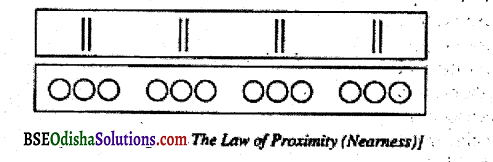
The principle of proximity in perception suggests that an object is more likely to be perceived if:
(a) it is huge
(b) it is nearer to the perceiver
(c) it is close to the perceiver
(d) the stimuli are close together they, tend to be grouped together.
Answer:
(c) it is close to the perceiver

Question 24.
Apperception refers to the process of:
(a) not allowing new
(b) associating new ideas with old one
(c) substituting new ideas in lace of old ones
(d) None of the above
Answer:
(c) substituting new ideas in lace of old ones

Question 25.
When two stimuli are presented and one perceives one thing in relation to the other it is called:
(a) Simultaneous perception
(b) Figure-ground perception
(c) Consecutive perception
(d) Successive perception
Answer:
(b) Figure-ground perception

Question 26.
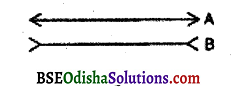
Muller Lyer illusion occurs because of:
(a) Visual defect
(b) errors in perception
(c) abnormality
Answer:
(b) errors in perception

CHSE Odisha Class 11 Psychology Unit 2 Perceptual Process Objective Questions

Question 27.
Muller Lyer illusion is ________ illusion.
(a) arithmetical
(b) geometrical
(c) geographical
Answer:
(b) geometrical

Question 28.
The number of items a person can perceive at a single glance is called:
(a) Span of immediate memory
(b) Span of attention
(c) Span of perception
(d) Immediate perception
Answer:
(d) Immediate perception

Question 29.
The theory of organization in perception has been advocated by:
(a) Behaviourist
(b)Associationists
(c) Gestalts
(d) Functionalists.
Answer:
(c) Gestalts

Question 30.
Perception is the interpretation of sensation in the light of:
(a) Present experience
(b) Immediate experience
(c) Past experience
(d) None of the above
Answer:
(c) Past experience

Question 31.
The mechanism through which the ‘O’ converts a sense impression to perception is called the __________.
(a) Process of sensation
(b) Process of attention
(c) Process of perception
(d) None of the above.
Answer:
(b) Process of attention

Question 32.
Perception involves the _________ process.
(a) receptor
(b) symbolic
(c) effect or
(d) all of the above.
Answer:
(d) all of the above.

Question 33.
Perceptual organization is best explained through the:
(a) Phi phenomenon
(b) Closure
(c) Movement
(d) Figure and ground phenomenon.
Answer:
(d) Figure and ground phenomenon.

CHSE Odisha Class 11 Psychology Unit 2 Perceptual Process Objective Questions

Question 34.
A pattern will have the advantage of being perceived as a ___________ if it can be formulated by combining all the elements, present in the field:
(a) Part
(b) Whole
(c) Both whole and part.
Answer:
(b) Whole

Question 35.
The organization helps in ___________ perception.
(a) quick
(b) delayed
(c) wrong
(d) false
Answer:
(a) quick

Question 36.
The functional factors of perception lie _________ the individual:
(a) Within
(b) Outside
(c) In the environment of the individual
(d) None of these.
Answer:
(a) Within

Question 37.
Experiments on value and need as organizing factors in perception have been conducted by:
(a) Bruner and Goodman
(b) Kofika
(c) Pinter and Anderson
(d) Muller and Lyer
Answer:
(a) Bruner and Goodman

Question 38.
The tendency of a percept to remain the same from movement to movement and from time to time refers to __________ of perception :
(a) Closure
(b) Movement
(c) Constancy
(d) Good figure
Answer:
(c) Constancy

Question 39.
The perception of movement in a stationary spot is called:
(a) Geometrical illusion
(b) Delusion
(c) Phi phenomenon
(d) Auto kinetic phenomenon.
Answer:
(c) Phi phenomenon

CHSE Odisha Class 11 Psychology Unit 2 Perceptual Process Objective Questions

Question 40.
Division of attention
(a) Does not affect the efficiency
(b) Affects efficiency
(c) Divisions of attention is impossible
Answer:
(b) Affects efficiency

Question 41.
Attention is a __________.
(a) Preperceptive attitude
( b) Learning skill
(c) Mechanical process
Answer:
(a) Preperceptive attitude

Question 42.
Habit is a _________ determinant of attention.
(a) Objective
(b) Subjective
(c) Quantitative
(d) None of the above.
Answer:
(b) Subjective

Question 43.
Which of the following psychologist can be associated with a span of attention?
(a) Marrow
(b) Watson
(c) Miller
(d) Mc Gaoch
Answer:
(c) Miller

Question 44.
__________conducted a test on shifting of attention.
(a) Linton
(b) Kholer
(c) Hersey
(d) Urban & Schitch
Answer:
(d) Urban & Schitch

Question 45.
Those factors which lie in the stimulus is of great importance in determining the __________ attention.
(a) Nature
(b) Quality
(c) Directions
Answer:
(a) Nature

CHSE Odisha Class 11 Psychology Unit 2 Perceptual Process Objective Questions

Question 46.
An auditory nerve as connected to__________.
(a) acceipital lobe
(b) parietal lobe
(c) temporal lobe
(d) frontal lobe
Answer:
(c) temporal lobe

Question 47.
Receptors are the structure that is _________ to physical energy.
(a) affective
(b) assertive
(c) reactive
(d) cooperative
Answer:
(c) reactive

Question 48.
___________ conducted several experiments on cerebral localization.
(a) Lashley
(b) Maslow
(c) Proca
(d) Sherrington
Answer:
(a) Lashley

Question 49.
Complex learning does not depend upon a definite structure of specified areas of the body. Who among the following said the above?
(a) Lashley
(b) Sherington
(c)Franz
(d) Cock
Answer:
(a) Lashley

Question 50.
Currently, neuropsychology is being studied in relation to:
(a) Psychology
(b)Anthropology
(c) Sociology
(d) Neurosurgery
Answer:
(d) Neurosurgery

Question 51.
The receptive organ is that organ of the human body which:
(a) Receive stimulation
(b) Sends the response
(c) Receives the response
Answer:
(a) Receive stimulation

Question 52.
A neuron is a basic unit of:
(a) Gland
(b) Nervous system
(c) Brain
(d) Spinal Cord
(e)All these
Answer:
(b) Nervous system

CHSE Odisha Class 11 Psychology Unit 2 Perceptual Process Objective Questions

Question 53.
A neuron is also called a:
(a) Sweat Gland
(b) Duct Gland
(c) A ductless gland
(d) Nerve cell
(e) None of these
Answer:
(d) Nerve cell

Question 54.
Posterior pituitary:
(a) Raise blood pressure
(b) Regulates metabolism
(c) Shows down the heartbeat
(d) Increases contraction of smooth muscles in the intestine and uterus.
(e)All the above.
Answer:
(e)All the above.

Question 55.
The autonomic nervous system is divided into _________ parts.
(a) Two parts
(b) Three parts
(c) Four parts
(d) Striated muscles.
Answer:
(a) Two parts

Question 56.
The brain fundamentally acts as a whole. This view is supported by:
(a) Principles ofequipotentiality
(b) Principle of Mass action
(c) Both the above
(d) None of these
Answer:
(b) Principle of Mass action

Question 57.
To study the localization of brain functions the following method is used.
(a) Anatomical method
(b) Method of expiration
(c) Action potential method
(d) Method of stimulation
(e) All the above.
Answer:
(e) All the above.

Question 58.
Electrical stimulation of which of the following organs can awaken a sleeping animal?
(a) Thalamus
(b) Hypothalamus
(c) Reticular formation
(d) None of the above.
Answer:
(c) Reticular formation

CHSE Odisha Class 11 Psychology Unit 2 Perceptual Process Objective Questions

Question 59.
Reflex actions are :
(a) Voluntary
(b) Involuntary
(c) Independent of the person’s will
(d) Controlled by the person
(e) None of the above.
Answer:
(b) Involuntary

Question 60.
The size of the reticular activating system is just like ___________.
(a) Small finger of man
(b) Middle fmger of man
(c)Forefinger of man
(d)Thumbofman
Answer:
(a) Small finger of a man

Question 61.
Which of the following is an aid to be the central switchboard of the brain:
(a) Thalamus
(b) Hypothalamus
(c) Cerebrum
(d) Midbrain
(e) None of these
Answer:
(b) Hypothalamus

Question 62.
The occipetal lobe is a part of the:
(a) The central nervous system
(b) The autonomic nervous system
(c) The endocrine system
(d) The cardiac vascular system.
Answer:
(a) The central nervous system

Question 63.
Reflex actions are controlled by __________.
(a) brain
(b) C.N.S.
(c) A.N.S.
(d) Spinal Cord
Answer:
(d) Spinal Cord

Question 64.
The interior part of the mid-brain consisting of grey masters and interconnected with groups of actions is called ___________.
(a) Cerebral cortex
(b) Medulla
(c) Reticular formation
(d) Medulla oblongata
(e) None of these
Answer:
(c) Reticular formation

Question 65.
Which region of the nerve cell is particularly sensitive to stimulation from a receptor of another nerve cell?
(a) Dendrite zone
(b) Axon
(c) Myclin shealth
(d) Nucleus
Answer:
(b) Axon

CHSE Odisha Class 11 Psychology Unit 2 Perceptual Process Objective Questions

Question 66.
In the cortex, a concentration of __________ is found.
(a) Axon
(b) Cell bodies
(c) Nerve cells
(d) Dendrites
Answer:
(a) Axon

Question 67.
The reticular formation of the midbrain helps in the control of ___________.
(a) Eating behavior
(b) Eliminating behavior
(c) Well-coordinated movements
(d) Amusai level
Answer:
(d) Amusai level

Question 68.
Most of the vital functions of life are governed by the___________.
(a) Sympathetic system
(b) Para sympathetic system
(c) Spinal cord
(d) None of these
Answer:
(b) Para sympathetic system

Question 69.
Certain parts of the lymbic system arc intimately connected with ___________.
(a) Emotional behavior
(b) Reflex action
(c) Learning
(d) None of these
Answer:
(a) Emotional behavior

Question 70.
Destruction of the septal region of the hypothalamus leads to ____________.
(a) Excessive fear
(b) Excessive anger
(c) Combination of hear and anger
Answer:
(c) Combination of hear and anger

Question 71.
The sympathetic nervous system of man consists of ___________.
(a) 22 sympathetic ganglia
(b) 33 sympathetic ganglia
(c) 51 sympathetic ganglia
(d) None of these
Answer:
(a) 22 sympathetic ganglia

Question 72.
The neurons are the ___________ units of the whole nervous system.
(a) Smallest
(b) Biggest
(c) Medium
(d) None of these
Answer:
(a) Smallest

Question 73.
Which of the following areas of the cortex is concerned with the coordination of activity?
(a) Occipetal lobe
(b) Parietal lobe
(c) Temporal lobe
(d) Frontal lobe
(e) None of these
Answer:
(d) Frontal lobe

Question 74.
The reticular activating system is damaged or injured when a man suffers from:
(a) Paralysis
(b) Diabetes
(c) Heart disease
(d) None of these
Answer:
(a) Paralysis

Question 75.
The parietal lobe lies in the ___________.
(a) Front of the brain
(b) Back of the brain
(c) Centre of the brain
(d) None of these
Answer:
(b) Back of the brain

CHSE Odisha Class 11 Psychology Unit 2 Perceptual Process Objective Questionss

Question 76.
Damage of the temporal lobe leads to:
(a) Blindness
(b) Deafness
(c) Dumbness
(d) Forgetfulness
(e) None of these.
Answer:
(b) Deafness

Question 77.
The parietal lobe is also known as:
(a) Body sensitivity area
(b) Anatomical area
(c) Association area
(d) Premotor area
Answer:
(a) Body sensitivity area

Question 78.
The area for recognition of music is located in the ___________.
(a) Occipetal lobe
(b) Temporal lobe
(c) Parietal lobe
(d) Frontal lobe
Answer:
(b) Temporal lobe

Question 79.
The shape of the occipetal lobe is __________.
(a) Circular
(b) Rectangular
(c) Parallelogram
(d) Triangular
(e) None of these
Answer:
(d) Triangular

Question 80.
The cerebrum contains the major area of ___________.
(a) Intelligence
(b) Cognitive process
(c) Sensational process
(d) All these
Answer:
(d) All these

Question 81.
A portion of the parietal lobe located just behind the fissure of Roland is called _____________.
(a) Somasthic area
(b) Body feeling area
(c) All these
(d) None of these
Answer:
(a) Somasthic area

True or False Type Questions

Question 1.
Two membranes over the spinal cord. (True / False)
Answer:
False

Question 2.
The spinal cord controls reflexes and simple acts. (True / False)
Answer:
True

Question 3.
The hypothalamus is the master control center of all the endocrine glands. (True / False)
Answer:
False

Question 4.
Most of the activities of the neonate are reflections. (True / False)
Answer:
True

Question 5.
The sympathetic and parasympathetic divisions are largely thought to completely act in opposite directions. (True / False))
Answer:
True

CHSE Odisha Class 11 Psychology Unit 2 Perceptual Process Objective Questions

Question 6.
The brain and the spinal cord together control all bodily activity through the peripheral nervous system. (True / False)
Answer:
True

Question 7.
An axon is a thin cylinder of cytoplasm which expands like a branch. (True / False)
Answer:
True

Question 8.
The junction of two neurons is called the synapse. (True / False)
Answer:
True

Question 9.
Primitive forms of animal life do not have a spinal cord. (True / False)
Answer:
True

Question 10.
The flow of tears is an example of a glandular reflex. (True / False)
Answer:
True

Question 11.
All reflex actions arc voluntarily. (True / False)
Answer:
True

Question 12.
The cerebellum is the largest part of the hindbrain. (True / False)
Answer:
False

Question 13.
The medulla connects each side of the cerebellum with the opposite side of the cerebrum. (True / False)
Answer:
True

Question 14.
The size of the Reticular activating system is just like the small finger of a man. (True / False)
Answer:
True

CHSE Odisha Class 11 Psychology Unit 2 Perceptual Process Objective Questions

Question 15.
The R.A.S. and cerebrum are connected and contacted by receptors and effectors. (True / False)
Answer:
True

Question 16.
The thalamus is said to be the central switchboard of the brain. (True / False)
Answer:
True

Question 17.
Electrical stimulation of the somesthetic area of the brain leads to pressure sensation. (True / False)
Answer:
True

Question 18.
The temporal lobe contains the visual area. (True / False)
Answer:
True

Question 19.
The longitudinal fissure divides the brain into two halves. (True / False)
Answer:
True

Question 20.
The effectors are the nerves. (True / False)
Answer:
False

Question 21.
The parietal area of the brain is connected with coordination activities. (True / False)
Answer:
True

Question 22.
The cerebellum is connected with balance. (True / False)
Answer:
False

Question 23.
Lashley is made prominent studies on brain localization. (True / False)
Answer:
False

Question 24.
The nucleus of each cell in the human body contains 23 pairs of chromosomes. (True / False)
Answer: True

Question 25.
Electrical stimulation of the hypothalamus produces compulsive drinking. (True / False)
Answer:
True

CHSE Odisha Class 11 Psychology Unit 2 Perceptual Process Objective Questions

Question 26.
Gonads are otherwise known as sex glands. (True / False)
Answer:
True

Question 27.
The cerebrum is also called the new brain. (True / False)
Answer:
True

Question 28.
The midbrain has important communicative and integrative functions. (True / False)
Answer:
True

Question 29.
The nerve center in the hypothalamus controls the sympathetic and parasympathetic activities of the atomic nervous system. (True / False)
Answer:
True

Question 30.
When the cortex is removed or damaged automatic reactions are very often exaggerated. (True / False)
Answer:
True

Question 31.
If a region in the posterior hypothalamus is damaged in a person he sleeps and sleeps or remains in a coma stage.(True / False)
Answer:
True

Question 32.
The right hemisphere is connected with the right side of the body and the left hemisphere with the left side of the body. (True / False)
Answer:
True

Question 33.
The parietal lobe lies near the central fissure in the back half of the brain. (True / False)
Answer:
False

Question 34.
If the parietal lobe is damaged a person cannot discriminate between a piece of silk cloth and sandpaper. (True / False)
Answer:
False

Question 35.
That branch of psychology that studies the physiology of human beings is called physiological psychology. (True / False)
Answer:
True

CHSE Odisha Class 11 Psychology Unit 2 Perceptual Process Objective Questions

Question 36.
The parietal lobe is the seat of the association area. (True / False)
Answer:
True

Question 37.
The peripheral nervous system includes all the cell bodies and the nerve fibers outside the brain and spinal cord. (True / False)
Answer:
False

Question 38.
The sympathetic system helps the organism to meet the emergency situation more effectively. (True / False)
Answer:
False

Question 39.
The overall function of the parasympathetic system is to conserve bodily resources and help build-up up the body. (True / False)
Answer:
True

Question 40.
The nerve centers in the hypothalamus control the sympathetic and parasympathetic activities of the Autonomie nervous system. (True / False)
Answer:
True

Question 41.
Perception is limited to our experience. (True / False)
Answer:
True

Question 42.
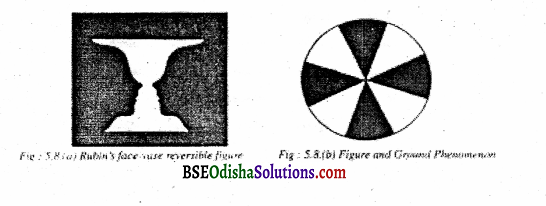
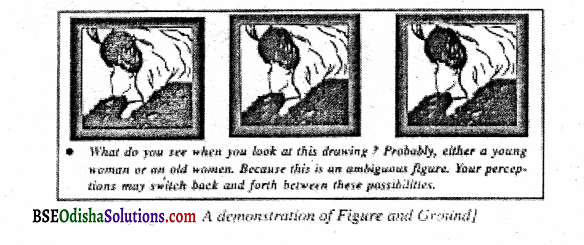
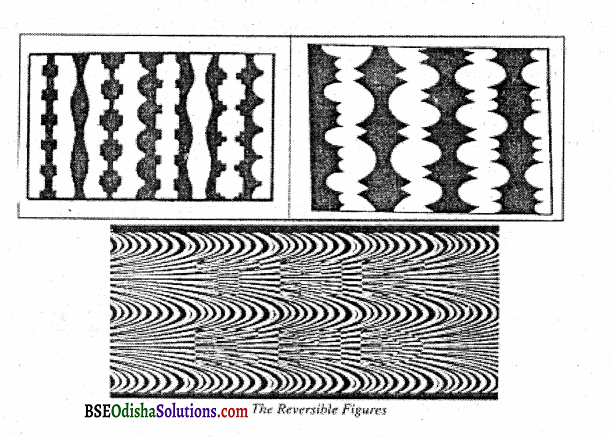
Figure and ground perception is reversible. (True / False)
Answer:
True

Question 43.
Precepts and concepts are the same. (True / False)
Answer:
True

Question 44.
A percept is a specific instance of a concept. (True / False)
Answer:
False

Question 45.
There cannot be any perception without a sensation. (True / False)
Answer:
True

CHSE Odisha Class 11 Psychology Unit 2 Perceptual Process Objective Questions

Question 46.
There cannot be perception without a sensation. (True / False)
Answer:
False

Question 47.
There can be a sensation without some perception. (True / False)
Answer:
True

Question 48.
Double images have a confusing effect on distance perception. (True / False)
Answer:
True

Question 49.
Hallucination is the wrong perception while illusion is a false perception. (True / False)
Answer:
False

Question 50.
Illusion is the wrong perception while hallucination is a false perception. (True / False)
Answer:
True

Question 51.
We perceive things as they are and not as we are. (True / False)
Answer:
False

Question 52.
We perceive them as things that exist. (True / False)
Answer:
False

Question 53.
Hallucination is a universal phenomenon. (True / False)
Answer:
False

Question 54.
Illusions are universally found in everybody. (True / False)
Answer:
True

Question 55.
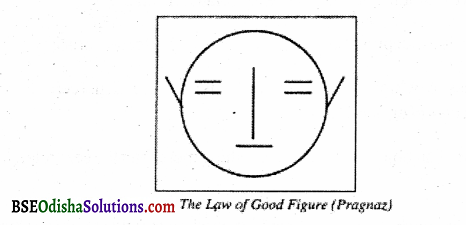
The law of good figures states that there is a tendency to organize things to make a balanced or symmetrical figure that includes all the parts. (True / False)
Answer:
True

CHSE Odisha Class 11 Psychology Unit 2 Perceptual Process Objective Questions

Question 56.
Perception is defined as a preperceptive attitude. (True / False)
Answer:
True

Question 57.
Perception contributes meaning and awareness to a particular sensation. (True / False)
Answer:
True

Question 58.
Perception is basically selective. (True / False)
Answer:
True

Question 59.
Perception is an interpretation of the sensory world. (True / False)
Answer:
True

Question 60.
Attention is the first step in the process of perception. (True / False)
Answer:
False

Question 61.
Attention is a complex process while perception is a simple process. (True / False)
Answer:
False

Question 62.
The process of perception consists of receptively symbolic and affective processes. (True / False)
Answer:
True

Question 63.
Perception consists of sensations and images. (True / False)
Answer:
True

Question 64.
The perception of adults is more subject to errors than the perception of children. (True / False)
Answer:
False

Question 65.
The study of Bruner and Mc Gianes indicates the importance of social values on perception. (True / False)
Answer:
False

CHSE Odisha Class 11 Psychology Unit 2 Perceptual Process Objective Questions

Question 66.
The perception was first studied from the physiological point by Wundt and Titchener. (True / False)
Answer:
True

Question 67.
Gestalt psychologists showed interest in the whole/part approach of perception. (True / False)
Answer:
True

Question 68.
The Gestalt opined that isomorphism makes one perceive things constantly as a whole with meaning. (True / False)
Answer:
True

Question 69.
This Wunditian school of psychology held that the process of perception is organized. (True / False)
Answer:
False

Question 70.
The process of perceptual organization can be best experienced by the figure-ground phenomenon. (True / False)
Answer:
True

Question 71.
The greater the ambiguity of the stimulus field the lower the chance for the organization. (True / False)
Answer:
True

Question 72.
Gestalt’s view is that each and every perception is spontaneously organized into a figure-ground relationship. (True / False)
Answer:
True

Question 73.
In the opinion of the structural school of psychology, the most primitive perception is only figured and ground perception. (True / False)
Answer:
False

Question 74.
Structural and functional factors determine perceptual organization. (True / False)
Answer:
True

Question 75.
A pattern will have the advantage of being perceived as a whole if it can be formulated by combing all the elements present in the field. (True / False)
Answer:
True

CHSE Odisha Class 11 Psychology Unit 2 Perceptual Process Objective Questions

Question 76.
Past experience and learning have nothing to do with perception. (True / False)
Answer:
False

Question 77.
Continuous patterns tend to be grouped together compared to discontinuous patterns. (True / False)
Answer:
True

Question 78.
In the principle of closure, the stimulus which makes the figure unsymmetrical is perceived as a single pattern. (True / False)
Answer:
True

Question 79.
The principle of closure is found as an inherent tendency in every individual in the process of perception. (True / False)
Answer:
True

Question 80.
Phi phenomenon is an illusion of movement. (True / False)
Answer:
True

Question 81.
The illusion of movement is a universal phenomenon. (True / False)
Answer:
False

Question 82.
Phi phenomenon is Wertheimer’s brainchild. (True / False)
Answer:
True

Question 83.
The structural factors of perception lie within the individual. (True / False)
Answer: False

Question 84.
Perception is defined as the interpretation of sensation in the light of present experience. (True / False)
Answer:
False

Question 85.
“We perceive as we are and not as things are”. (True / False)
Answer:
True

CHSE Odisha Class 11 Psychology Unit 2 Perceptual Process Objective Questions

Question 86.
Motives play a selective role in perception. (True / False)
Answer:
True

Question 87.
One’s perception is colored by his need, value, and past experience. (True / False)
Answer:
True

Question 88.
Culture and perception are integrally related. (True / False)
Answer:
True

Question 89.
Bruner and Goodman viewed that the perceived world shows the organized need within. (True / False)
Answer:
True

Question 90.
Horizontal, vertical illusions occur due to the stimulus factor. (True / False)
Answer:
True

Question 91.
In perceptual defense, the perceptual threshold is higher. (True / False)
Answer:
True

Question 92.
Perception is the wrong interpretation of sensation while illusion is the correct interpretation of sensation. (True / False)
Answer:
False

Question 93.
Orbison illusion is a geometrical illusion. (True / False)
Answer:
True

Question 94.
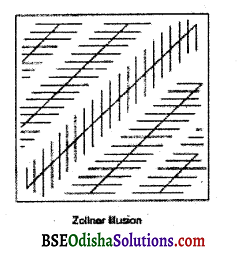
Zollner illusion is named after Zollner (True / False)
Answer:
True

Question 95.
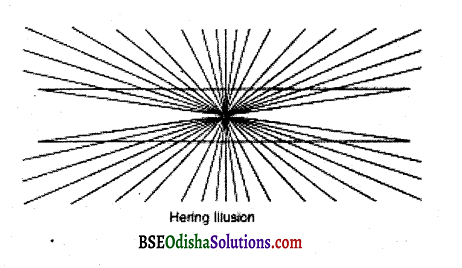
Hering illusion is not a geometrical illusion. (True / False)
Answer:
False

CHSE Odisha Class 11 Psychology Unit 2 Perceptual Process Objective Questions

Question 96.
Muller Lyer illusion is an illusion of movement. (True / False)
Answer:
True

Question 97.
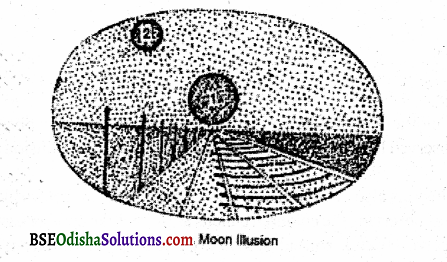
The Moon illusion is an example of a space constancy illusion. (True / False)
Answer:
True

Question 98.
Hallucinations are only visual. (True / False)
Answer:
False

Question 99.
There are as many hallucinations as sensations. (True / False)
Answer:
True

Question 100.
In the illusion, the sensory stimulus is present, while it is completely absent in hallucinations. (True / False)
Answer:
True

CHSE Odisha Class 11 Foundations of Education Unit 2 Fundamentals of Educational Psychology Questions and Answers

Odisha State Board CHSE Odisha Class 11 Foundations of Education Solutions Unit 2 Fundamentals of Educational Psychology Questions and Answers.

CHSE Odisha 11th Class Foundations of Education Unit 2 Fundamentals of Educational Psychology Questions and Answers

Very Short-Answer Type Questions

Question 1.
Give the meaning of growth.
Answer:
Growth refers to the physical sense. Growth refers to an increase in height, weight, and size. It is measurable as quantitative.

Question 2.
What is development?
Answer:
Development is in a mental sense. It is both physical and mental aspects.

Question 3.
Give three natures of educational psychology.
Answer:
The nature of educational psychology is as follows:

  • Educational psychology deals with two facts related to educational situations.
  • It helps the process of learning like memorising, perceiving, recalling, reasoning and intelligence.
  • It discovers new methods and approaches in the field of education.

Question 4.
Give three objectives of educational psychology.
Answer:
The three objectives are :

  • It helps create a positive attitude towards learning.
  • It helps to provide correct methods of teaching to the pupils:
  • It helps to study the learner and his environment.

Question 5.
Discuss three features of educational psychology
Answer:
Educational psychology is the application of psychology in the field of education. It is the study of human behaviour. It deals with the problems of education.

CHSE Odisha Class 11 Foundations of Education Unit 2 Fundamentals of Educational Psychology Questions and Answers

Question 6.
Give three distinctions of growth and development.
Answer:
Growth refers to change in aspects of the body but development implies the organisation as a whole. Growth does not continue throughout life but development is a continuous process, from womb to tomb. Growth is structural and development is functional.

Question 7.
Give three scopes of educational psychology.
Answer:
To give knowledge of the nature of the child. To present principles and techniques of learning and teaching. To give knowledge of the growth and development of the children.

Question 8.
Explain any three principles of development.
Answer:

  • The development follows a pattern, a regular step-by-step process.
  • Development in intelligence correlated to physical development.
  • All changes in the body are due to growth and development.

Question 9.
Give three factors that determine growth and development.
Answer:
Maturation and learning affect growth and development. Heredity and environment always affect growth and development. Environmental factors like school, family, culture, S.E.S, and nutrition always affect growth and development.

Question 10.
Give three behaviours during the childhood stage.
Answer:

  • Friendship: Adolescents choose and make friends.
  • Leadership: Leadership is an important aspect of this stage of behaviour.
  • A boy-girl relationship is developed.

Short-Answer Type Questions

Question 1.
Explain how education and psychology are related.
Answer:
Education is the modification of behaviour whereas psychology is the science of behaviour. Education helps in the physical, moral, and spiritual development of man and psychology helps in such growth. Education is a lifelong process. By psychology, there is developmental knowledge and experience in different stages of growth. Framing the aims of educational psychology helps. In the case of a child’s internal and external responses and mental analysis, psychology helps

Question 2.
How educational psychology is an applied science?
Answer:
Educational psychology is an applied science in the sense that various psychological principles are being widely applied to the field of education. The principle of individual differences of learning by doing the self-discipline of personality, adjustment, guidance and counselling finds favour in all educational situations. The various laws of learning have made the teaching-learning process in the classroom economical and effective.

Question 3.
Discuss the aims of educational psychology.
Answer:
The aims of educational psychology are as follows:

  • To give insight to the teacher about the nature of the child.
  • Enlightening the teacher with the growth and development of the child
  • Imparting knowledge about principles out of methods of learning.
  • Studying the control of emotions and their educational implications.

Question 4.
Forming differences between growth and development?
Answer:
Though the terms growth and development are synonymous still there is a great distinction between the two. Growth refers to change in a particular aspect or aspect of the body whereas development implies the organisation as a whole. Growth does not continue throughout life. It stops at maturation but development is a continuous process which goes from womb to tomb.

Growth is structural and development is functional. Growth is quantitative which is measurable but development is qualitative which can not be measured but is assessed. The changes brought about by growth can be measured directly whereas changes brought about by development are difficult to be measured directly. Both growth and development are affected by heredity and environment.

CHSE Odisha Class 11 Foundations of Education Unit 2 Fundamentals of Educational Psychology Questions and Answers

Question 5.
Give, the nature of educational psychology.
Answer:
The nature of educational psychology is as follows:
Educational psychology deals with the facts related to educational situations. Educational psychology studies the behaviour of the child in teaching learning matters. Educational psychology becomes general rules, laws and techniques in order to achieve educational objectives. Educational psychology discovers the method and approaches in the field of education. Educational psychology develops a scientific outlook.

Question 6.
Give the scope of educational psychology.
Answer:
The following is the scope of educational psychology:
To give knowledge of the nature of the child. To give an understanding of the nature, aims and purposes of education. To present principles and techniques of learning and teaching. To give training in methods of measuring abilities and achievement in school subjects.
to give knowledge of the growth and development of the children.

Question 7.
How is educational psychology helpful to a teacher?
Answer:
Educational psychology is helpful to a teacher and a learner in many ways. To study the most effective ways to teach, specific materials to different children. To place the learner in the best possible learning situation, independent study, large or small group instructions with one or several teachers for a given course. To estimate the optional level wage at which the subject matter should be presented. To determine what courage material is appropriate to the needs, characteristics and goals of each teamer.

Question 8.
Define in short educational psychology?
Answer:
Educational psychology is a combination of two different words- education and psychology. Education is aimed at the modification of behaviour whereas psychology is the science of behaviour. Psychology is an applied science related to the principles and techniques of psychology to solve all the problems in education to achieve educational objectives.

Educational psychology is concerned with the child, the learning situation, the learning process and, the teacher. The teacher with the help of educational psychology becomes conscious of the content of the educational method of teaching, the nature of the child and the frame curriculum. He studies the characteristics of the child as well.

Question 9.
Write at least five contributions to educational psychology.
Answer:
Educational psychology influences the aims of education and studies the developmental characteristics of the child. A survey of learning situations and different types of education centres is opened taking into account to individual differences. Psychology helps the teacher with new methods and techniques of teaching.

The pupils face a large number of problems at different stages of growth and development. The knowledge of psychology aids him so solve those problems. It helps in curriculum construction. It helps in evaluating learning outcomes. The psychological study helps in making provision for learning, the process for exceptional children.

Question 10.
What special behaviours are seen during the childhood stage?
Answer:
In the late childhood stage, some special features are seen in children.
Friendship:
Adolescents choose and make friends with others of some age group.

Social maturity:
As they become socially mature they develop a wide behavioural form of hard living, kindness, sympathy, emotional stability, cooperation and sacrifice.

Leadership:
Leadership is an important aspect of this stage of behaviour.

Boy-girl relationships:
The boy-girl relationship is developed. There are recreational interests.

Question 11.
Give five distinctions of growth and development.
Answer:

  • Growth is structural arid development is functional
  • Growth is quantitative in nature whereas development is both qualitative and quantitative.
  • Growth refers to change in particular aspects of the body arid development implies the organisation of the whole body.
  • Growth continues till maturation but development continues till death.
  • Growth is additive in nature whereas development is both additive and subtractive.

CHSE Odisha Class 11 Foundations of Education Unit 2 Fundamentals of Educational Psychology Questions and Answers

Question 12.
What are the factors that determine that growth and development?
Answer:
The growth and. development is affected by the factors like maturation and learning and heredity and environment. The factors influence the development of physical, moral, social intellectual and emotional abilities. Heredity is quite inclusive and affects the sex hormones, twin birth, sex and chromosomal anomalies. The environment includes a large variety of actors such as family, school culture, socioeconomic status, nutrition etc.

Question 13.
Give the role of the environment in growth and development.
Answer:
The environment has a powerful effect on the growth and development 6f an organism. The same person may behave differently in a different environment. Moreover, different persons behave differently in the same environment. The environment which influences growth and development can be classified under two heads. Physical environment and social environment in the form of condition takes care of self-expression, play and exercise etc.

Question 14.
Give five objectives of educational psychology.
Answer:
Some specific objectives of educational, psychology art are as follows:
It helps in creating a positive attitude towards learning. It helps to provide correct methods of teaching to the pupils. It helps to study the principles and techniques of learning. It helps to study the learner and his environment. It helps to study individual differences.

Question 15.
Give the nature of educational psychology.
Answer:
The nature of educational psychology arc as follows:
Educational psychology deals with the facts related to educational situations. Educational psychology studies the behaviour of the child in teaching-learning situations. It helps the process of learning like memorizing, perceiving recalling, reasoning and intelligence. It studies the instincts and drives, habits and attitudes, emotions and sentiments and personality. It discovers new methods and approaches in the feels of education.

Long Type Questions With Answers

Question 1.
What is psychology? What is educational psychology? How it is derived? Give its meanings.
Answer:
Psychology i$ a mind’ and mental process. It is also that part of philosophy which studies the mind and mental process as a positive science. In the beginning, it was the part of philosophy known as mental philosophy. The word Psychology is derived from two greek words ‘psyche and Logos’ in which ‘Psyche’ means ‘soul’ and ‘logos’ means ‘to study’ or ‘science of’.

Therefore, Psychology means the science of the soul. Such a definition was put. forward by the Greek philosopher Plato and Aristotle. But such a definition of psychology was discarded, Soul is a metaphysical idea. It can neither be perceived nor imagined. The nature and function of the soul cannot be studied. Scientific methods like observation and experimentation in psychology.

On this ground, the definition that psychology is the science of the soul’ has been rejected. Psychologists like Descartes defined psychology as the ‘science of the mind’. It is also supported by Aristotle, But the word ‘mind’ is as vague and ambiguous as soul. The mind is not a, part of human anatomy. It is nothing but an assembly of ideas.

It stands for the private, personal and internal experience of a man like pleasures and pain, wishes and images, dreams arid desires. No two psychologists agree on the such definition of mind. Moreover, that definition of psychology had been rejected and discarded by other psychologists.

The psychologists like Descartes and Mc. Dougall could not agree with the mind’s definition of psychology. Sir William James put forward another definition of ‘psychology. “Psychology is the science of consciousness”. But the mental life is not only conscious but also there are unconscious and sub-conscious mental levels.

These conscious and subconscious mental levels also affect and influence the behaviour of men and animals in various ways without our knowledge and consciousness. Our conscious mental, functions cannot be fully explained without the help of unconscious and sub-conscious mental processes. Consciousness constitutes only a part of our mental life and it does riot include animal, behaviour.

Therefore, psychology is the science of consciousness is an incomplete definition which it is discarded and rejected by modem psychologists. Again, psychology has also been defined as the ‘science of experience’. This is out and out a subjective definition as it does not take Into consideration outward or external behaviour into account.

Experience is what a man feels internally during any activity. Psychology deals with both inward and outward activities, experiences and behaviours, So the definition is also incomplete. J.B. Watson, the American psychologist, and the founder of the school of behaviourism put forward the latest definition of psychology, “Psychology is the science of behaviour”.

Behaviour means actions and activities. J .B. Watson and other behaviourists wanted to make psychology an objective science and so they rejected experience as the subject matter of psychology. Psychology is a positive science of behaviour with two scientific methods – objective observation and experiment.

Meaning of Educational Psychology:-
Psychology is applied in the field of education with principles and techniques to the development of educational practices and solutions to educational problems like wastage and stagnation, and dropouts. So educational psychology is the science of engineering concerned with the application of psychological principles, the practical problems in the field of education.

Other Definitions of Educational Psychology:
To support the definition of psychology put forward by J.B.Watson, some other modem psychologists advanced some other supporting definitions, as follows:-

  • Me Dougall- “Psychology is the positive science of human conduct and behaviour”.
  • Woodworth- “Psychology is the science of the activities of the individual in relation to the environment”.
  • Skinner – Educational psychology – deals with the behaviour of human beings in educational situations.
  • Tro – Educational psychology is the study of the psychological aspect of educational situations.
  • Pillsbury – “Psychology is the science of human behaviour”.
  • Nunn – “Psychology is the positive science of experience and behaviour”.

CHSE Odisha Class 11 Foundations of Education Unit 2 Fundamentals of Educational Psychology Questions and Answers

Question 2.
What are the aims and objectives of educational psychology? Give its nature.
Answer:
The aims and objectives of educational psychology are as follows- Educational psychologists assist a teacher to give an insight into the nature of the child. To enlighten the teacher with the growth and development of the child, the developmental process. It helps the teacher in finding ways and means of social adjustment for the child.

A study of the psychological method of investigation is used in the field of educational psychology. It helps to control the emotions of the child and their emotional development. It imparts knowledge about the principles and methods of learning. It helps to understand the social problems of the children.

It helps to plan the education of children to their age, ability and aptitude. Imparting knowledge to the teacher about the latest problem in education, the latest development in the field of education, the field of child psychology and various methods of teaching.

Helping the teaching in solving the problems that may arise in the classroom.
Nature of Educational Psychology:

Positive science:
Educational psychology is a positive science but not a normative science like logic and ethics. It always deals with the facts that are happening. It studies the laws of children’s nature as they are or as they operate. It has nothing to do with “ought to be”. It has scientific investigation and application.

It is an applied science:
Educational psychology is an applied science. It constitutes the application of psychological principles and techniques in the development of educational practices and programmes and in the study of educational problems. It acts as an applied science.

As a social science:
Educational psychology acts as a social science because educational findings are applicable to all individuals. As a social science, it studies the behaviour of human beings in all activities. It also studies both the social individual and the interaction.

A practical science:
Educational psychology is practical in nature because the educator makes use of the knowledge of, the educational psychology of each and every walk of teaching and learning situations.

A growing and developing science:
Educational psychology is a growing and developing science new facts and principles also come about from human nature and behaviour a number of researches in the field of education. So educational psychology as a science is ever-growing and developing.

An academic discipline:
Educational psychology is an academic discipline. It is a science which is focussing on human behaviour and its result can be generalised into the principles theories.

Question 3.
Discuss the scope of Educational Psychology.
Answer:
The word ‘Scope’ means the range extent and limitations of the study of what is to be included in the study of a particular subject of the subject matter. The scope of educational psychology is very vast, and wide because it studies human behaviour under various conditions from birth to death.

The scope of educational psychology centres around” the learner- developmental characteristics, individual differences, intelligence, personality and mental health of the teacher and students. It deals with the learning process, motivation in learning, and factors affecting learning and the evaluation of learning performances, in conducting research on educational problems.

Some of the scopes of educational psychology are as follows:
Human behaviour:
It studies human behaviour in all educational situations in the various stages of growth and development, and the characteristics of each stage are included in the study of educational psychology.

Growth and development:
Educational psychology is a psychological process study, the growth and development of a child. How a child passes through the various stages of growth like infancy, childhood and puberty and what the characteristics of each stage can be included in the study of educational psychology.

Learning process:
Educational psychology as-a a psychological process it studies the laws of learning. Learning is a major phenomenon in education. It studies how learning can take place most effectively and economically.

Heredity and Environment:
To what extent do heredity and environment contribute towards the growth of individuals and how knowledge can be made used for bringing about the optimum development of the child, It studies the heredity and environment of the child for better learning achievement.

Intelligence:
The scope of educational psychology also includes the study of the nature of intelligence as well as its measurement. The teacher educator handles educational psychology to measure. The intelligence of the child.

Individual differences:
Every individual child differs from others in physical and mental aspects. The learning experience differs in the same manner. Educational psychology deals with the nature of learning, laws in learning, principles and theories of learning, remembering and forgetting, perceiving, concept formation, thinking and realising process, problem-solving, transfer of learning, and training ways and means of effective earning etc.

The learning situation:
Educational psychology deals with the environmental, factors and learning situations which come between the learner and the teacher. Topics like classroom climate and group dynamics, techniques and aids which facilitate learning situations, techniques and practices, guidance and counselling etc. which help in the smooth functioning of the teaching-learning process come under the scope of educational psychology.

CHSE Odisha Class 11 Foundations of Education Unit 2 Fundamentals of Educational Psychology Questions and Answers

Question 4.
How the knowledge of psychology is helpful to a teacher in the teaching-learning process? Explain. Discuss the application of educational psychology helpful in the teaching-learning process. Explain.
Answer:
Educational psychology is helpful to a teacher to guide the process of education and the knowledge of psychology helps the teacher to realise the objective of effective teaching and educating the pupils properly. The knowledge of psychology helps the teacher in the below following ways.

Understanding the child:
It has been recognised that the teacher can truly teach the child only when he possesses the knowledge of child psychology. The teacher must know how children think, what are their interests of various stages of development and how their energies can be utilised for educational purposes. All modifications in the technique of teaching are really the growing application of the knowledge of psychology in the process of teaching and learning.

To understand the developmental characteristics:
The human child passes through different stages of development as infancy, childhood and adolescence. Each stage has its unique characteristics. A teacher possessing knowledge of these characteristics can profitably apply them to properly educate his pupils.

To understand, individual differences:
No two individuals are alike even though maybe twins. We find individual differences in body structures, achievement, intelligence, personality, interests, and attitudes of children, A teacher must be responsible for determining such individual .differences. The teacher can adopt different methods of instruction, curricular and means of evolution for individual interests.

To develop knowledge of the learning process:
All education depends upon the learning of new responses and the capacity of a human child to learn new responses. Psychology analyses different aspects of the process of learning. It tells us that learning is impossible if the learner does not cooperate in the learning process. The problem of teaching then takes the form of a psychological problem. Incentives like illustrative aids in the classroom and general maxim of the teaching area all are based on sound psychological theory.

To understand the relative importance of heredity and environments :
The heredity and environment of the child determine his growth and development, his personality and his learning process, intelligence, interest and attitude. The body structure is determined by heredity whereas other factors like intelligence, personality interest and attitude are determined by the environment. So, teachers should create environments for the healthy development of their pupils.

Curriculum construction:
For constructing a balanced curriculum educational psychology is helpful to a teacher. The needs of the child, his developmental characteristics, interests, attitudes etc. are some of the essential factors that should be taken into consideration while framing the curriculum.

Planning methods of education:
Psychology is also helpful to a teacher planning methods of education in such a manner – that there is no problem with motivation. Modem methods of teaching like project methods help to achieve educational goals. Separate methods of instruction should be adopted for gifted or bright children, average children and slow learners. The knowledge of educational psychology equips the teacher with all these effective methods of teaching.

Research :
The knowledge of educational psychology helps teachers to develop and try out tools and devices for measuring various variables which affect the child’s behaviour. He can control, direct and predict the behaviour of students on the basis of action research in the classroom.

Question 5.
What do you mean by growth and development? Bring the difference between G and D.
Answer:
Growth and Development: Growth means it is in a physical Sense. When and after the birth of a human baby, we make a number of changes in-bodily parts gradually, which is seen in the increase in height, weight, and body size. Such changes in the structure of the body of the child are known as growth. Structural change is the result of rapid cell divisions in the body.

At different stages of growth, a number of physical changes take place in the child. Development implies changes in bodily functions. As the body grows there is gradual progress in the movements. The child starts to swing his hands and legs. He is able to sit wait and run to and throw many things. The child starts to walk, to think, to express emotions like laughter, anger mid fear.

Thus, all the changes in the functions of different parts of the body and mind are the features of this development. So development is a progressive series of functional changes in a child and such changes lead the child towards maturity. So development is in a mental sense, the mental powers, mental ability. There is the power of concept formation, thinking, reasoning and power judgement.

Difference between growth and development:-
Growth and development seem to be synonym terms but in a strict sense there is a gulf of difference between the two, as follows:

Growth implies quantitative changes in bodily structures. Such changes can be expressed in some quantitative terms like metres (height), and kilograms (weight). On the other hand, development is qualitative in nature. All aspects of development like the development of motor activities: language, thinking, and emotions cannot be expressed in numerical measures.

So growth is structural and quantitative in nature but development is functional and both qualitative and quantitative in nature. Growth refers to changes in particular aspects of the body but development implies the organisation of the body as a whole. Growth continues for a specific period called physical maturation. But development continues throughout life.

For example, after the age of 25, there is no growth but development continues till death. Growth is always additive in nature which means adds something to the structure of the body, So it proceeds in the forward direction only. But development is both additive and subtractive in nature and may add new features and eliminate some old features to improve the quality of body functions.

CHSE Odisha Class 11 Foundations of Education Unit 2 Fundamentals of Educational Psychology Questions and Answers

Question 6.
Explain the general principles of growth and development.
Answer:
Various studies and research have highlighted certain significant principles underlying the process of growth and development.

The development follows a pattern:
If we take any dimension of growth and development we will find a particular pattern of growth. In physical development, in the cephalo-caudal sequence, the development proceeds from the head to the upper parts of the body and grows earlier than the lower parts. At birth, the head is much large compared to the adult head. Similarly, the development of movements is earlier in the upper parts of the body. The child can raise his head first with better control before he can move his chest or hand or leg.

Development proceeds from general to specific:
The child first shows general responses and then he shows specific responses to specific stimuli. For example, the new bom baby moves his whole body. If one time instead of moving one part of it. He moves his whole hand to specify one object instead of using a finger. In the emotional field, he responds through only general responses like crying to denote joy, hunger, pain or fear.

Development is a continuous process:
Development maintains continuity at a slow and regular pace. It does not take place abruptly or by leaps and bounds. All dimensions of development continue to grow gradually until they reach their maximum. For example, a child cannot speak all of a sudden and he develops speech habits through continuous efforts.

Growth is not uniform:
Different aspects of growth develop at different rates. All parts of the body can never grow at the same rate. At birth, the head is larger, about one-fourth of the body in length, But the rate of growth slows down and hands and legs grow at a faster rate. The brain reaches its maximum size at about six. Likewise, memory develops faster than creative imagination.

Most traits are correlated:
Most of the traits of growth and development are correlated which means superior in other respect, he is also found superior in other respect. A child whose intelligence is above average is also so in health size, sociability and special aptitudes. But this is not always true. We find very lean and thin boys with high intelligence but not sociable.

Individual differences in growth and development:
There are Individual differences in growth and development. No two individuals grow and develop in the same way or at the same rate. Some grow taller, some dwarf, and some become adolescents very soon. Some others develop secondary sex characteristics very soon and some get early maturation. So there is the individual difference in physical and mental characteristics.

Development is predictable:
It is impossible to predict in advance what type of development a child will follow because the rate of development of a particular child remains fairly constant. The environmental factors determine the product of maturation. But mental development cannot be predicted with some degree of accuracy.

Development is a product of heredity and environment:
Both hereditary and environment determine the growth and development of a child. Heredity is responsible for physical growth and intellectual development, whereas the environment is responsible for the intellectual, social and temperamental development of the child. Likewise, parental care, nutrition, the climate in the home and school and society are also essential for a child’s sound development. So hereditary and environment both contribute effectively maximum growth of the child.

Question 7.
What is physical growth? Explain the physical characteristics of growth and development.
Answer:
In growth and development remarkable physical and physiological changes take place in boys and girls, Specially in adolescence period, there is rapid physical and physiological changes are seen.

Changes in height and weight:
In the infancy stage, there is rapid physical growth. The development of the body and nervous system is very fast. Almost all adolescent boys and girls show remarkable growth in height and weight. There is a rapid growth in girls from 10 to 14 years and in boys from 12 to 16 years. The mature height is attained from 13 to 20 years. Boys are in average taller than girls up to 11 years. From 12 to 15 years girls grow faster than boys. Boys are heavier than girls in all ages.

Changes in body proportion:
Human individuals differ not only in height and weight but also in body proportion as they grow. The different parts of the body mature more in one age while others attain maturity at earlier or later ages.

Changes in internal organs:
During the growth of child important changes occur in the internal organs such as the brain, muscles, skeleton and glands. The brain gradually matures with the nervous system. The skeleton becomes .longer day by day and the joints of the bone become also stronger. During the physical. growth there are glandular changes and the sex glands. The thyroid, Hymus, and pituitary also develop ill at maximum rates. The changes, in glands, affect the behaviour of adolescents, boys and girls and they also develop masculine and feminine qualities.

Change in voice:
There is a change in the voice of the boys and girls. During the stage of adolescence, the voice becomes course day by day and the voice of the adolescent girls becomes sweeter day by day.

Changes in physical activity strength:
In the childhood stage, the child remains engaged in play. He becomes physically strong. Adolescent boys and girls become physically active and they develop the ability, skill, strength and speed in doing any work or activity. Jn physical activity girls become more mature than boys. Boys are more muscular in strength. Then the girls always like adventure activities.

Growth of secondary sex qualities:
During adolescence, secondary sex characteristics are seen in both boys and girls. Hairs appear in different parts of the body and boys develop beards on their faces and menstruation starts in girls.

Development of sex:
During the stage of adolescence, both boys and girls are sexually mature. The genital organs in boys and the sex organs in girls increase. Both boys and girls develop an interest in the opposite sex and develop an interest in mutual intercourse or heterosexuality. For sex satisfaction, they practise masturbation, and both adolescent boys and girls achieve production capacity.

CHSE Odisha Class 11 Foundations of Education Unit 2 Fundamentals of Educational Psychology Questions and Answers

Question 8.
What is social development? What are the social characteristics seen in adolescents? Explain.
Answer:
Man is a social animal. As the child grows and psychologically matured he develops gradually some of the social behaviours. Social development means the attainment of the maturity of social relationships and helps the individual for adjustment to his environment.

As the child grows to adolescence he learns the social ways of the society like customs, traditions, miners and languages, and ways of living which change his tastes, interests, and attitudes. He may develop interaction from person to person, person to group and group to group.

The social characteristics seen among adolescent boys and girls are given below:
Friendship:
Adolescents tend to choose friends of their own age and temperament They develop friendships based on common interests, needs and goals.

Social consciousness:
Adolescent boys and girls become socially conscious and they develop social responsibilities duties, rights and responsibilities, and obligations. In attending social programmes, they develop group loyalties. Social service attitudes are developed with them.

Social maturity:
Adolescent boys and girls attain social maturity and they very soon develop the ability to adapt to changing situations. They become social and develop social potential ties like kindness, sympathy, tolerance, cooperation, dependability etc. They also learn sacrifice and wise judgement.

Leadership:
Leadership is an important aspect of social development in adolescence. The adolescent boys and girls participate in group activities and develop leadership qualities. They develop the qualities like patience, endurance, quality of domination, sincerity, hard-working, and responsibility. In schools and colleges, adolescents show their leadership in academic performances, games and sports, participating in college union elections, and organising debates, competitions, excursions and social service programmes.

Development of social, cultural, recreational, and vocational interests:
Social interests:
The adolescents develop an interest in attending different fairs, social functions, festivals etc. visiting religious places, running discussions on social problems and developing social awareness and interests.

Recreational interests:
The adolescents develop an interest in reading, cultural activities, attending movies, group games, and radio listening, and they also organise different hobbies like gardening, writing, photography, collection of stamps etc. which develop a recreational interest in them.

Development of social attitudes:
Social interaction determines the degree of adjustment of adolescents. Such social interaction is possible by observing different customs, organising cultural and religious ceremonies and marriage functions etc.

Question 9.
What is emotional growth? What are the emotional characteristics seen in adolescence? Explain.
Answer:
Emotion is a feeling, a state of mind, a state of being moved or stored up. So emotion involves feelings, impulses and physiological reactions. The feelings of emotions are anger, disgust, pleasure and fear. Emotions are accompanied by physiological changes including heart and stomach problems, heartbeat, breathing and blood pressure which affect hunger, rest, sleep etc.

Such emotions are reflected with over behaviour like throwing, smiling, staring at etc. The adolescence period is marked by heightened emotions like nailbiting, tension, conflicts, quarrels with parents and teachers, and siblings with classmates. Other emotions like absent-mindedness, shyness and negativism are seen.

Emotional characteristics during adolescence:
Complexity:
As the child grows from childhood to adolescence his emotions become complex. Various experiences come from the environment and to the complexity of emotional development. The adolescent hides his emotions and it is difficult to understand.

Emotional feelings widened:
At adolescence, adolescents start making friends, forming groups with other taking leadership etc. and he is also emotionally attached to the group or person.

Development of tolerance:
Adolescents develop the tendency to bear and tolerate tensions, troubles, frustrations and failures in different social situations. They give emphasis to self-control and redirect their emotions in acceptable directions.

Capacity to share emotions:
The adolescents develop the ability to share with others and to love their neighbours, mates, fellow beings, and members of groups. Adolescents also derive pleasure from the achievement of their friends.

Love for freedom:
Adolescents develop a kind of inner freedom to feel, express act and behave independently which makes them rebellious and stubborn.

Tolerance of aloneness:
Adolescents at times prefer to stay alone in their homes and get pleasure from daydreaming and fantastic imagination by sitting alone for a long time.

Common emotions-during adolescence:
Love and affection :
During the period of childhood, love comes around as the object of interest but in adolescence, love is associated with relatives, peers and the opposite sex. During adolescence, love takes a sexual colour and adolescent boys and girls engage in conversations about sex and its problems.

Joy, pleasure and delight:
In adolescence period, adolescents feel joy when he is well adjusted and they also he get pleasure and delight from their achievements. He develops a feeling of superiority. He gets delighted when he gets successful in competitions, sports, debates and other such activities.

Worries and anxieties:
Worry is an imaginary fear which is caused by frequent thinking about a situation. Adolescents get worried about school work, examinations and tests, unreasonable homework, failure in competitions, and sex problems. Some other worries include lack of adjustment with parents, illness of parents and poverty of parents family problems and presence of stepmother.

Fear:
Fear is formed by the child from the environment which includes fear of animals and snakes, fear of electric appliances, huge machines, deep seas and rivers, high places, strange noise and darkness etc.

Anger:
Anger is the violent emotion expressed by adolescents due to the reasons like unfair treatment by teachers and parents, satirical remarks, encroachment of human rights, tasks beyond ability etc. Sometimes anger is seen in the failure of responsibility.

CHSE Odisha Class 11 Foundations of Education Unit 2 Fundamentals of Educational Psychology Questions and Answers

Question 10.
What is intellectual development? Give its characteristics.
Answer:
Intellectual development refers to cognitive, mental, memory, reasoning, understanding, intelligence, generalisation, interpretation, language ability, conceptual ability etc. These abilities are interrelated. Intellectual development is the mental development and overall development of all those above abilities.

Characteristics of intellectual development:
Development of time senses:
As the child grows he develops the ability to differentiate, between events that are now occurring and those which have occurred in the days gone by. He is in a position to locate events in the space where they are performed. As he advances in image his ability to react in terms of recollection from the past and anticipation of the future increases.

Increase in the power of attention:
The child has the ability to utilise past experiences but with the passage of time, he acquires an increasing ability to plan out remote goals and actions. For instance, in order to advise the remote goal through the examination a child may make or prepare time table plan to study.

Increasing ability to use symbols and signs:
With the increased ability to use signs and symbols, for example, the hungry child who would stop crying only when he was actually fed a later stage ceasing crying at the sight of a milk bottle a symbol for being fed.

Increase in the development of morality:
As a child advances in age, he learns to obey certain moral norms and starts thinking in terms of good and bad. In that way, the foundations of moral character are laid in the child.

Increase in curious questions:
As a child’s age increases the questions put by him to satisfy his curiosity are more definite as compared to those put by him prior to what is it? Who has done it? Why is it so?

Increase in creative impulses:
As the child grows in age he exhibits creative impulse in another world he engages himself in making on collecting things. He creates interest and social pleasure in solving puzzle problems. In this way, he develops the power of abstract thinking.

Increasing sensory development:
Sensory development occurs during the first month of the child. It learns to make effective use of the sense and experiences. Many topics of sensations such as hardness, pain, pleasure, and the sensation of smell and sound. As it advances in age it comes to have developed sensory equipment more accurately and sharpened the power of perception, the ability to compare various sensations. Logical thinking in place of vivid memory and the ability to generalise on the basis of experience.

Increase in language development:
The crying of a child at birth is an expression of the emotion of pain and pleasure. At the age of six months, its crying stands for its recognition of the new situation. By the time he is one year of age, he utters a few words- Aa, Ba, Maa, Daa etc. and at the age of two to three years it can repeat very short sentences spoken by elders.

CHSE Odisha Class 11 Psychology Unit 2 Perceptual Process Long Answer Questions Part-1

Odisha State Board CHSE Odisha Class 11 Psychology Solutions Unit 2 Perceptual Process Long Answer Questions Part 1.

CHSE Odisha 11th Class Psychology Unit 2 Perceptual Process Long Answer Questions Part-1

Long Questions With Answers

Question 1.
What are perception and its operational benefits? Discuss the process of perception. Meaning and Operational Definition.
Answer:
While interacting with the environment, the organism is impinged by a number of stimuli, lie receives these stimuli through its sense organs. This is called sensation. The sensation is the raw material of experience. When meaning is added to the sensation, with the help of past experience and learning it becomes perception.

In other words, perception provides meaning and awareness to a particular sensation. The sensation is mere acquaintance with the stimulus. But perception contributes a clear knowledge about the stimulus. So perception has been included under the cognitive (knowing) aspect of the mind. Perception has become the meeting ground of experimental, clinical, and social psychology.

Starting from Wundt to Gestalt perception has been a topic of great interest. Watson, Wundt, Titchener, and Gestalts, all gave due importance to the process of perception. Gestalt School dominated the study of perception for the next two decades. Their research centered around the organization of perception.

As already pointed out, perception contributes meaning and awareness to a particular sensation. For instance, you see a big bird-like object flying in the sky. This is the sensation when you attend to it and say that it is an airplane, it becomes perception. Perception is, therefore, defined as the awareness of sensory stimulation.

But this is an incomplete definition. Along with awareness, the most important thing in perception is adding knowledge and meaning to this awareness, i.e., interpreting it on the basis of past experience. Perception is, therefore, defined as the interpretation of sensation in the light of past experience.

When a person faces a stimulus, he gets a sensation. It may be a sensation of vision, smell, or sound. When he tries to go ahead and add knowledge to this sensation with the help of experience and learning, it becomes perception. Titchener has defined perception as a complex of sensory and imaginal elements.

By this, he implied that perception is always built up of complex experiences out of sense impressions, characteristics, and qualities supplied by mental activities. According to Hebb, it is a process of information, extraction, and preparation for response. This definition of Hebb emphasizes the selective nature of perception. We do not perceive each and every stimulus. We perceive the one which we select to perceive.

Processes involved in Perception:

The mechanism through which the organism converts a sense of impression to perception by adding knowledge and meaning to it is called the process of perception. Thus, the sensation is the first step in the process of perception. Perception, in fact, starts with sensation. Though without sensation there cannot be any perception, all sensation may not lead to perception, because perception is a selective process.

According to Munn (1954), “The term perception is customarily used to refer to relatively complex receptors or neural processes which underlie our awareness of ourselves and our world. This awareness is referred to as perception. “Perception is, therefore, a very complex process.”

As mentioned earlier at a given moment We get a number of sense impressions from the environment around us. But it is neither possible nor necessary to perceive everything at a time. So our perception at a given moment is based on selection. Selection is guided by set, need, or by objective determinants of the stimulus.

Needed objects are perceived first. A large number of studies on perceptual selectivity lead to the conclusion that there are certain objects in the environment that conform to the current needs, values, attitudes, and past experiences of the perceiver and hence are selected for perception.

Titchener has explained perception as a selective act in terms of attention as attention is a preperceptive attitude. The selective manner in which different part systems are analyzed in perception is largely determined by the unique interaction between the individual and his cultural media, which he has passed through and of which he is a part at the moment.
After selection one starts perceiving.
This process of perception involves:

  • Receptor Process
  • Symbolic Process
  • Affective Process

In each act of perceiving, these three processes are involved.
Receptor Process:
Perception not only depends upon the mental set but also upon the forms of stimulation, the receptor functions, and the neural functions. Simultaneously different receptor processes like visual, auditory, olfactory, gustatory, kinesthetic, and neural are activated. At a particular time perception is limited only to a particular receptor process.

For instance, at the same time the telephone rings, and the calling bell rings. Here you receive both sounds through your auditory receptors. But you cannot attend to both simultaneously. So you decide to attend to the tclephni1; call first and then the calling bell.

Symbolic Process:
Sensory stimulations arouse certain neural activities which have their trace in the nervous system. These are popularly known as neural traces. These traces act as symbols or substitutes for the original stimulus or experience. There are called images. When the teacher, for instance, asks the student in the class to draw a picture of his father in his mind’s eye, it becomes symbolic.

These symbolic images help us while perceiving something. This symbolic process is activated by any experience or image associated with the father. It is called symbolic because it represents some experiences or images, as it stands for some experiences or images which is a necessary part of the perceptual process. While sensations depend upon the present, images are derived from past experiences.

For any perception both present sensation and past experience in the form of images are necessary. Perception, therefore, does not consists only of sensation or only of images. It is made up of sensations, ideas, and images. All these come simultaneously at the same moment to make perception complete. Particularly, for adding meaning and knowledge to their interpretation of a sensory experience, the symbolic process helps.

Affective Process:
When we are perceiving an object, with receptor and symbolic process, the affective process is also involved to complete perception. In fact, an effective process forms an integral part of the process of perception. When one is interpreting a fruit, say a mango, it may appear to him pleasant or unpleasant or it may bring an indifferent neutral feeling in him.

This pleasantness or unpleasantness for the percept (the object which we perceive) may arise due to past experience or due to the very nature of the percept. Say, you like the mango as it is sweet. So its presence brings a pleasant sensation in you. The fragrance of a flower always gives a pleasant sensation. The bitterness of quinine always creates an unpleasantness.

Such ideas about the percept are not due to past experience only, but because of the very nature of the object. But in most perceptions, the affective feeling is determined by past experience. You don’t like the sight of a particular person or females on the whole. You cannot stand the sight of jasmine because it reminds you of a very painful memory.

Individual differences in the perception of the same object are mostly guided by this affective process, perception is an active process as pointed out by Ruch (1970), “perception is a process whereby sensory cues and relevant past experience are organized to give us the most structure, meaningful picture possible under the circumstances.”

BSE Odisha Solutions

Question 2.
What is attention and what types of attention?
Answer:
Attention is also described as selective and fluctuating. At a particular moment, so many stimuli around us attract outs attention and draw our awareness. But we Only attend to that stimulus that suits our purpose at the moment. So, we select only the stimulus at a time and reject the rest. When you enter the drawing room of your friend, the beautiful personal carpet immediately draws your attention because of its fantastic color combinations. You at this moment, only select to attend this and it remains in the center of your consciousness for some time.
Types of Attention
Attention has been classified in 3 groups:

  • Voluntary Attention
  • Involuntary Attention
  • Habitual Attention

Voluntary Attention:
Voluntary attention also called effortful attention. When attention requires special effort on the part of the attendee to attend it, it is called voluntary attention. In this case, we attend an object that we really want to attend. At the time of examination, a student has to attend to a particular topic if he comes to know that questions have been set from this topic.

Involuntary Attention:
When without one’s own effort one attends to a stimulus it is called effortless or involuntary attention. Munn (1954) remarks that “when stimuli or situations force themselves upon us as it were, whether or not we are set for their perception, attending is said to be involuntary.” In voluntary attention, stimulus draws our attention because we can not help attending.

In voluntary attention usually occurs because of the quality of the stimulus itself, either loud sound, eye-catching color, or the huge size of the stimulus object. As opposed to voluntary attention involuntary attention is incidental. There is more fluctuation and greater distraction in involuntary attention since the desire to attend is very less in this type of attention.

Habitual Attention:
We attend to certain objects in our environment because we have been attending to these stimuli from the very beginning. So just out of habit and past experience, we attend to it not by pressure nor out of the will, rather because of continuous observation of these stimuli we become habituated to attending them.

The gardener attends to the plants, the housewife attends to the kitchen, the mother attends to the baby and the student attends to his study, because of habit. In a similar way, a smoker attends a cigarette shop, and a painter’s attention is drawn immediately to beautiful paintings. The doctor’s husband attends to the telephone call and the mother attends to the baby’s crying.

In habitual attention, the person is permanently set for the reception of certain stimuli. Let us take the example of a husband chess player, who purchased a book on ‘Chess’, a wife who was interested in cooking and purchased a book on Chinese recipes, and finally, a daughter who is a cricket lover, who purchased a book on cricket. Thus, in habitual attention, internal conditions and bit play a major role.

In habitual attention, the attitude of alertness develops which determines one’s attention to a particular stimulus. In the words of Munn, “Most of our acts of attending are continuing rather than abruptly assumed sets and they are sets of which we are frequently unaware. These continuing sets stem from our motives. They are related to drives, interests, attitudes, prejudices, and aspirations”.

Habitual attention may develop out of voluntary attention. In the beginning, you may start reading, cooking, or gardening because of necessity, out of your own will. But once you are habituated to doing it, it becomes a part of your life and you cannot give up reading daily to it. A student who was habituated to reading daily for four hours used to read daily even after he passed his MBBS Examination.

Once when this author asked him “Why are you studying daily, going to the library ? You have already passed. Take some rest”. The boy remarked, “I can’t sleep peacefully unless 1 read daily and go to the library. It has almost become a habit with me.” The present author who has cooked for the family for the last thirty-five years, now it has almost become a habit with her to attend to cooking.

Question 3.
What are the various determinants of attention? Explain objective determinants in detail.
Determinants of Attention
Answer:
The complexity of the environment makes the individual face so many stimuli simultaneously at a given moment. But as it is impossible to attend to all at a time, he selects one of them. What are the conditions for selecting a particular stimulus for attention? What are the factors that make stimulus attract our attention? Why do we select one and reject the others? All these questions deal with the determinants of attention. Many factors influence the direction and selection of our attention. They determine our attention.

The determinants of attention may be classified under two broad heads:

  • The objective or external determinants.
  • The subjective or internal determinants.

A large number of researches in consumer psychology, in the area of advertisement and selling, have uncovered several external and internal determinants.

Objective Determinants:
Those factors or determinants which lie in the stimulus or object of attention are called the external or objective determinants. They are the qualities and characteristics present in the object of attention. They are:

  • Intensity
  • Size
  • Duration
  • Novelty
  • Repetition
  • Change
  • Systematic form
  • Movement
  • Location
  • Colour
  • Contrast
  • Prepotency

More often than not, several of these factors operate together in determining our attention at a given moment.
Intensity:
The more intense the stimulus, the more likely it is to be attended. It is also called the potency of the stimulus. The sound coming from the loudspeakers, deep and bold colors, bright, gorgeous shades, strong, fragrance, severe pain, all these draw attention immediately. On the other hand, a soft whisper, low sounds, plate color, and fade shades, and dim light do not catch our immediate attention, keeping other words constant.

The brilliantly lit signs in front of the traffic stand or cinema hall attract our attention to those than the low power lights. Thunder draws our attention at once. According to Boaz (1984) here the selection depends upon the very nature of our sense receptors and on the greater amount of energy stimulated.

Size or Extensity:
The size of a stimulus is of great importance in determining the direction of our attention. Big things always draw one’s attention more than smaller ones, other things being equal. A big poster, a big elephant, a big mouse, a full-page advertisement, and big letters draw instant attention in comparison to their smaller counterparts.

For successful advertisements very big posters and big lights are kept in front of shops. During elections in India, the full-page advertisement of hand, the election symbol of Congress (I), drew the immediate attention of a large number of people. Thus, the greater size of the stimulus has an advantage over smaller sizes. However, size is only one among the diverse factors determining one’s attention.

Duration:
Other things being equal, objects exposed for a longer period of duration have greater attention-catching value than those shown for a shorter period. When a card containing a few digits is exposed before us for 1 minute it is better attended than when it is exposed for only 1/10 part of the second. Similarly, a sound or a visual exposed for a moment obviously escapes our notice while the one which persists catches and holds our attention.

But the stimulus presented for a continuous duration is less likely to hold one’s attention because of fluctuations than the stimulus which is presented at intervals and for a moderate duration. For example, if the noise goes on without break it might escape our attention. The duration of exposure hence should be up to a limit.

Novelty:
Most of us attend to anything that is novel. Things to which we are unaccustomed, which are new to us, whether sound, smell or taste, are instantly noticed by us. That is why, anything strange or unusual has always a unique charm for the attending person than the things which are conventional, traditional, ordinary, and usual.

Say, for instance, a newly designed unusual dress used by a girl may draw our immediate attention to her more than when she is dressed in a traditional saree or salwar kameez. Similarly, strange animals, ultramodern buildings, unusual colors, strangely decorated drawing rooms, and novel flower arrangements draw our attention more than conventional ones. Novelty in the technique of advertisement on T. V., Radio draws a lot of attention.

Repetition:
According to Ruch (1970), “A work stimulus frequently repeated may be as effective as a strong one presented once.” Thus, a stimulus may not be very intense or colorful, it may not be very big in size, and the sound may not be very loud, but if it is repeated over and over again it may eventually draw our notice.

Repetition brings the object to the center of consciousness and so we are bound to attend it. When you are studying and somebody gives knocks on the door, you overlook it. But if the knock is made repeatedly over and over again, you are definitely drawn to it. But there is a limit to the effectiveness of repetition.

If it goes beyond the limit, it ceases to draw one’s attention just like diminishing returns. If repetition is overdone it can also lead to monotony and unpleasantness. For instance, the continuous and repeated ticking sound of the timepiece kept on the study table escapes our attention though it is there in the fringe of our consciousness. This is because we are so adopted or accustomed to it.

BSE Odisha Solutions

Question 4.
What do you understand by errors in perception? Explain some geometrical and fan’s Zollner, height width, Ponzo, and Jastrow illusion.
Answer:
Errors in perception Always our sense organs do not provide correct information. So we can not always rely upon these sense organs. Very often what we see and hear may be wrong and misleading. We perceive certain things which are not actually present there and sometimes we perceive one thing for another.

On the whole, our perception of the stimulus world may not be always accurate. The sensory information may be incorrectly interpreted on certain occasions. These are called errors in perception. Mainly two types of errors are there – illusion and hallucination.

Illusion:
Illusions are the wrong perception while perception is the correct interpretation of sensation, illusion is the wrong or mistaken interpretation of a sensory experience. In both perception and illusion existence that is illusion always has an apparent external stimulus. A person suffering from a severe cold may not get the real fragrance of flowers or the smell of fish. Thus the errors in perception seem to be a function of diverse factors.

Muller Lyer- Illusion:
It is also known as a geometrical illusion. An observation of the diagram given below would lead to every normal person saying that the horizontal line ‘A’ looks smaller than line ‘B’.

What do you understand by errors in perception Q4

But actually both the lines are of the same length. Muller and Lyer, two psychologists, observed this kind of error in perception for the first time and hence called it Muller Lyer Illusion. In this visual illusion, both lines are of equal length. At the end of line ‘A’ two very short lines are joined just like an arrow and at the end of line ‘B’ two very short lines of the same size as line ‘A’ are joined like a feather.

These two are known as arrow-headed and feather-headed lines. Though both lines are of similar length the feather-headed line appears invariably longer than the arrow-headed line. It is a universal illusion as this error in perception takes place in every normal person due to the stimulus factor.

Even children old enough to express their nature of experience and some animals react in the same way as normal adults. Perception of the comer of buildings, and rooms is due to this type of geometrical illusion. Hering illusion, Zollner illusion, and Orbison illusion are some of the examples of geometrical and optical illusions universally found.

Hering Illusion:
It is named after Hering (1861). In the following figure, the two horizontal lines are parallel. The distance between 1 and 2 is the same, all the way across the figure. But they appear every one as unparallel. This is also called Fan’s illusion.

What do you understand by errors in perception Q4 1.1


Zollner Illusion:
It is named after Zollner (1860). All these lines are drawn in a parallel way. But they are not perceived as parallel.

What do you understand by errors in perception Q4 1.2

Height Width Illusion:
A tall hat is put in a short vase. The height and width of the hats are equal. But one looks taller than the other.

Ponzo Illusion:
It is also a geometrical illusion. Circles 1 and 2 are really of the same size. But circle 2 looks bigger than 1.

What do you understand by errors in perception Q4 1.3

Jastrow Illusion:
The two crescents 1 and 2 are of the same size but 1 appears to be bigger than 2.

Question 5.
Define perceptual constancy. Perceptual Constancy
Answer:
The tendency of the percept to remain the same from moment to moment and from time to time refers to the constancy of perception. Even when we perceive an object under different conditions, size shape, and height, the perception of the stimulus does not change. It remains the same. Thus, in spite of the constant changes in the stimulus field, the stimulus situations that are familiar are easily recognized for what they are. Perceptual constancy includes the constancy of size, shape, distance, color brightness, etc.

Size Constancy:
The size of a stimulus varies with the change in distance in distance between the percept and the perceiver. A tree that is usually perceived at a distance of 5 feet will look very small when perceived from a distance of 30 feet. This is because the size of the retinal image becomes smaller and smaller as the distance of the object from the eye becomes larger and larger.

But in spite of this significant difference in the sense of impression, we perceive the tree to be of its usual size. Similarly, from whatever angle you perceive a square table, you will perceive it in its actual size. Martin did an experiment on size constancy. A series of 13 blocks were lined up from the observer varying in size from 30 mm to 90 mm.

The standard blocks, one at a time, were placed at varying distances from the observer, but always nearer to him than the comparison series. The technique again was to have the observer select the blocks that appeared equal in apparent size to the standard. Considerable constancy was indicated by the observer in the perception of the size of the blocks.

Colour Constancy:
When a black paper is brought from the dark comer of a room into direct sunlight by a window, the intensity of the sunlight being reflected from its surface is increased. The paper is still perceived as black, and the perception of the color of the paper does not change though the conditions against which it, is observed are radically changed.

When a blue paper is placed in yellow illumination of the optimum intensity and observed through a reduction screen it appears neutral grey. But when observed without the screen it appears as blue because in yellow constancy illumination is perceived as blue. Cramer has shown that well-known objects projected into an obviously colored screen, retain their object colors.

Shape Constancy:
We perceive a circle as a circle or a triangle as a triangle though it appears to be of different sizes from different angles. A circle may appear of an oval size from a particular angle, but we perceive it as a circle though referral images vary from angle to angle and position to position.

Brightness Constancy:
Under brightness constancy, a known object is always perceived as having the same color even if the conditions of illumination are quite different. Always the sense impression of the refer a very with the conditions of illumination that is dim, bright, average, etc.

BSE Odisha Solutions

Question 6.
Define illusions and illusions caused by stimulus factors and illusions of movement and moon illusion.
Answer:
Illusions- are wrong perceptions while perception is the correct interpretation of sensation, illusion is the wrong or mistaken interpretation of a sensory experience. In both perception and illusion, the sensory experience of a stimulus has real existence that is illusion always has an apparent external stimulus. In perception, the sensory conventional example of an illusion is taking a “coil or roope or rope for a snake in darkness”.

Illusions are misperceptions resulting from misinterpretation of information received by our sensory organs, illusions are experienced by all normal human beings, third, and animals. They are experienced through the stimulation of any of our senses. It is true that our perceptual process involves the organic and functional factors for the interpretation of a particular sensory experience.

Perceptual Process:
According to Morgon and King, “An illusion is not a trick or a misperception. It is a perception that does not agree with other more trustworthy perceptions. Illusions demonstrate that what we experience depends upon processes which go far beyond the sensory input.” Thus, a well-defined and very similar stimulus may lead to an illusion undo-certain circumstances, but not always.

As already discussed, our perceptual process involves the organic and functional factors for the interpretation of a particular sensory experience. In other words, we interpret a stimulus in the light of our past experience, organic needs, values, attitudes, motives, etc. If this interpretation is incorrect, we perceive the stimulus wrongly and commit mistakes in our perception.

Errors in perception are not very unusual and every individual is likely to commit errors in his perception in his day-to-day life. These errors mainly depend upon the physical and psychological conditions and circumstances under which the stimulus is interpreted. Illusions may be categorized under different heads on the basis of their causes.

Illusions due to organic and functional factors also occur due to defects in the sense organ of the perceiver and limitations in the receptors. Award-hearing persons or partially blind or colorblind persons may be liable to many illusions. Mental deficiency and emotional states also affect the accuracy of perception. Perception becomes distorted and is misinterpreted under highly disturbed and emotional states.

Illusion caused by Stimulus Factor:
Horizontal, vertical illusions occur due to the stimulus factor. Suppose we take two straight lines of 3 cm each. The first line we draw horizontally exactly from its middle point (1.5 cm):

Define illusions and illusions caused by stimulus factors and illusions of movement and moon illusion Q6

We draw another vertical line of 3 cm (the second line). Now observe both lines, the vertical line is observed longer than the horizontal line. This type of illusion is caused due to stimulus factors. Certain illusions also occur due to personal or functional factors like need, value, past experience such as observing the colored balloons as fruits.

Take another case. You have gone to the station to receive a friend. You call somebody else your friend from his back. This is an illusion due to expectations or mental set. A color-blind person cannot perceive the real color of a stimulus or a hard-hearing person may consider the sound coming from a truck as the sound coming from a scooter.

Define illusions and illusions caused by stimulus factors and illusions of movement and moon illusion Q6 1.1

The illusion of Movement:
When an observer perceives a moving picture when actually the object is not moving it is called an illusion of Movement. This is also known as Phi-phenomenon named by Gestaltist Wertheimer. In Movies, T.V. screens, and electrical advertisements this illusion of movement is noticed.

What exactly mean? When a number of still pictures are projected one after another at a suitable rate, say for a fraction of a second, we see the picture moving though actually, they are static, still pictures. Take an example, you are traveling in a fast-moving train. You find the trees on both sides moving, though actually, they are static. This is also an illusion of movement.

Moon Illusion:
It is an example of the size constancy illusion. Hochberg writes, “It has been known as everybody the moon looks quite large when it is near the horizon than when it is overhead at its zenith even though the visual angle subtended by the moon remains constant”. Recent research on the Moon illusion has supported an ancient explanation.

The earliest explanation for this moon illusion has received some experimental support to argue that: “the sky at the horizon looks further away (due to the intervening fortress and thus the moon seems larger near the horizon.” (Kaufman and Rock). Thus, the distance is taken into account while judging the size of the object.

Define illusions and illusions caused by stimulus factors and illusions of movement and moon illusion Q6 1.2

BSE Odisha Solutions

Question 7.
What is an illusion? Discuss briefly the various theories of optical illusion and Hallucination
Answer:
Although our perceptions are usually quite accurate, they are also subject to distortions called illusions. So these are wrong and incorrect perceptions. Here external stimulation is always present illusions are mistaken or wrong interpretations of sensory experiences. In the true sense, these are not perceptions.

Because in perception, the stimulation is correctly interpreted. Whereas, in illusions, the stimulation is wrongly interpreted. It is obvious that the experience depends upon the process. In short, illusions are misperceptions resulting from misinterpretation of information received by our sensory organs illusions are experienced by all normal human beings, birds, and animals.

They are experienced through the stimulation of any of our senses. It is true that our perception process involves the organic and functional factors for the interpretation of a particular sensory experience.

Theories of Optical Illusion:
Several theories have been developed to explain the causes of optical illusions, and they are discussed here briefly.

The Eye Movement Theory:
According to the eye movement theory, optical illusions sometimes occur if the eye movements are blocked due to the inward projection of other lines. This theory explains the Muller-Lyer Illusion.

The Perspective Theory:
It argues that everyone knows that distant objects appear smaller in size than nearer objects. The perceiver thus compensates for such learning even though they may be equal. Thus, he perceives the objects at a distance to be greater in size than the nearer ones.

The Confusion Theory:
The perceiver observes the percept as a whole, as one unit, and does not analyze it fully. It has been found that if the Muller-Lyer Illusion is analyzed by narrowing down over a range of vision, the illumination would be greatly reduced.

Good Figure Theory:
As a natural tendency, we eliminate the irregularities in a particular figure and fill up gaps to give it a complete meaning. We want to see the figure as a single, meaningful and compact unit. This leads to illusions. It has, therefore, been concluded that illusions like constancies are the natural products of certain factors like need, value, mental set and post experiences, etc. functioning in a given physical environment.

Hallucination:
It has been already discussed how the illusion is a normal affair. Most normal people sometimes or others experience the illusion. But hallucination which is also a type of perceptual error is experienced by mentally disturbed abnormal persons. It is also experienced by those who are under the influence of drugs.

Illusions always have an external stimulus. In hallucination, there is no real sensory stimulus or apparent objective external stimulus, but we perceive it as some object or figure and demonstrate experiencing a hallucination. For instance, when we visualize a ghost every night when there is none when we hear a huzzing sensation inside the stomach.

When there is no such sensation or when we experience severe pain when there is no pain sensation at all, we experience visual, auditory, and tactual hallucinations respectively. Hallucinations may be visual, auditory, olfactory, tactual, gustatory, etc. But usually visual and auditory hallucinations are more commonly experienced.

Hallucinations represent our inner conflicts, fears, anxieties, and mental imbalances. Particularly, in certain forms of insanity like Schizophrenia, hallucination forms a major symptom. Sometimes such patients hear the voice of God, and spirit and are found to actually talk with them in their imagination. Especially common are auditory hallucinations.

BSE Odisha Solutions

Question 8.
Critically examine the role of the organization in perception.
Answer:
Perceptual Organisation:
Very often we are confused. How does perception work? This question has long fascinated psychologists and philosophers, who have generated many theories to explain the key functions and operating principles of perception. Two prominent explanations are there:

  • Experience-based influence and
  • Gestalt Principles of Perception.

The experience-based inference was the dominant approach established by Hermann. Von Helm Holtz (1966). Helmholtz argues for the importance of experience in perception. According to his theory, an observer uses prior knowledge of the environment to make sense of the proximal stimulus. His theory proposes that we learn how to interpret sensations on the basis of our experience with the world.

But in the early 1.920, Gestalt psychologists maintained that psychological phenomena could be understood only when viewed as organized, structured wholes and not when broken down into primitive perceptual elements. The German word ‘Gestalt’ roughly means form, whole, or configuration. It challenged the views of structuralists and behaviorists by arguing that the whole is more than the sum of its parts.

Gestalt psychologists first study several aspects of perceptual organization systematically. Perceptual organization is the process by which we structure the input and create perceptual coherence. In other words, the perceptual organization puts sensory information together to give us the perception 6f coherence. Many of the organization processes we will discuss in this section were first described by Gestalt theorists who argued that perception depends on the laws of the organization or simple rules by which we perceive shapes and forms.

The organization of sensory data is the beginning of the perceptual process. We will have a confusing world if we do not put together and organize the information available to us through our millions of receptors. Max Wertheimer, Kohler, Koffka, and other Gestalt psychologists have studied and experimented on perceptual organization extensively.

They have discovered a number of principles relating to the organization of perception. According to these psychologists, an individual organizes a multitude of environmental stimuli into meaningful structures and forms. Always a person perceives patterns of stimuli rather than random collections of individual stimuli.

An individual integrates disconnected parts of sensory information into a meaningful structure, which ultimately results in the perception of a whole. So the perception of an object or event is something more than the sum total of its sensory input. To bring out a clear picture of the perceptual process, Gestalt psychologists have discovered a set of principles, which are popularly known as Gestalt laws of perceptional organization.

The Gestalt Laws of perceptual organization are based on three groups of principles:

  • Laws of grouping
  • Figure-ground relationship and
  • The goodness of figures.

Laws of Grouping
Generally, the laws of grouping propose how certain elements in the perceptual field of an individual go together. The following are some important principles of grouping.
The Law of proximity (Nearness):
Very often, elements may be grouped according to their perceived closeness in time or space. In short, elements that appear together tend to be grouped together. Now see the figure below. Here eight lines are seen as four pairs of lines.

Critically examine the role of the organization in perception Q8

Here, a very pertinent question is – how does our visual system accomplish this perceptual grouping, the perception that sets of stimuli are together? The perception of stimuli as ‘grouped’ was first studied extensively by Gestalt psychologists. Max Wertheimer (1923). He presented subjects with arrays of simple geometric figures.

By varying a single factor and observing how it affected the way people perceived the structure of the array, he Was able to formulate a set of laws of grouping including proximity. According to Wertheimer, all else being equal, the nearest (most proximal) elements are grouped together.

The Law of Similarity:
Our tendency to perceive things are belonging together because they share common features reflects the law of similarity. This law proposes that with the proximity among elements being equal, perceptual elements that are similar in some respect tend to be grouped together.

Critically examine the role of the organization in perception Q8 1.1

In the above (Fig. 5.3), you see rows of triangles, squares, and circles rather than a column consisting of a triangle, a square, and a circle. In the figure, you observe triangles go with triangles, squares with squares, and circles with circles. Since there is a uniform distance between triangles, squares, and circles; therefore, the law of proximity does not occur.

The Law of Good Continuation:
This principle suggests that elements that appear to follow a particular direction, such as a straight line or a simple curve are readily perceived as forming a group. It is just a tendency to perceive stimuli as a part of a continuous pattern. In the figures below, you see a zigzag line with a curved line running through it, so that each line continues in the same direction it was going prior to the intersection.

Critically examine the role of the organization in perception Q8 1.2

The Law of Closure:
We have a tendency to perceive stimuli as complete and balanced even when pieces are missing. Closure makes us see incomplete figures as complete and supplies the missing edge. beyond gaps and barriers. In other words, within limits, physically incomplete figures tend to be perceived as complete figures or as meaningful wholes.
Critically examine the role of the organization in perception Q8 1.3

Here, grouping occurs in a way that favors the perception of the more enclosed or complete figure. Now from the figure above (See Fig. -5.5), the following curved line is not perceived as a curved line; rather, it is perceived as a circle. Here the curved line is not perfectly closed, but we see a circle because it is more tempting to perceive a complete figure than simply a curved line.

Attention and Perception:
The process of selecting a stimulus or a group of stimuli from among a large pool of stimuli is called attention. Attention is a complex process, combining a state of focused awareness with a readiness to respond. Attention influences both the stimuli an individual processes and the responses one is likely to make. Perception is a cognitive mechanism of sorting out, interpreting, analyzing, and integrating stimuli involving our sense organs and brain.

Perception is a receptive, selective, symbolic, and affective process. The process by which we structure the input and create perceptual coherence is called perceptual organization. Perception of an object or event is something more than the sum total of its sensory input. The perceptual organization puts sensory information together to give us the perception of coherence.

The Law of Common Fate:
According to this Gestalt principle, elements that are more in the same direction are perceived as together. Of course, this is a type of grouping on the basis of similarity but applied to moving objects. When we see a flock of birds moving in the same direction in the sky, it appears as groups or units. Now you can see how the law of common fate operates in the perceptual organization from the figure above (Fig -5.6).

Critically examine the role of the organization in perception Q8 1.4


The Law of pragnaz (Meaningfulness):
The principles of Gestalt grouping operate only when two or more elements, are simultaneously present in a visual field. According to Gestalists, the whole stimulus pattern somehow determines the organization of its own parts. In other words, the whole percept is different from the mere collection of its parts. Gestalt psychologists believe that all of these grouping laws are particular examples of a single general principle the Law of Pragnaz (Meaningfulness).

This principle reveals that the simplest organization requiring the least cognitive effort will always emerge. This law also proposes that we perceive the simplest organization which fits the stimulus pattern. The law of pragnaz is otherwise known as “the minimum principle of perception. ”

Critically examine the role of the organization in perception Q8 1.5

Again always we have a tendency to perceive figures as good, regular, and simple, with minimal cognitive effort. Therefore, this law is also known as the Law of Good Figure This law also emphasizes on the fact that we like to see regular and simple forms, rather than irregular forms.

BSE Odisha Solutions

Question 9.
Define the figure – Ground Relationship.
Answer:
Figure – Ground Relationship:
We tend to divide the world around us into two parts – a figure, which has a definite shape, and a location space, and ground, which has no shape, but seems to continue behind the figure and has no definite location. The figure-ground relationship helps clarify the distinction between sensation and perception.

Define the figure - Ground Relationship Q9

A figure is an object-like region in the forefront and the ground is the backdrop against which the figures stand out. The tendency to perceive a figure as being in front of the ground is very strong. When you perceive a region as a figure, boundaries between light and dark are interpreted as edges or contours belonging to the figure and the ground seems to extend and continue behind these edges.

When we see birds flying in the sky, birds are figures in the background of the sky. When you see the moon in the sky, the moon is the figure and the sky is the background. Similarly, the boat is the figure in the sea.

Define the figure - Ground Relationship Q9 1.1

The following difference in the characteristics of figure and ground relating to any perceptual activity was observed by a Danish Psychologist Rubin( 1958). The figure has a definite shape, whereas the ground appears to have no shape. The figures have the quality of a thing, but the ground appears relatively formless.

The ground seems to continue behind the figure. But the figure seems to be present in front of the ground. The figure seems to be closer to the perceiver with a clear location in space. But the ground is farther away. It has no clear location in space. Always figure appears more impressive, dominant, and better structured. A figure has more associations with meaningful shapes than the ground.

Besides all these above differences, Coren (1969) revealed another difference between figure and ground. According to his observations, the figure is always brighter than the ground. There should be a stable perception of the figure. In short, a figure should be perceived as a figure on different occasions.

But when the figure-ground relationship is ambiguous or is possible for different types of interpretation, the perception tends to become unstable. In these occasions, the figure and ground reverse their positions frequently. Very often, the figure becomes the ground and the ground becomes like a figure simultaneously. Almost spontaneously these reversals occur. Now, look at figure 5.8(a). What do you perceive? A vase or two faces?

Define the figure - Ground Relationship Q9 1.2

Perception of Movement:
Every day, we see the movement of different types of vehicles on the road, and birds and airplanes fly in the sky also, we see the movement of people around us. But how do we perceive this movement? Is there any difference between the perception of movement and the perception of static objects? In some instances, the objects do not move, but we perceive the movements of objects. How does this happen? Psychological, as well as physiological processes, are involved in the perception of movement.

CHSE Odisha Class 11 Psychology Unit 2 Perceptual Process Long Answer Questions Part-2

Odisha State Board CHSE Odisha Class 11 Psychology Solutions Unit 2 Perceptual Process Long Answer Questions Part 2.

CHSE Odisha 11th Class Psychology Unit 2 Perceptual Process Long Answer Questions Part-2

Long Questions With Answers

Question 1.
What is Neuron? Describe the structures and functions of neurons, flow does it differ from a cell?
Answer :
Building Blocks of the Nervous System:
Neurons are basic units of the nervous system. These are the nerve cells that actually process information. The human brain contains about 100 billion neurons. The average neuron is as complex as a small computer and has as many as 10,000 physical connections with other cells. Most neurons are created very early in life, but their shape, size, and connections can change throughout the lifespan. On the whole, the way the neurons function reflect the major characteristics of the nervous system.

Basic Structure of a Neuron:
Not all neurons are alike. They are specialized to handle different information processing functions. However, all neurons have some common characteristics. In general, every neuron has the following structures

  • Cell body or soma
  • Dendrites
  • Axon and
  • Terminal buttons or axon terminals
    (See fig. 4.1)
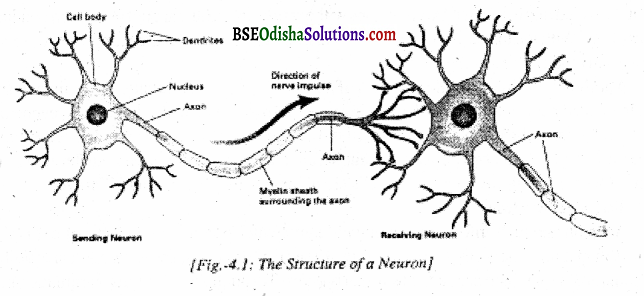
What is Neuron Q1

Cell body or Soma:
The cell body or ‘ Soma’ is the enlarged head of the neuron. It is enclosed by the cell membrane. The cell body contains the nucleus of the cell and cytoplasm which sustains its life. Some are the head side of the neuron. It uses oxygen and nutrients to generate energy. Its shape varies depending on the type of neuron. Generally, neurons transmit information in only one direction, that is, from the dendrites through soma to the axon to the terminal buttons.

Dendrites:
Dendrite is the branching fiber from the cell body. A neuron receives information at one end and sends out messages through the other. The part of the cell which receives incoming signals is called a dendrite. The dendrites receive nerve impulses from adjacent neurons or directly from sense receptors and conduct them to the cell body.

Axons relay or send impulses from the cell body to other neurons or to muscle tissue. The very word ‘dendrite’ came from the Greek word ‘dendron’ which means ‘tree’. So dendrites of a neuron look very much like trees. Dendrites are extended from the cell body. Dendrites increase the neuron’s surface area, allowing each neuron to receive input from many other neurons.

Axons:
Two types of extensions are found in the cell body. The short extensions from the cell body are called dendrites. But the longer single-branched extensions are called the axon. It is that part of the neuron which carries information away from the cell body to other cells. Each neuron has only one axon.

The point in the axon nearest to the cell body is called the axon hillock. Axons may have some branches which are called axon collaterals. Axons have two coverings. Of course, these two coverings are not found in every neuron. The outer boundary of the neuron is called the membrane. The membrane serves as a barrier for the neuron.

In some axons, there is a fatty white sheath called the myelin sheath. Axons having myelin sheath are called myelinated axons and which do not have it is called unmyelinated axons. Axons without myelin sheaths are not very good conductors of electricity. With the insulation of myelin sheaths, axons transmit electrical impulses and convey information much more rapidly.

Another covering is found in axons of neurons exclusively outside the brain and spinal cord. It is called a neurilemma. Neurilemma is a very thin covering that takes part in regeneration. If a neuron outside the brain and spinal cord is damaged, it can be regenerated. But the neurons of the brain and spinal cord can not be regenerated, as they do riot have neurilemma in their actions. Once these highly specialized cells are damaged, they are damaged forever.

Terminal Buttons:
An axon conducts information along its length which can be several feet in the spinal cord and less than a millimeter in the brain. At the far end of the axon, some swollen and bulb-like structures are there which are called terminal buttons. Through these buttons, stimulation passes to Astrocytes and oligodendroglia are two important glial cells.

Astrocytes produce chemicals that neurons need to fulfill their functions. On the other hand, astrocytes help control the chemical composition of the fluid surrounding neurons. The main function of oligodendroglia is to provide support to axons to produce myelin sheaths.

Functions neurons:
The main function of the neuron is to communicate messages of stimulation in the form of nerve impulses. Our behavior is only possible through the flow of nerve impulses. Near about 10 billion neurons fire in our brain. They send and receive various nerve impulses. This is the communicative function of the neuron.

Sensory or afferent neurons come from receptors and go to the brain and motor (efferent) neurons go to muscles or glands. The inter-neurons are the linking neurons. An electrochemical reaction occurs inside when a neuron is adequately stimulated. Neurons fire or do not file like a gun. There is no in-between stage. This is called the all-or-none principle.

All neurons follow this principle. They are either off or on. Now let us see how neurons serve their communicative functions and how nerve impulses or nerve energies are formed. The neuron contains intracellular fluid. The fluid on the outside of the neuron is called the extracellular fluid. In between these two types of fluids, there is a cell membrane.

The fluid contains many dissolved substances. Many chemical substances are broken into pieces when they dissolve in water or any fluid. Ions are electrically charged particles when dissolved. The electrical charges are negative or positive and are carried out by ions. As you know, positive and negative electrical charges attract each other.

But only positive electrical charges or negative electrical charges repel each other. Since ions are found in both extracellular fluid and intracellular fluid, the same thing happens in a neuron. (See fig. 4.3) A neuron works to maintain its resting potential. It does not come automatically.

When a neuron is in a resting state, there is a negative electrical charge of about – 70 million votes. Ameli volt one – thousand of a volt. This is called the resting potential of the neuron. The neuron can be best compared with a battery with the inside of the neuron representing the negative pole and the outside of the neuron representing the positive pole (Koester, 1991).

When a neuron is stimulated by externals like heat, light, or sound, the message arrives, and the positively charged ions outside the neuron rush inside the neuron at rates as high as 100 million ions per second. This sudden arrival of positive ions inside the neuron causes the charge to change from negative to positive.

When it reaches a critical level, an electrical nerve impulse known as action potential travels down the axon of the neuron. The very term ‘action potential’ is used to describe the brief wave of positive electrical charge which sweeps down the action.
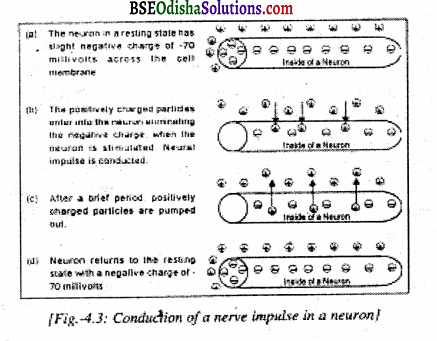
What is Neuron Q1 1.1

Generally, an action potential lasts only about 1/1000th of a second. When a neuron sends an action potential, it is commonly said to be ‘ firing’. The action potential abides by the all-or-none principle. Once the electrical impulse reaches a certain intensity, it fires and moves all the way down the axon without losing any of its intensity.

Again, the axon potential moves from one end of the axon to the other. After the nerve impulse has traveled, the positive ions are pumped out of the state. It becomes ready to fire again. The flow of the nerve impulse depends upon the diameter of a particular neuron. A nerve impulse is carried out speedily through a larger diameter and slowly through a smaller diameter.

Absolute Refractory Period:
After the action potential is transmitted by the neuron, it takes rests for a brief period of time. The neuron can not be fired again immediately, no matter how much stimulation it receives. It is just like reloading the gun after each shot. This time span just after carrying action potential during which the neuron is inactive is called the absolute refractory period.

During this period, the neuron is in resting potential. This time span of resting time is usually less than 1/1000th of a second. An action potential can not be produced during the absolute refractory period. When this span is over, again the neuron can cany a nerve impulse. The absolute refractory period is followed by a relative refractory period during which a strong stimulus can make the neuron active.

Threshold Point:
Weak stimuli can not produce an action potential in a neuron. Therefore, a stimulus of a certain strength is needed to produce an action potential. So the point at which a stimulus triggers an action potential is called the threshold of a neuron. Different neurons have different thresholds of excitation. Generally, the threshold point of each neuron is fairly constant.

Cell:
The nervous system of a living organism is made up of cells. A cell may be defined as a unit of living material. All can live independently by synthesizing within themselves substances from the nutrition absorbed from their environment. A cell contains living material called PROTOPLASM which is surrounded by a membrane called plasma membrane or the cell membrane.

CHSE Odisha Class 11 Psychology Unit 2 Perceptual Process Long Answer Questions Part-2

Question 2.
Define AH or None law. Neural transmission or synapse?
Answer:
AH or None Law:
According to this principle, the nerve fibers respond completely or not at all. The stimulus has to be a minimum strength for the nerve to react. A weak stimulus will excite a few nerve fibers and we may not have sensory experience at all. But a strong stimulus will excite a larger number of nerve fibers resulting in a more intense experience. We can take the lighting of a match stick for illustration.

We must strike it with a certain amount of force to ignite the powder. If greater power is striking is exerted, the match flame will not be brighter. Beyond the minimum pressure necessary, any extra effort does not add to the brightness of the flame. This is exactly what happens with the stimulation of a nerve fiber. When such an explosion takes place, the nerve fiber is ready for another charge in a fraction of a second.

This principle is called the ‘all-or-none law”. Further, the nerve impulse is an electrochemical stimulation, which does not decrease in its intensity as it travels through the axon. If an axon carries any nerve impulse at all, the impulse continues to maintain the same strength throughout its travel in the axon until it reaches the terminal buttons.

The speed of a nerve impulse depends on the diameter of the axons. The larger the diameter, the greater is the speed. The strength of the nerve impulse depends upon the nature of the axons. It must be remembered that the dendrites and the cell body of a neuron do not obey the all-or-none principle. Only this principle is applicable to axons. So the axon is only governed by this law.

Neural Transmission:
No doubt, our mental functions stem from biological functions. In turn, they also influence our biological activities. Neural activity is biological activity. Neural activity is the biological medium in which all our psychological processes occur. Therefore, it is necessary to gain preliminary knowledge about how neural impulses travel from one part of the biological system to another. Not only the neural impulse travels within a neuron, but it also travels from one neuron to the other. The two major parts of the neural transmission are

  • communication within a neuron (action potential) and
  • communication between neurons (synaptic transmission).

We have already discussed how neural impulses travel from one neuron to another neurons.
Synapse:
A synapse is a gap or junction which is generally found between the axon tip of one neuron and the dendrite of another. Neurons never touch each other. The nerve impulses are transmitted chemically across a small gap between the neurons. This type of contact provided between the axon of one neuron and the dendrites of another neuron is very interesting and significant.

The gap is very minute so that the conduction can easily go on. It is the synapse that makes our motor learning possible. When an impulse arrives at the end of an axon, electrical conduction in the axon is changed to chemical transmission. The tiny sacs in the terminal buttons of the axons, called synaptic vesicles release a transmitting substance called “neurotransmitters” which can the message to the other neuron.

Before the electrical impulse across the synaptic gap, it must be converted into a chemical signal As their name suggests, neurotransmitters transmit or carry information across the synaptic gap, it must be converted into a chemical signal. As their name suggests, neurotransmitters transmit or carry information across the synaptic gap to the next neuron.

When a nerve impulse reaches the end of the axon, it triggers the release of neurotransmitters which flood the synaptic gap. The dendrites of the receiving neuron come in direct contact with these neurotransmitters and receive the message. The receiving neuron will experience a change if the neurotransmitters are sufficiently stimulated, the received impulse will be conducted within the neuron and will be relayed from neuron to neuron until the message is completed.

It is estimated that the billions of neurons in the brain have trillions of synapses. There are many neurotransmitters. Each of them plays a specific role and functions in a specific pathway. Some neurotransmitters stimulate or excite, whereas, others inhibit neurons from firing (Bloom, Nelson & Lazerson, 2001). some neurotransmitters are both excitatory and inhibitory.

Most neurons secret only one type of neurotransmitter, but many different neurons are simultaneously secreting different neuro-transmitters into synaptic gaps of a single receiving neuron. Researchers have identified more than 50 neurotransmitters, each of which has a unique chemical makeup. Here, let us consider the functions of some neuro-transmitters which have major effects on our behavior.
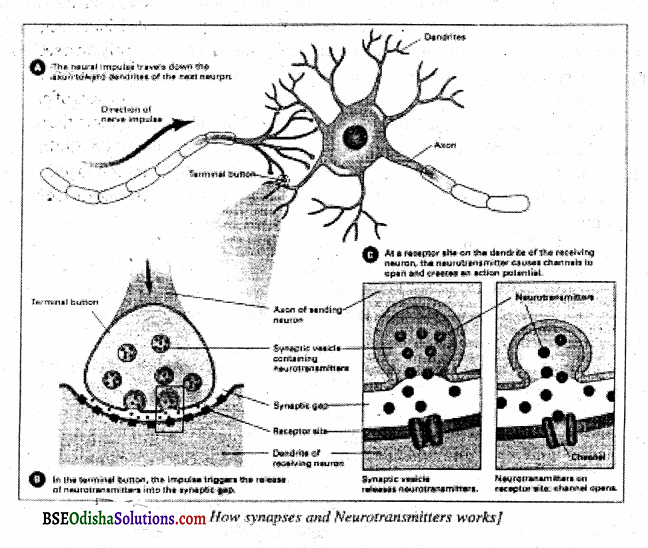
Define AH or None law. Neural transmission or synapse Q2

Question 3.
Describe the structure and function of the spinal cord.
Answer:
Central Nervous System Structure and Function:
The central nervous system is well protected in the bony case of the skull and spinal column. It is divided into the spinal cord and the brain. The sensory or efferent neurons carry impulses from receptors into the central nervous system. The motor or efferent neurons cany impulses originating in the central system outward to effectors.

The Spinal Cord-Structure:
The spinal cord is a continuation of the brain below the medulla. It has a simple structure compared to the brain. It presents the same structure from angle to angle. A cross-section of the spinal cord at any level reveals the same uniform structure. The different parts of the spinal cord are connected to the brain.

The membranes cover the spinal cord and separate the fine neural tissues from the bony box of the central nervous system, lire outer, middle and inner membranes are called dura mater, arachnoid, and parameter respectively. The spinal cord has a rich acroterial blood supply. In a section of the spinal cord, we find grey matter in the central region and white matter in the peripheral region. The grey matter consists of millions of cell bodies of neurons.

The white matter consists of processes of neurons, that is, of axons and dendrites. In a six-foot man, the spinal cord is about the diameter of a little finger and 45 cm long. We do not find the spinal cord in most of the primitive forms of animal life. But when we go higher in the scale of evolution the nerve cells are found to be gradually combining into clusters and groups. These nerve clusters grow up the first step towards the evolution of the spinal cord and brain.
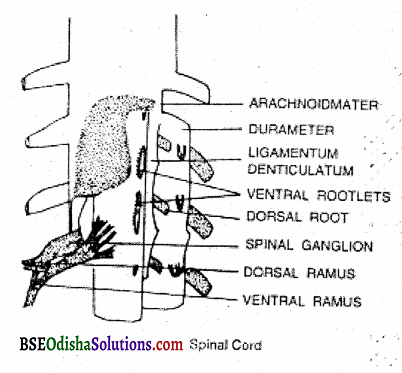
Describe the structure and function of the spinal cord Q3

Connected to the spinal cord are thirty-one pairs of peripheral spinal nerves. In each nerve thousands of individual axons are bundled together. Some of these have sensory and some motor function. The sensory branches of the spinal cord enter the cord at the back of the dorsal portion.

The sensory branches cany into the spinal cord impulse generating in the sensory receptors in the skin, joints muscles, and viscera. After synaptic connections in the cord, the sensory activity runs toward the brain. On the other hand, the motor branches of the spinal nerves leave the front or ventral part of the cord. They control the axons of nearby muscles and glands.

Functions of Spinal Cord:
Complete transaction of the spinal cord proves that the spinal cord has communicative and integrative functions. Observations of patients show that if the cut of the spinal cord is above the level of exit of the spinal nerves to the arm and legs, the outcome is quadriplegia. Similarly, if the cut is below the arm level, but above the leg level, the person suffers from paraplegia.

In both cases, there is no recovery. There is complete anesthesia and permanent paralysis of the parts of the body below the level of the cut. Why there is paralysis? Because the sensory stimulations cannot reach the brain. The motor impulses also cannot come out because of this cut in the spinal cord.

So though voluntary movements in the parts of the body before the cut are absent, reflex actions are not lost. The presence of Kneejerk refer and the reflex arising out of the pinching in such patients indicate the integrative capacity of the spinal cord and also its capacity to respond adequately to simple stimuli and by acting differently to different stimuli.

The last act shows a crude kind of decision-making. However, the capacity to perform these actions upon command is lost in paraplegics. The moderating influences of the higher center are also lost. In normal people, the reflexes are under some sort of descending inhibition from the brain. But in these types of patients, the reflexes are relatively larger and more sudden.
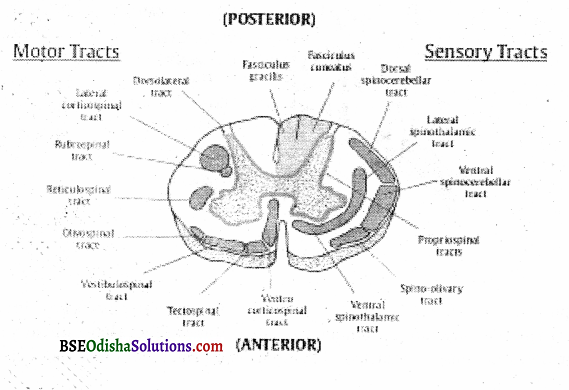
Describe the structure and function of the spinal cord Q3 1.1

CHSE Odisha Class 11 Psychology Unit 2 Perceptual Process Long Answer Questions Part-2

Question 4.
What do you mean by reflex action and define its type or characteristic?
Answer:
Reflex Action:
The reflex action is a very simple type of response that occurs automatically without our voluntary knowledge. According to Woodworth, “It is a direct muscular or glandular response to a sensory stimulus.” The examples of reflex actions are many. If someone puts his finger inside the mouth of a new baby, he starts sucking it. When a mosquito comes in front of someone’s eye, it is automatically closed as a protective measure.

Aeroflex action is very quick and rapid because it proceeds directly from the spinal cord. It does not go to the brain while in other activities the sensory stimulation is carried over to the brain through the spinal cord. The brain, in turn, sends out the message for making a particular response. That is why there is some delay in making these responses to activities other than reflex actions.

Types of Reflexes:
Basic reflexes, postural reflexes, segmental reflexes, inter-segmental reflexes, and spinal reflexes, come under different types of reflexes. There are also muscular reflexes such as knee jerks, the withdrawal of the hand, coughing, sneezing, swallowing, crying, and grasping reflexes. Glandular reflexes such as the flow of saliva, and the flow of tears are also notable.

Characteristics of Reflex Action:
The reflex actions are involuntary, unlearnt, and innate in nature like winking, knee erk, withdrawing leg from painful stimulation, sneezing, etc. The individual has no control over such reflexes. They occur very abruptly within a fraction of a second and also terminate very quickly. The involuntary or primary reflexes are purely universal.

The same type of avoidance of the pin pricking, grasping, winking and pupillary reflex is found in almost every person in the world. The reflexes are unlearnt behavior. Most of the behaviors of neonates are expressed in terms of reflexes. In babies, these reflexes are found in their original form.

As they grow up, the number of reflexes decrease and learned behavior increase. In other words, reflexes decrease with age. But there are certain reflexes that continue throughout life, like a knee-jerk, eye blink, etc. Finally, reflexes protect the individual from danger and help in maintaining the safety and welfare of the organism. Reflexes have, therefore, many positive values.

A reflex action is different from an ordinary action. In ordinary action, sensory stimulation in the form of electric waves is sent to the brain through the spinal cord. The brain then sends the message about the response to be made through the effectors. But in the case of reflex action, the message does not go to the brain. The spinal cord controls it. So the reflex action follows the spinal cord.

Reflex Arc:
The structure through which reflex action takes place is called the reflex arc. It involves the sensory nerve, spinal cord, and motor nerve. Take the example of withdrawing the foot when the pin is pricked. Sensory neurons cany impulses to the association.

Question 5.
How many lobes are there in the brain? Describe their location and function.
Answer:
Four lobes, in the brain and these, are:
Frontal lobe:
It is located in front of the nearly vertical fissure of Rolando and above the fissure of Sylvius. It contains three important areas of the brain: the motor area, the association area, and the speech area.

Motor Area:
At the farther end of the frontal lobe and adjacent to the central fissure, we have the motor area Which controls the voluntary movements of various parts of the body like the leg, arm, face, etc. It is technically known as the precentral area (Broadman’s area 4).

Promotor Area:
It is located in front of the precentral area. It also controls complex muscular movements of the body. Each hemisphere is connected to the opposite side of the body. The right limbs are paralyzed if the motor area of the left hemisphere is damaged or destructed and vice versa, complete destruction of the motor area of one of the hemispheres will produce paralysis of the muscles, on the opposite side of the body. The motor area has centers that control different parts of the body such as feet, hips, trunks, etc.

Association Area:
Just below the premotor area, there is an association area that deals with psychological processes like reasoning and memory. These areas are also responsible for giving a coherent form to various experiences of the organism. It is because of the association area, that man is different from animals. The essential function of these areas is to react to immediate sense impressions and symbols as well.

A small baby does not have the capacity to react to symbols. But with age, the power to react with symbols grows and these symbolic processes become a significant part of the association areas. Because of these areas, we are able to correlate all our present experiences with past experiences and make use of memory and thought processes.

ParietalLob:
The parietal lobe lies near the central fissure in the back half of the brain. It has the somesthetic area, which is the most important functional area. It lies adjacent to the central fissure itself. The parietal lobe is the seat of sensation. All the sensory impulses coming from the various parts of the body reach this area. So it is named a somesthetic or body sensitivity area.

Like the motor area, here we have separate centers for receiving the impulses from different parts of the body such as the arm, Teg, etc. All the bodily sensations are projected in this area. If this area is damaged person cannot discriminate between a piece of silk cloth and sandpaper. The sensation of wool, pinprick, mud, or clay is projected in the parietal lobe.

Temporal Lobe:
The major part lying below the lateral fissure is called the temporal lobe. The auditory area is located here. Electrical stimulation in this area leads to the sound of all sorts of noises heard by the subject. Damage to this area leads to deafness. The area for recognition of music is situated in this area If the recognition area of the temporal lobe is destroyed, the person loses the taste sensation. Connected with the temporal lobe is the gustatory area which lies directly below the temporal lobe.

The olfactory area also lies at one end of the temporal lobe. So it is undoubtedly the most important area of sensitivity. Thus, neurophysiology research indicates that this area is more vital than the frontal lobe and it has also been suggested that memory may ultimately be found to depend upon the temporal lobe. It plays a significant role in emotional behavior. So it has close functional contact with the interbrain.

Occipital Lobe:
The shape of the occipital lobe is triangular and it is located at the back portion of the brain. It is the seat of visual sensation. The most important functional area located in this lobe is the visual area. The retina, the crucial Organ of the eye is connected with it. Optic nerves1 coming down from the eye are extended to the occipital lobe. If one of the optic nerves is damaged, either of the eyes will lose the visual ability.

But if one part of the occipital lobe is destroyed, the person will not be able to sec half of the object. Several optic nerves going down from the retina go to different parts of the occipital lobe and we see the objects. The cerebrum and particularly, the cortex, contains the major centers of intelligence, cognitive process, sensational process, and all such creative higher mental processes.

Functions of the Brain:
Sensory Function:
Specialized sensory areas are located to the parietal, temporal, and occipital lobes and they are known as sensory projection areas because nerve impulses originating in receptors are as if it were projected upon them.

Somasthetic Activity:
A portion of the parietal lobe located just behind the fissure of Rolando serves as a terminal or projection area for impulses originating in the skin and in the Kinesthetic receptors. It is called somesthetic or body feeling area. When this area is stimulated electrically in human beings these are reports of temperature, touch, and movement experiences in the body.

But no pain sensation is experienced in the body. Medical reports indicate that even when tumors are operated on from various areas of the cortex, no pain is experienced. So it is concluded that pain sensitivity is mediated by the thalamus and not by the cortex.

Visual Sensitivity:
At the back of each cerebral hemisphere, in the front part of the occipital lobe lies an area called the striate area which is responsible for visual sensation. The visual area in the right cerebral hemisphere receives impulses from the right half of each eye and in the left cerebral hemisphere from the left half of each eye. If the visual cortex of the right hemisphere is damaged, the right parts of both eyes become blind.

Total blindness will be possible only when visual areas are destroyed in both hemispheres. Flashes of light, whirling colors, and similar such visual experiences thus warn the epileptic patient that he is going to be attacked by a fix. How is this possible? Frequent irritation of tissues in the visual cortex of the epileptic caused by tumors brings these visual signals.

Auditory Sensitivity:
The temporal lobe contains the auditory area. When the temporal lobe of epileptic patients is electrically stimulated or is cut, the patient hears buzzing, humming, and even musical sounds. Destruction of the auditory cortex in one hemisphere leads to minor defects in hearing. If, however, both the auditory areas are completely destroyed, the person becomes fully deaf.

This indicates that each car has representation in both hemispheres. Broca, a neurologist, found that when an area on the side of the left hemisphere was destroyed, the loss of speech occurred which is known as Broca’s speech area.

Motor Functions:
These areas of the brain are involved in controlling the movements of the body. The primary motor area, secondary motor area, and supplementary motor area. These areas of the brain are involved in the movement of the body, control of postures, and the tension of muscles. The secondary and supplementary areas do not send long axons to the spinal cord. They send sort axons into the nuclei in the interior of the cerebral hemispheres.

From it, in turn, other short axons go to nuclei in the brain stem, and a chain of such neurons leads down to the spinal cord. When stimulated electrically, part of the motor areas cause movements in the extremities. So when these areas are injured or damaged, the same parts are paralyzed. As already indicated, movements on the right side of the body originate from stimulation of the motor area of the left hemisphere and movement of the left side through stimulation of the right hemisphere.

Damage to the motor area on one side is followed by loss of voluntary movement on the other side of the body. Though voluntary movement stops in a corresponding limb, when a part of the motor area is damaged, the individual is able to move his limbs reflexly in response to strong stimuli because reflex arcs function at the lower level and are not controlled by the higher centers. The supplementary motor area is located in the longitudinal fissure.

These parts of the brain are involved in the control of postures, tensions, and body movement. These areas send short axons while long axons are sent by the premotor area. It is now suspected though not confirmed that these short axons play a major part in the control of movements like trembling and jerking etc. When the lower region is stimulated, the face may be twitched, the mouth may be opened and closed, and the like.

It was earlier believed that paralysis produced by cortical injuries was permanent and the patients never recovered. But experiments with monkeys and rats show that limbs that are paralyzed by the destruction of cells present is the motor cortex sometimes recover their functions, this brings the hope that if paralyzed human beings are given proper training, they might also start showing muscular movements. It has also been proved in some cases by messages etc.

Associative Functions:
The association areas of each side of the cerebral cortex are connected with each other, with sensory and motor areas, with the thalamus, and with similar areas on the opposite side. The chief function of the association area is to correlate and integrate the simpler functions of the sensory and motor areas since the sensory area act as gateways into the cortex and the motor areas act as exits.

Therefore, injuries to the cortex outside but near the visual areas do not cause blindness but destroy awareness of depth and recognition of visual objects. According to Munn, The cerebral cortex is a device not only for receiving sensory and initiating motor impulses but also through its association neurons for connecting, relating, and integrating functions.

These integrative functions of the cortex plus its susceptibility to modification during an organism’s life | time provide the foundation of such psychological processes as learning, recalling, past experiences and thinking”.

CHSE Odisha Class 11 Psychology Unit 2 Perceptual Process Long Answer Questions Part-2

Question 6.
State the structure and function of the autonomic nervous system.
Answer:
Autonomic Nervous System:
The anatomical distinction between the central nervous system and the autonomic nervous system lies in that the nerve fibers of the A.N.S. have always a junction with another neuron outside the brain or spinal cord on the way to muscles or glands. But such outside synapses are not found for nerves running to the straight muscles, that is, the central nervous system. By and large.

The A.N.S. controls the internal environment of the O while the CNS controls the impulses from the sense organs, organizes them in the brain, and sends the motor impulses to the muscles. Why is it called A.N.S. ? Because many of the activities it controls are autonomous or self-regulating activities such as digestion and circulation which continue from life to death even when the person is asleep or unconscious. Its activity never stops in a living organism.

Division of Autonomic Nervous System

  • Sympathetic System
  • Parasympathetic System

Sympathetic System:
On either side of the spinal column, closely connected with it through the spinal nerves the chains of nerve fibers and masses of cell bodies from which fibers extend to various visual organs. These are called sympathetic chains. This sympathetic outflow takes place through the thoracic and lumber regions of the spinal cord. Due to this it is also sometimes called “The Thora Cicolumbar System”.

Structure:
The sympathetic nervous system consists of 22 sympathetic ganglia in a man:
arranged along the spinal cord. These fibers originate in the spinal cord and either end upon the sympathetic ganglion or they may extend to the other bundles of the ganglion chain. By this, they help in connecting the various sympathetic ganglia with each other or they may go to the distant parts of the body or end near the muscles or glands.

Besides, there are three important ganglia in the neck region which are known as superior, middle, and inferior ganglia. These cervical ganglia play a significant role in controlling the blood vessels of the heart and head, and dilator fibers of pupils. In general, they influence the blood supply of the brain.

Functions:
As the name suggests, the sympathetic nervous system sympathizes with the organism during an emergency situation or need by mobilizing all bodily energies effectively in the direction of facing an immediate need or emergency situation. When the man is asleep, he is at the lowest level of activity.

At this stage, the sympathetic system is at its minimum in its function. Suddenly, he is awakened by the loud noise “Fire, Fire”. Immediately his level of activation rises to the maximum through the activation of the sympathetic system. The sympathetic system puts itself into action to meet this emergency situation. The man gets up and runs with maximum speed to help himself or others out of the fire.

The sympathetic system constricts the visceral blood vessels and directs them to muscles and the brain increases the rate of the heartbeat so that more blood is pumped through to the heart, and helps the secretion of adrenalin which raises the level of blood sugar necessary for more energy, etc. There is also inhibition of intestinal and gastric activity, widening of the pupils.
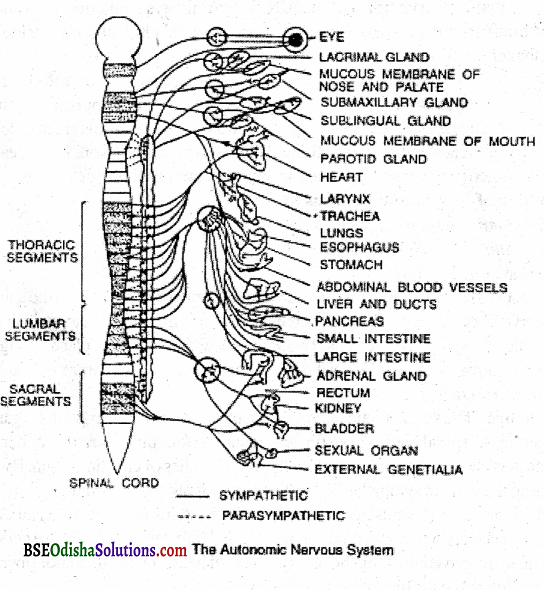
State the structure and function of the autonomic nervous system Q6

Let us take the case of a person who is angry. During anger, the action of the sympathetic system includes dilating the pupil of the eye, lifting the lid and protecting the ball, speeding up the heart rate, and raising blood pressure. There is also the cessation of digestive movements, peristaltic contractions of the stomach, and of secretion of digestive juices.

The blood that normally goes to these organs is diverted to the muscles to enable the O to face the emergency situation. All these duplicate the energy of the person. In this manner, the sympathetic system makes the O ready to face the emergency situation by helping in organizing the bodily resources to meet the situation more effectively.

Parasympathetic System:
It is a division of the autonomic Nervous System concerned with projecting and conserving the body’s resources, preserving normal functions, and maintaining a calm emotional state. It has two divisions :

  • the cranial part
  • The sacral part.
    So it is called the craniosacral system. But here there is no such chain of parasympathetic ganglia.

The Cranial Part:
It consists of all the nerves and outlets that one, associated with the brain and the head.

The Sacral Part:
It comes from the extreme lower end of the spinal cord.

CHSE Odisha Class 11 Psychology Unit 2 Perceptual Process Long Answer Questions Part-2

Question 7.
Describe the location of the brain.
Answer:
He conducted several experiments on rats and other animals to find out the effect of the removal of various parts of the cerebrum on psychological purposes.

  • Several experiments on rats and of the problem and cerebral lessons; and
  • the effects of destruction on various sizes and locations on the maze learning habits are notable.

The findings of these studies showed an intimate relationship between the difficulty of the problem and the effect of cerebral lessions. There was an increase in error while learning when cortical destructions 1 were higher. Lashley finally concluded that the quantity of the lesson was a significant factor in retardation in learning. lie found that many problems like the skill of ordinary maze learning can be acquired equally well with one part of the cortex as with another.

He further found that there was a positive relationship between the amount of cortex and the difficulty of the task that is, as the difficulty of the task increases the greater amount of cortex is required to solve it. Even when half of the cortex was removed, simple tricks were learned equally quickly, but difficult problems could not be solved.

In one experiment by Lashley (1929) adequate training was given to monkeys to open the door by handling a latch. After learning was complete the monkeys were decorticated. Some portions of the frontal lobe were removed by surgical operation, without any danger to the life of the monkey. After decortication, it was found that some portions of the brain are at least responsible for certain work.

But later he also found that money could be educated and they could relearn the previous learning after decortication. From these experimental findings, he established two principles to explain the functional localization of the brain, that is, whether the brain acts as a whole or in parts.

Principle of Equipotentiality:
Lashley was of opinion that complex learning does not depend upon the definite structure of a specific area of the cortex. On the other hand, he noted that complex learning depends upon the total organization of the cortex. The principles of equipotentiality hence mean that with some very specific exceptions.

One part of the cerebral cortex is potentially the same as another part in its functional capacity related to the learning process. In other words, the capacity of the uninjured or intact part of the brain for functioning as a substitute for other parts in case of emergency is called the principle of equipotentiality.

All parts of the cortex, therefore, are equal potential for the learning function. Thus, Lashley in his book Brain Mechanism and Intelligence (1929), has remarked, “The term equipotentiality I have used to designate the apparent capacity of the intact part of a functional area to carry out with or without reduction in efficiency, the functions which were lost by destruction as a whole.

This capacity varies from one area to another and with the character of the functions involved. It probably holds only for the association areas and for function more complex than simple sensitivity or motor coordination.”

The Principle of Mass Action:
To Lashley, the principle of mass action meant that the brain fundamentally functions as a hole. He said that the more the cortex available, the better would be the learning capacity. In this connection, he has pointed out that the animals with various amounts of their cortices removed. Showed a general reduction in sensitivity, aggressiveness, and in exploratory activity in puzzle-born learning situations in comparison to their normal counterparts.

What he intended to say is that the cerebral cortex seems to be responsible for the characteristics of one’s behavior as a whole. That is why the removal of one part of the cerebrum affects learning in a general manner. The most important generalized function of the brain is to establish associations between our various present and past experiences.

The association area of our brain contains all our experiences and it is because of this connection of experiences that our mind acts as one unit. Franz later found that the amount of brain has also got a major contribution to higher psychological activities and complex learning processes. He noticed that if a small portion of the cortex will be decorticated, it will not decrease the activities undertaken by this part.

The other parts of the brain will take charge of it and the work will be somehow managed. But if a longer part is taken away there will be a deterioration in learning and other complex mental activities. It is thus proved that more amount of cerebral cortex is needed for higher psychological processes like learning, application of intelligence and judgment, synthesizing ability, thinking, problem-solving, perception, etc.

This principle, therefore, states that the brain acts as a whole or in a mass. The principle of equipotentiality and mass action is confirmed and supported by many experimental studies on apes, monkeys, human beings, etc. These principles are also confirmed by the findings of studies on human beings whose parts of the brain were injured or damaged by disease or accident.

Analysis of these principles and the experimental findings in their support do prove that simple sensory-motor functions may show a relatively high degree of localization while complex and higher-order mental activities require less localization and more mass action. Therefore, it would probably be more appropriate to conclude that the brain acts in widespread patterns.

patterns that include many cortical areas and their connecting association fibers. Loss of any large portion of the cortex will disturb the interaction of parts and break up the usual pattern. It is the general type of function. So, we have to accept somewhere between the two. In ordinary simple work, the brain acts in part.

But in higher-order activities and higher mental processes, coordinating the integrative function of the entire brain is essential. So, in such cases the brain functions as a whole. There is evidence for the localization of sensory and muscular movements. There is some indication that the frontal lobes are concerned with the management of planned activity and that the rear half of the brain is more concerned with knowing and understanding things.

Learning seems to be an unlocalized function and adjustment of the organism for the total situation and for a goal is probably a function of the entire cerebrum. It would, therefore, be not appropriate to generalize about the principles of complete equi-potentiality of the functions of various areas of the cerebrum. Besides, the evidence derived from rats, cannot be applied with equal confidence in human organisms.

Experiments on monkeys show a much greater loss in the ability to learn when their frontal lobes were destroyed than the damage elsewhere. Some cases of human subjects also indicated that there is a considerable degree of specificity in the cortex. However, further research in this area is necessary to draw a generalized conclusion on the functional localization of the brain.

CHSE Odisha Class 11 Psychology Unit 2 Perceptual Process Long Answer Questions Part-2

Question 8.
What are the methods applied to study the brain?
Answer:
Some of the important methods to study the localization of functional areas of the brain are discussed below:
Anatomical Method:
In this method, the anatomist attempts to find out various nerve pathways by observing the nature of neural tissues under the microscope. By this method, the anatomist not only learns the origin and termination of different nerve fibers but he also finds out what sense organs send fibers where and what parts of the brain send motor fibers to the spinal cord. This method only finds out the structure of the brain and spinal cord. The functions of the brain and the spinal cord are not traceable by this method.

Method of Extirpation or Aplation Method:
Extirpation means to destroy or cut off. In this method, a particular part of the brain is destroyed or cut off and its effect is studied on the functions of the brain or human behavior. The behavior of the organism is carefully observed and recorded. Then it cuts off a specific part of the brain and observes its effects on the behavior of the ‘O’, that is whether it changes his behavior or not.

Action Potential and Electrical Recording Method:
Neurons produce electric currents when they conduct and the potentials underlying them can be recorded with a cathode ray oscilloscope. By correlating the parts having the greatest electrical activity with the nature of the stimulus one can find out which area of the brain is involved in various types of sensations and how the body surface is represented on surfaces in the brain.

Method of Stimulation:
It is a direct method. Different parts of the brain are stimulated with mild electric currents. While making brain operations on patients an introspective report is taken from the patients on the sensations they experience while stimulation. Using this method, functions of different parts of the brain can be located.

Chemical Method:
In this method certain chemicals are used to distinguish axons from cell bodies; certain parts of neural tissues from others to observe their specific functions. Similarly, it is used to find out which axons are part of the same neurons. Otherwise, because of their complexity, it is not possible to say these things merely by looking through a microscope. Behavioral changes are also observed by using various chemicals on the external and internal parts of the brain.

Scanning Method:
Today medical science has made rapid progress, thanks to the continuous and meaningful research in the area, particularly in the West. Scanning means taking pictures intently of all parts. With the development of scamming methods, new models of X-ray machines, and computers, the functions of the brain are being studied in a very scientific and organized manner.

Through scanning, it is possible to get an X-ray picture of every millimeter of the brain. Scanning of the brain helps in knowing the damages and destruction made to the brain because of accidents. Alzheimer’s disease, Korsakoft’s Syndrome, and many other diseases like a brain tumors.

There are different types of Scanning like Cat Scans, Pet scans, and MRIs, etc.
Cat Scan:
The Cat Scan method is used when one is interested to know and analyze the minute details of the functioning of the brain of an individual. Scanning of the brain is recommended particularly when the doctor has to diagnose to patient.

Question 9.
Describe the structure of the human brain.
Answer:
The Brain:
Modem scientific psychology recognizes that is the brain, not the heart or soul which guides human behavior. Recently, technological innovations such as the electron microscope and brain scanning systems have led to an explosion in a number of new theories and tests of how the brain works. It has been found that an adult brain weighs about 1.36 kg and contains around 100 billion neurons.

The brain receives one-fifth of the blood pumped by the heart. If deprived of oxygen for 3 to 4 minutes, the brain cells are irreparably damaged. Brain investigation reveals that while some mental functions are widely distributed among different areas in the brain, man activities are highly localized.

Different areas in the brain are specialized for specific jobs. Our brain controls almost all the activities that we do, except the reflex activities which are controlled by the spinal cord.

Structure of Brain:
With the development of the human embryo inside the mother’s womb, the nervous system begins forming as a long, hollow tube in the back of the embryo. After three weeks of conception, cells making up the tube differentiate into a mass of neurons, most of which then develop into three major regions of the brain – the hindbrain, which is adjacent to the top part of the spinal cord, the mid-brain, which rises above the hindbrain and the forebrain, which is the uppermost region of the brain (see fig. 4.6).

Hindbrain:
It is the lowest portion of the brain located at the rear of the skull. In other words, the backside of the brain is called the hindbrain. It has three subdivisions medulla, cerebellum, and pons. The medulla begins where the spinal cord enters the skull. It is also called the medulla oblongata.

This structure is located at the lowest portion of the brain stem. It is a link between the brain stem and the spinal cord. The medulla helps to control our breathing and regulates reflexes which allow us to maintain an upright posture. It also controls some vital and autonomic functions such as respiration, circulation of blood digestion of food, etc.

It has some roles in sneezing, sleep, and coughing also. The cerebellum extends from the rear of the hindbrain, just above the medulla. It is also called the ‘Tittle brain’ because it is a miniature version of the cerebrum. Its outer surface looks grey and the interior white. It consists of two rounded structures thought to play important roles in motor coordination (Middleton & Strick, 2001).

Its vital function is to control body balance and posture. It also controls biological rhythm or perception of time. Injury to the cerebellum may lead to a lack of motor coordination, stumbling, and loss of muscle tone. When the cerebellum is damaged, movements become uncoordinated and jerky.

Extensive damage to the cerebellum even makes it impossible to stand up. It also stores the memory of movement patterns so that we do not have to concentrate on how to walk, dance, or ride a bicycle. Moreover, the cerebellum is associated with coordinating movements, controlling posture, and maintaining equilibrium.
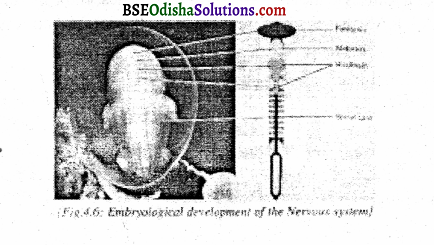
Describe the structure of the human brain Q9

The Pons lies between the medulla and the midbrain. It is a Latin word, which means ‘bridge’. But it does not look like a bridge. It is so named because of the bundle of nerves that passes through it. the pons region connects to the cerebellum and is involved in dreaming and waking. It contains several clusters of fibers involved in sleep and arousal (Kolb, Whishaw & Terao: 2003, 2004). Moreover, the pons transmits information about body movement and is also involved in functions related to attention, sleep, and alertness.

The Midbrain:
The shortest part of the brain is the midbrain. It is also the topmost part of the brain which is located in the central region. It is just a tube-like structure. The outside of the midbrain looks white and the inside looks grey. Through this tube, a fluid-like substance called cerebrospinal fluid passes which provides nutrition to the brain. Besides providing nutrition, it has got sensory and motor pathways. The midbrain contains primitive centers for vision and hearing and plays a key role in the regulation of visual reflexes.
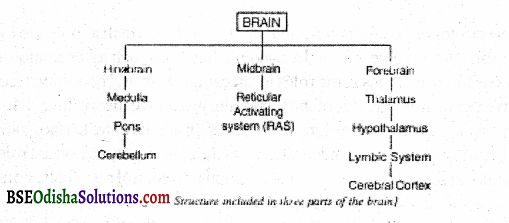
Describe the structure of the human brain Q9 1.1

Two systems in the midbrain are of special interest – One is the reticular formation or Reticular Activating System (RAS) and the other one is the brain stem, the RAS begins in the hindbrain and ascends through the region of the midbrain into the lower part of the forebrain. It is a network of neurons crossing each other.

The size of RAS is just like a small finger of a man. RAS has two parts ascending reticular system and descending reticular system. The ascending reticular system sends impulses to the cerebral cortex and the descending system sends impulses downward to the RAS. RAS also receives impulses from the cerebral cortex.
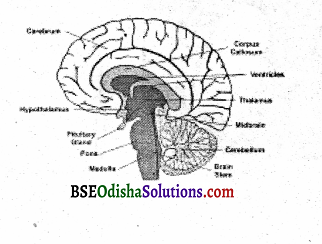
Describe the structure of the human brain Q9 1.2

Electrical stimulation of RAS awakens sleeping animals. If the RAS is damaged, the animal may not die but will sleep forever. This kind of sleep is called comatose or simply coma. Once it is destroyed, it does not recover. RAS also acts as a relay station for emotional behavior. The RAS is less activated during sleep. It is connected with the cerebrum by receptors and effectors. Further, it plays an important role in selective attention and filtering of information through learning.

The brain stem is so-called because it looks like a stem (Carlson, 2001). It is the most ancient part of the brain. The brain stem connects with the spinal cord at its lower end and then extends upward to encase the reticular formation in the midbrain. Clumps of cells in the brain stem determine alertness and regulate basic survival functions, such as breathing, heartbeat, and blood pressure.

The Forebrain:
It is the most important part of the brain. Virtually it possesses all the parts concerned with the perception, and coordination of behavior patterns including those of emotion, motivation, learning, memory, language, and thinking. The significant parts of the forebrain are the thalamus, hypothalamus, limbic system, and cerebrum.

Thalamus:
Thalamus is located almost in the exact center of the human brain. It consists of an egg-shaped cluster of neurons. Thalamus connects the cerebrum with peripheral parts of the body. All the nerves come and go through it. So it is an important relay station for incoming sensory impressions from all parts of the body. Further, it is called the central switchboard of the brain.
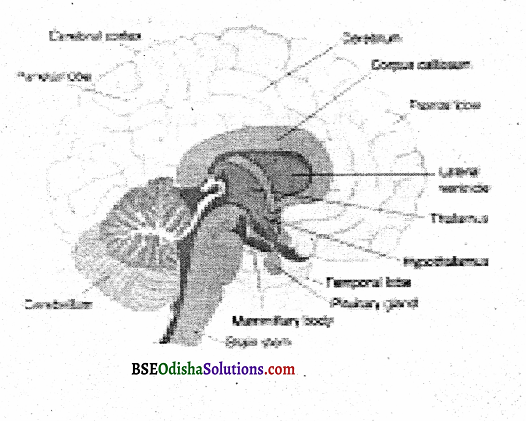
Describe the structure of the human brain Q9 1.3

The main function of the thalamus is to send incoming sensory impulses to respective parts of the cerebral cortex. Most neural input to the cerebral cortex goes through the thalamus. Thalamus is also involved in controlling sleep and attention in coordination with other brain structures, including RAS. When the cortex wants to inhibit or control certain automatic activities, it sends the impulses to the thalamus.

Basal Ganglia:
Just above the thalamus and under the cerebral cortex lie large clusters of neurons called basal ganglia. The basal ganglia work with the cerebellum and the cerebral cortex to control and coordinate voluntary movements. These large clusters of neurons or ganglia enable people to engage in habitual behaviors such as riding a bicycle. People with damage to basal ganglia suffer from either unwanted movement, such as constant writing or jerking of limbs, or too little movement, such as the slow and deliberate movements of those with Parkinson’s disease.
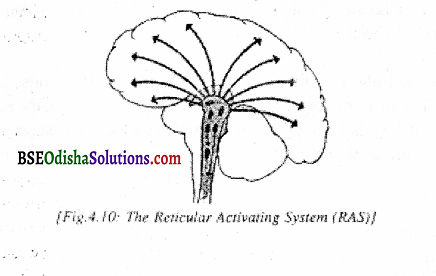
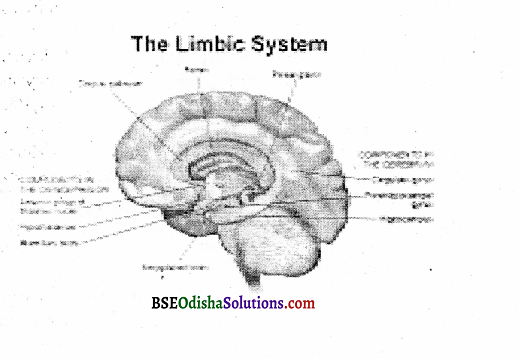
Describe the structure of the human brain Q9 1.4

Describe the structure of the human brain Q9 1.5

Hypothalamus:
Hypothalamus is a small forebrain structure located just below the thalamus. It lies at the base of the cerebrum. It regulates the functioning of the Autonomic Nervous System. Hypothalamus monitors three pleasurable activities eating, drinking, and sex – as well as emotion, stress, and reward. It also directs the endocrine system. Hypothalamus acts as a regulator of the body’s internal state.

It also plays an important role as an integrative location for handling stress (Hayashi and others, 2004). Much of the integration is accomplished through the hypothalamus’s action on the pituitary gland, an important endocrine gland located just below it. If certain areas of the hypothalamus are stimulated electrically, a feeling of pleasure results.

The Limbic System:
The limbic system is composed of a group of structures that is found in all mammals, sometimes called the old brain. Only mammals and reptiles have limbic systems. It is a ring-like structure having several other structures. The limbic system is structurally interconnected with the hypothalamus. So it is involved in the drives of hunger, sex, aggression, and some of the behaviors regulated by the hypothalamus.

The three principal structures in the limbic system are the amygdala, hippocampus, and septum. The amygdala has an important role in aggression. It is involved in memory, emotions, and certain basic motivations. The damage to the amygdala causes an animal to be less fearful, over-curious, hypersexual, and more exploratory.

CHSE Odisha Class 11 Psychology Unit 2 Perceptual Process Long Answer Questions Part-2

Question 10.
What is the endocrine gland and discuss the functions of the endocrine system?
Answer:
The endocrine system is a set of glands that regulate the activities of certain organs by releasing their chemical products into the bloodstream, like the nervous system, it plays a crucial role in our behavior and development previously, the endocrine system was considered separate from the nervous system.

However, today neuroscientists know that two systems are interconnected. The endocrine system consists of ductless glands which secret complex chemical substances called hormones, directly into the bloodstream. The human body is not only under the control of the nervous system but also of a complementary system of hormones.

This system is controlled by Autonomic Nervous System (ANS) activity and like ANS, it is not under conscious control but regulated by the body itself. It helps in maintaining bodily homeostasis. Hormones are involved in different bodily functions and behaviors. They influence body growth, sexual development arousal, mood, and metabolism.

Endocrine or ductless glands are stimulated in 3 ways:

  • by chemical level in the bloodstream,
  • other hormones and
  • nerve impulses from the Bram

Once secreted into the blood, hormones are promoted it’s their bodily targets. This system not only sustains our slow and continuous bodily processes but also helps us to respond to crises. During an emergency, the Iannone ‘adrenaline’ is released into the bloodstream, energizing our body for quick defensive action for ‘ fight’ or ‘ flight’.

‘Hormones’ are generally called ‘the messengers of life’ because their influence is diverse but specific (Carpo 1988). Different hormone factories ‘sites of our body produce chemicals that influence a variety of bodily processes. A small structure of the limbic system, the hypothalamus, is the brain center in charge of the endocrine system.

In the hypothalamus, specialized cells receive messages from other brain cells committing to release a number of different chemicals. These chemicals influence the adjacent pituitary gland, the so-called master gland which can either stimulate or inherit the release of hormones from other glands.

The functions of the Endocrine System:
The important functions of the endocrine system are discussed below:

  • The pituitary gland
  • Thyroid gland
  • Parathyroid
  • Adrenal gland
  • The pancreas
  • The Gonads

The Pituitary Gland:
Although the pituitary gland is situated within the cranium, still it is a part of the endocrine system, rather than the nervous system. This gland is popularly known as the master gland. It is located in a small bony hollow at the base of the brain. Centre of the skull. The size of the pituitary gland is very small. But control growth and regulates other glands. This pea-sized gland is controlled by the hypothalamus.

The pituitary gland has:

  • anterior
  • posterior pituitary secretions.

Anterior:
The anterior pituitary secretions help growth. Hypersecretion of it causes gigantism and a rugged personality.

Posterior pituitary secretions:
The posterior pituitary gland hormone raises blood pressure, regulates metabolism, and increases the contraction of smooth muscles in the intestine and uterus.

Thyroid Gland:
The thyroids are located in the neck at either side of the ‘Adam’s apple’. These glands produce thyroxin, which influences the body’s metabolism rate. It also helps to control the rate of physical growth and influences the structure and functions of the nervous system.

CHSE Odisha Class 11 Psychology Unit 2 Perceptual Process Long Answer Questions Part-2

Question 11.
What is the cerebrum and describe how does the brain function?
Answer:
The Cerebrum:
The cerebrum or cerebral cortex is more highly developed in humans than in any other animals. The cerebral cortex is divided into two halves or hemispheres. It is the highest region of the forebrain and is the most recently developed part of the brain in the evolutionary scheme. In humans, the cerebral cortex covers the lower portions of the brain like a large cap.

The cortex is greatly convoluted with lots of grooves and bulges which considerably enlarge its surface area. It is connected with other parts of the brain. Literally, millions of axons connect the neurons of the cerebral cortex with those located elsewhere in the brain.
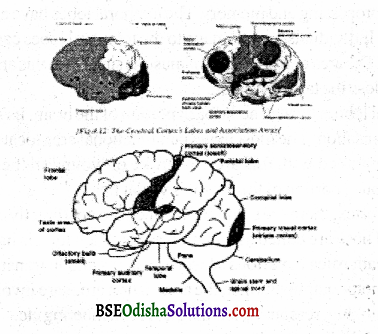
What is the cerebrum and describe how does the brain function Q 11

The cortex looks gray since it consists largely of cell bodies and unmyelinated fiber. A very depressed or fissure divides the cerebrum into two equal halves – the left hemisphere and the right hemisphere. The left hemisphere is connected with the right-hand side of the body. The right hemisphere is connected with the left-hand side of the body.

The two hemispheres are connected with each other by a thick fiber bundle known as the corpus callosum. Each hemisphere is divided into four parts or lobes by two fissures – the frontal lobe, the parietal lobe, the temporal lobe, and the occipital lobe. However, the occipital lobe is not clearly demarcated. It is located at the rear of the brain.

The frontal lobe is that portion of the cortex behind the forehead which is involved in the control of voluntary muscles, intelligence, and personality. The frontal lobes of humans are especially large when compared with those of other animals. This lobe is primarily responsible for the planning, execution, and control of movements.

Without intact frontal lobes, humans are emotionally shallow, -5 distractible, listless, and insensitive to social contexts (Hopper & Teresi, 1992). Individuals with frontal lobe damage become so distracted by irrelevant stimuli that they often cannot carry out some basic directions. An important part of the frontal lobe is the prefrontal cortex, which is at the front of the motor cortex.

It is believed to be involved in higher cognitive functions such as planning and reasoning (Manes & Others, 2002). Neuroscientists refer to the prefrontal cortex as an executive control system because of its role in monitoring and organizing thinking (Owen, 1997). The parietal lobe is located at the top and towards the rear of each hemisphere.

It is involved in registering spatial location, attention, and motor control. This cortex receives information from the somatic senses. Therefore, this area is specialized for touch, pressure, and pain. On the whole, it controls incoming sensory information. The portion of the cerebral cortex just above the ears is the temporal lobe. It is involved in hearing, language processing, and memory.

The temporal lobes have a number of connections to the limbic system. Individuals with damage to the temporal lobes can not file experiences into long-term memory. The area of recognition of music is situated in this area. If this area is destroyed, an individual may lose the taste sensation.

The occipital lobe is located at the back portion of the brain. Its shape is triangular. It is the seat of the visual sensation. The most important functional area located in this lobe is the visual area. The retina is connected to this area. A stroke or wound in the occipital lobe can cause blindness or wipe, out a portion of the person’s visual field.

In the cerebral cortex, there are some areas that are not directly concerned with sensory or motor functions. These are called association areas. Each lobe is having an association area. They play significant roles in various sensory systems and in transmitting sensory input to programmers for motor output. Further, the association areas are involved in complex cognitive activities such as thinking, reasoning, learning, remembering, etc.

How does the brain function?
Very often, the question arises whether or not the brain functions as a ‘whole’. Physiological psychologists are trying to answer this question since the days of Johannes Muller. There are differences in views. A group of experts believed that each part of the cerebrum had a definite function. Another group believed that parts of the brain are functionally interchangeable. Modem findings indicated that the brain functions in parts as well as as a whole.

The experimental findings of Franz and Lashley on localization are expressed in two theories:

  • the theory of equipotentiality and
  • the theory of mass action.

Theory of Equipotentiality:
The theory of equipotentiality suggests that all parts of the cortex are equal potential enough for simple learning functions. Lashley has conducted a good number of studies on animals. According to him, complex learning does not depend upon the definite structure of a specific area of the cortex, rather, complex learning depends upon the total organization of the cortex.

This principle suggests that with some very specific exceptions, one part of the cerebral cortex is potentially the same as another part in its functional capacity related to the learning process. Therefore, all parts of the cortex are equal potential for learning function.

The Principle of Mass Action:
The principle of Mass Action reveals that the brain fundamentally functions as a whole. The more parts of the cortex an available, the better would be the learning capacity. In his study, Lashley found that animals having decorticated cortex demonstrated a general reduction in sensitivity, exploratory activities, and aggressiveness. The removal of any part of the brain affects the learning process.

Later, Franz found that the amount of brain has got major contributions to higher psychological activities and complex learning processes. The principles of Mass Action and Equipotentiality were confirmed and supported by many experimental studies on apes, monkeys, human beings, etc.

These principles were also confirmed by the findings of the studies on human beings whose parts of the brain were injured or damaged by disease or accident. Probably it would be more appropriate to conclude that the brain acts in widespread patterns, which include many cortical areas and their connecting association fibers.

Damage to the large portion of the cortex would certainly disturb the interaction of parts and break up the usual pattern. It is true that the brain acts in part in ordinary simple work. But in higher mental activities and higher mental processes, the coordinating and integrative function of the entire brain is necessary. In such cases, the brain functions as a whole. However, to draw a generalized conclusion on the functional localization of the brain, further research in this area is essential.

CHSE Odisha Class 11 Psychology Unit 2 Perceptual Process Long Answer Questions Part-2

Question 12.
What is the peripheral Nervous System?
Answer:
The peripheral nervous system is composed of all the neurons forming the nerve fibers that connect the CNS to the rest of the body. It consists of sensory and motor neurons that transmit messages to and from the central nervous system. Our brain will be isolated from the world without a peripheral nervous system. This system has two divisions.

  • Somatic Nervous System.
  • Autonomic Nervous System.

These are described below:
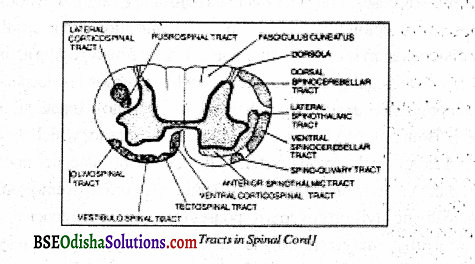
What is the peripheral Nervous System Q12
Somatic nervous system:
The somatic nervous system is the first part of the peripheral nervous system. It is under voluntary control and regulates the actions of the skeletal muscles of the body. The somatic nervous system has both sensory neurons and motor neurons. The sensory neurons mn from our sense organs toward the central nervous system for perception and learning etc.

On the other hand, the motor neurons carry messages from the brain to the striped muscles of the body for activities. Action like moving our legs or hands, running, jumping, and riding is possible by the somatic nervous system. On the whole, the somatic nervous system controls the striped muscles of our body.
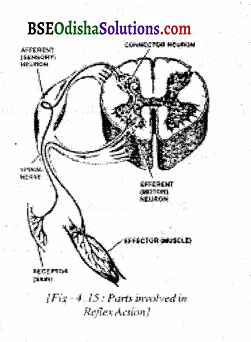
What is the peripheral Nervous System Q12 1.1

Autonomic Nervous System (ANS)
The very word autonomic means self-regulating or independent. ANS is the second part of the peripheral nervous system. It is involuntary and governs activity, which is not normally under the direct control of the individual. The ANS works even when we are asleep. ANS sustains basic life processes.

The ANS operates constantly, regulating bodily processes we do not usually control consciously, such as respiration, digestion, and arousal. On the whole, the autonomic nervous system is called as autonomic because many of the activities it controls are autonomous or self-regulating and continue even when a person is asleep or unconscious.

The autonomic nervous system (ANS) is subdivided into the sympathetic and parasympathetic nervous systems. Both these divisions have survival functions for which the autonomic nervous system is called as survival nervous system. The ANS is intimately connected with the spinal cord.

The sympathetic division tends to act as a unit. It is exciting in emotional situations. The sympathetic division governs responses to stress in emergencies when action must be quick and powerfully, energized. This is the ‘fight or flight response system. In short, the sympathetic nervous system is the division for emergency survival.

For example, during emotional excitement, digestion is stopped, heart rate is increased, blood flowing to the internal organs is directed to the skeletal muscles and the endocrine system is stimulated to release several chemicals which increase the effectiveness of the entire motor system. The sympathetic division energizes us to respond to a stressor quickly.

But the parasympathetic division monitors the routine operation of the body’s internal functions. It is concerned with projecting and conserving the body’s resources, preserving normal functions, and maintaining a calm emotional state. This division returns the body to calmer functioning after sympathetic arousal. Unlike the sympathetic division, the parasympathetic division tends to affect one organ at a time.

In short, whereas the sympathetic system is activated during violent emotions, the parasympathetic system is dominant and active during normal times or during quiescence. Activation of this system slows the heartbeat, lowers blood pressure, and conserves as well as protects bodily resources. The sympathetic and parasympathetic systems do not compete with one another, rather they function in a coordinated manner.

Points to remember

Question 1.
What is Neuron? Describe the structures and functions of a Neuron, How does it differ from a cell?
Building Blocks of the Nervous System:
Neurons are basic units of the nervous system. On the whole, the way the neurons function reflect the major characteristics of the nervous system.
Basic Structure of a Neuron:
In general, every neuron has the following structures.

  • Cell body or soma
  • Dendrites
  • Axon and
  • Terminal buttons or axon terminals

CHSE Odisha Class 11 Psychology Unit 2 Perceptual Process Long Answer Questions Part-2

Question 2.
Central Nervous System and Structure and Function.
Answer:
The central nervous system is well protected in the bony case of the skull and spinal column. It is divided into the spinal cord and the brain.

Question 3.
State the structure and function of the autonomic nervous system.
Answer:
Autonomic Nervous System:
The anatomical distinction between the central nervous system and the autonomic nervous system lies in that the nerve fibers of the A.N.S. have always a junction with another neuron outside the brain or spinal cord on the way to muscles or glands.

CHSE Odisha Class 11 Psychology Unit 2 Perceptual Process Short Answer Questions

Odisha State Board CHSE Odisha Class 11 Psychology Solutions Unit 2 Perceptual Process Short Answer Questions.

CHSE Odisha 11th Class Psychology Unit 2 Perceptual Process Short Answer Questions

Short-Answer Type Questions

Question 1.
Voluntary Attention.
Answer:
It is also called effortful attention. When attention requires special effort on the part of the attention to attend to it, it is called voluntary attention.

Question 2.
Symbolic Process.
Answer:
Sensory stimulation arouses certain neural activities which have their trace in the nervous system. These are popularly known as neural traces.

Question 3.
Figure and ground.
Answer:
Gestalt psychologists have shown that the factor of figure-ground relationships operates even in the simplest form of perceptual organization. Primitive perception is only figure and ground perception.

Question 4.
Muller Lyer – Illusion.
Answer:
It is also known as a geometrical illusion. Muller and Lyer, two psychologists, observed this kind of error in perception for the first time is called Muller Lyer illusion.

Question 5.
The illusion of Movement.
Answer:
The observer perceives a moving picture when actually the object is not moving it is called the illusion of movement. Examples of the illusion of movement are movies, T. V. screens, and electrical advertisements.

Question 6.
Moon Illusion.
Answer:
It is an example of the size constancy illusion. Recent research on moon illusion has supported an ancient explanation.

BSE Odisha Solutions

Question 7.
Illusions.
Answer:
Illusions are wrong perceptions. Illusion is the wrong or mistaken interpretation of a sensory experience.

Question 8.
Hallucination.
Answer:
It has been already discussed how the illusion is a normal affair. Hallucination which is also a type of perceptual error is experienced by mentally disturbed abnormal persons. Hallucinations may be visual, auditory, olfactory, tactual, gustatory, etc. Hallucinations represent our inner conflicts, fears, anxieties, and mental imbalances. Visual hallucination follows auditory hallucination.

Question 9.
Symbolic process.
Answer:
Sensory stimulations arouse certain neural activities which have their trace in the nervous system. These are popularly known as neural traces. These traces act as symbols or substitutes for the original stimulus or experience. These symbolic images help us while perceiving something. This symbolic process is activated by any experience in an image.

Question 10.
Size Constancy.
Answer:
The size of a stimulus varies with the change in distance between the percept and the perceiver. A tree that is usually perceived at a distance of 5 feet will look very small. Martin did an experiment on size constancy. Considerable constancy was indicated by the observer in the perception of the size of the blocks. But in spite of this significant difference in the sense of impression, we perceive the tree to be of its usual size.

Question 11.
PHJ Phenomenon.
Answer:
Phiophenomcnon is an illusion of movement. When objects are more in quick succession, they appear as one continuous unit or whole. In an experiment, the phenomenon is when two more lights are of optimum brightness, size, and distance. Human adults, children, and animals all are used by this type Of illusion of movement. It is also due to the basic characteristics of the brain activity involved in perception.

Question 12.
Neuron.
Answer:
The entire nervous system is composed of only two kinds of cells. Glia cells and nerve cells are neurons. Glia cells provide a mechanical framework supporting the networks of neurons.

Question 13.
Parietal Lobe.
Answer:
The parietal lobe lies near the central fissure in the back half of the brain. It has the somesthetic area, which is the most important functional area.

Question 14.
Hind Brain.
Answer:
The brain includes the cerebellum, medulla, and pons. The medulla and pons constitute the lower part of the brain stem.

Question 15.
Medulla.
Answer:
The medulla connects each side of the cerebellum with the opposite side of the cerebrum. The medulla joins the spinal cord to higher parts of the brain.

Question 16.
Scanning method.
Answer:
Scanning means taking pictures intently of all parts. The scanning method of the brain helps is knowing the damages and destruction made to the brain.

BSE Odisha Solutions

Question 17.
Cell.
Answer:
The nervous system of a living organism is made up of cells. A cell may be defined as a unit of living material.

Question 18.
Spinal Cord.
Answer:
A spinal cord is a continuation of the brain below the medulla. It is structured compared to the brain.

Question 19.
Mid Brain.
Answer:
The midbrain is the topmost part of the brain stem and also its shortest part. It only directs sensory input to the midbrain.

Question 20.
Reflex Arc.
Answer:
The structure through which reflex action takes place is called the reflex arc. It involves the sensory nerve, the spinal cord, and the motor nerve.

Question 21.
Parietal lobe.
Answer:
The parietal lobe lies near the central fissure in the back half of the brain. The parietal lobe is the seat of sensation.

Question 22.
Synapse.
Answer:
The junction of two neurons is called a synapse. The neurons interact only at synapses. Dendrites and axons for different reasons are gaps that are technically called synapses. If the stimulus is of high intensity the synapse restricts the flow and vice versa. Synapses, blow down or inherit.

Question 23.
Spinal Cord.
Answer:
The spinal cord is a continuation of the brain below the medulla. It has a simple structure compared to the brain. The different parts of the spinal cord are connected to the brain. The spinal cord has a rich acroterial blood supply. These nerve clusters grow up the first step towards the evolution of the spinal cord.

BSE Odisha Solutions

Question 24.
Hypothalamus.
Answer:
The hypothalamus is a small structure directly below the thalamus and is connected with it. It lies at the base of the cerebrum. It is closely connected with ANS. It controls body metabolism, hunger, thirst, and sexual activity. The function of the hypothalamus in emotional behavior is very significant.

Question 25.
Reticular Activating System.
Answer:
The reticular activating system is situated within the hindbrain and extends into the midbrain and hypothalamus. There is grey matter interplaced with crisscrossing groups of axons and cell bodies it is called ‘reticular’. The cerebral cortex and RAX influence each other’s functions, particularly in the sleep and arousal process. RAS has a lot of importance for the normal behavior of man. RAS is less activated during sleep.

Question 26.
Sympathetic system.
Answer:
A sympathetic system called “The Thora Cicolumbar System”. The sympathetic nervous system consists of 22 sympathetic ganglia in a man, arranged along the spinal cord. The sympathetic system put itself into action to meet this emergency situation. The sympathetic system consists of the visceral blood vessels and directs them to muscles and the brain increasing it. This sympathetic outflow it takes place through the thoracic and lumber regions of the spinal cord.

Question 27.
Neuron.
Answer:
The entire nervous system is compared to only two kinds of cells. Glia cells and nerve each or neurons. Glia cells provide a mechanical framework, supporting the networks of neurons. The neurons are the most active but smallest units of the whole nervous system. The axon transmits nerve impulses from the body to the effects organs of another neuron. Sensory and motor nerves are made up of neurons.

Question 28.
Functions of Cerebellum.
Answer:
The cerebellum is responsible for maintaining body balance and making fine muscular and motor coordinates in various bodily movements. The dorsal lobe is the most important part of the cerebellum. It helps in motor coordination. Cerebral unions lead to disturbances in the pattern of movements. The cerebellum part of the hindbrain receives stimulation from many different receptions.

CHSE Odisha Class 12 History Unit 5 Colonial Cities Objective Questions

Odisha State Board CHSE Odisha Class 12 History Solutions Unit 5 Colonial Cities Objective Questions.

CHSE Odisha 12th Class History Unit 5 Colonial Cities Objective Questions

Multiple Choice Questions with Answers

Question 1.
During which time the pre-colonial town did grow?
(a) Mughal
(b) Maratha
(c) English
(d) French
Answer:
(a) Mughal

Question 2.
Which among the following is a pre-colonial city?
(a) Calcutta
(b) Madras
(c) Bombay
(d) Lahore
Answer:
(d) Lahore

Question 3.
Which town of the South was famous for trade and commerce during the Medieval period?
(a) Walter
(b) Hyderabad
(c) Madurai
(d) Bangalore
Answer:
(c) Madurai

Question 4.
Where did the Portuguese establish their colony in India?
(a) Panaji
(b) Madras
(c) Pondicherry
(d) Musulipattanam
Answer:
(a) Panaji

Question 5.
Where did the French establish their colony in India?
(a) Madras
(b) Panaji
(c) Pondicherry
(d) Musulipattanam
Answer:
(c) Pondicherry

CHSE Odisha Class 12 History Unit 5 Colonial Cities Objective Questions

Question 6.
Where the Dutch settle in India?
(a) Calcutta
(b) Madras
(c) Pondicherry
(d) Musulipattanam.
Answer:
(d) Musulipattan

Question 7.
In which city the British established their first colony in India?
(a) Calcutta
(b) Madras
(c) Bombay
(d) Pondicherry
Answer:
(b) Madras

Question 8.
In which year railway was introduced in India?
(a) 1825
(b) 1850
(c) 1852
(d) 1853
Answer:
(d) 1853

Question 9.
At the time of the census starting who was the Viceroy of India?
(a) Lord Ripon
(b) Lord Curzon
(c) Lord Bentik
(d) Lord Canning
Answer:
(a) Lord Ripon

Question 10.
From which year census in India for ten years began?
(a) 1870
(b) 1853
(c) 1857
(d) 1881
Answer:
(d) 1881

Question 11.
What was the name of the fort built by the British at Calcutta?
(a) Fort George
(b) Fort William
(c) Fort St.George
(d) Fort Panjim
Answer:
(b) Fort William

Question 12.
Where Fort George was situated?
(a) Madras
(b) Calcutta
(c) Bombay
(d) Pondicherry
Answer:
(a) Madras

Question 13.
Name of the fort built by the British at Bombay?
(a) Fort William
(b) Fort Augustine
(c) Fort Panjim
(d) Fort George
Answer:
(d) Fort George

Question 14.
Name of the European settlement during the British period around the fort?
(a) George Town
(b) White Town
(c) Fort Town
(d) Black Town
Answer:
(b) White Town

Question 15.
For what factory, Calcutta was famous?
(a) cotton
(b) Leather
(c) Jute
(d) Iron
Answer:
(c) Jute

CHSE Odisha Class 12 History Unit 5 Colonial Cities Objective Questions

Question 16.
At first, where did the British establish Hill Station?
(a) Simia
(b) Mount Abu
(c) Kulu-Manali
(d) Darjeeling
Answer:
(a) Simia

Question 17.
In which year Simia Hill Station was established?
(a) 1816
(b) 1818
(c) 1835
(d) 1876
Answer:
(b) 1818

Question 18.
In which place of Sikkim, the British could establish a hill station?
(a) DarjeeLmg
(b) Sikkim
(c) Simia
(d) Manati
Answer:
(a) Darjeeling

Question 19.
Which British Governor-general built buildings for Government offices and his own residence at Calcutta?
(a) Lord Willim Bentïck
(b) Lord Clive
(c) Lord Wellesley
(d) Lord Hastings
Answer:
(c) Lord Wellesley

Question 20.
Where Victoria Memorial Hall situated in India?
(a) Madras
(b) Pune
(c) Delhi
(d) Calcutta
Answer:
(d) Calcutta

Question 21.
Victorial Memorial was established during which Viceroy time?
(a) LordRippon
(b) Lord Curzon
(c) Lord Canning
(d) Lord Willim Bentick
Answer:
(b) Lord Curzon

Question 22.
Where is St. Paul Cathedral Located?
(a) Bombay
(b) Madras
(c) Calcutta
(d) Goa
Answer:
(c) Calcutta

Question 23.
Which architecture of Bombay is built in the style of Big Ben of London?
(a) Writers Building
(b) Rajabai Tower
(c) Victorial Terminus
(d) Fort William
Answer:
(b) Rajabai Tower

Question 24.
In the Latin language which city is regarded as the ‘most famous city’ of India?
(a) Calcutta
(b) Madras
(c) Bombay
(d) Lahore
Answer:
(c) Bombay

Question 25.
Which architecture was built in order to welcome King George and Queen Mary?
(a) Mount Mary Church
(b) Fort St. George
(c) Gateway of India
(d) Victorial Terminus
Answer:
(c) Gateway of India

CHSE Odisha Class 12 History Unit 5 Colonial Cities Objective Questions

Question 26.
By whose direction, victoria was built?
(a) George Wettete
(b) F.W. Stevens
(c) William Forbes
(d) George Gilbert
Answer:
(b) F.W Stevens

Question 27.
Which building of Madras (Chennai) is a fine example of the neoclassical style of colonial architecture?
(a) Rippon building
(b) Thomas Mount Church
(c) Madras High Court
(d) Fort St. George
Answer:
(a) Rippon building

Question 28.
As per the letter of Queen Victoria which High Court of India was built?
(a) Bombay High Court
(b) Calcutta High Court
(c) Madras High Court
(d) Delhi High Court
Answer:
(c) Madras High Court

Question 29.
Who had told – ‘Odia is not an independent language’.
(a) R.L. Mitra
(b) R.C. Majumdar
(c) Kanti Chandra Bhattacharya
(d) Gouri Shankar Ray
Answer:
(c) Kanti Chandra Bhattacharya

Question 30.
In which year Ravenshaw College was established?
(a) 1803
(b) 1806
(c) 1867
(d) 1868
Answer:
(d) 1868

Question 31.
Who had established the printing press at Cuttack?
(a) Bichitrananda Das
(b) Gouri Shankar- Ray
(c) Fakir Mohan
(d) Gangadhar Meher
Answer:
(a) Bichitrananda Das

Question 32.
In which year printing press was established at Cuttack in Odisha?
(a) 1829
(b) 1866
(c) 1869
(d) 1876
Answer:
(b) 1866

Question 33.
Magazine ‘Utkal Dipika’ was published by the editorship of whom?
(a) Fakir Mohan
(b) Gangadhan Meher
(c) Bichitrananda Das
(d) Gouri Shankar Ray
Answer:
(d) Gouri Shankar Ray

Question 34.
Who introduced the Hindi language in Sambalpur?
(a) Lord Curzon
(b) Andrew Frezan
(c) Major Impey
(d) Dr. Hansan
Answer:
(b) Andrew Frezan

Question 35.
By whom ‘Sambalpur Hitaisini’ was edited?
(a) Brajamohan Pattnaik
(b) Gangadhar Meher
(c) Dharanidhar Mishra
(d) Nilamani Bidyaratna
Answer:
(d) Nilamani Bidyaratna

CHSE Odisha Class 12 History Unit 5 Colonial Cities Objective Questions

Question 36.
Who influenced Lord Curzon to visit Odisha?
(a) Gopabandhu Das
(b) Krushna Chandra Narayan Deo
(c) Madhusudan Das
(d) Gouri Shankar Ray
Answer:
(c) Madhusudan Das

Question 37.
Under whose leadership ‘Utkal Hitabadini Sabha’ was formed at Berhampur?
(a) Curzon
(b) Dr. Hansan
(c) Wiliam Mohanty
(d) Malati Devi
Answer:
(c) Wiliam Mohanty

Question 38.
In which year Rishley circular was published?
(a) 1902
(b) 1903
(c) 1904
(d) 1905
Answer:
(b) 1903

Question 39.
In which year Sambalpur detached from the central province and became a part of the Odisha Division?
(a) 1903
(b) 1904
(c) 1905
(d) 1906
Answer:
(c) 1905

Question 40.
In which year Utkal Union conference was formed?
(a) 1890
(b) 1899
(c) 1905
(d) 1903
Answer:
(d) 1903

Question 41.
Bihar Odisha province was created in
(a) 1910
(b) 1911
(c) 1912
(d) 1916
Answer:
(d) 1913

Question 42.
In which year the separate province was formed?
(a) 1932
(b) 1934
(c) 1935
(d) 1936
Answer:
(d) 1936

Question 43.
Who went from Odisha to raise the question of the formation of Odisha as a separate province in the first Round table Conference held at London in 1930?
(a) Baikunthanath Dey
(b) Krushna Chandra Narayan Deo
(c) Sri Ram Chandra Bhaja Deo
(d) Birakishore Dev
Answer:
(b) Krushna Chandra Narayan Deo

Question 44.
Which committee gave the final report to make Cuttack the capital of Odisha?
(a) Hubback Committee
(b) Philip-Duff Committee
(c) O’Donnell Committee
(d) Joint Parliamentary Committee
Answer:
(a) Hubback Committee

Question 45.
Who was the First Prime Minister of Odisha?
(a) Baikunthanath Dey
(b) Sri Ram Chandra Bhanja Deo
(c) Krusha Chandra Narayan
(d) Birakishore Dev
Answer:
(b) Sri Ram Chandra Bhanja Deo

CHSE Odisha Class 12 History Unit 5 Colonial Cities Objective Questions

Question 46.
Who was the first Governor of Odisha?
(a) Ravenshaw Saheb
(b) Barlo
(c) Austin Hubback
(d) Hansan
Answer:
(c) Austin Hubback

Question 47.
In which village was Madhu Babu born?
(a) kheras
(b) Salepur
(c) Padmapur
(d) Satyabhamapur
Answer:
(d) Satyabhamapur

Question 48.
In which year ‘Utkal Sabha’ was formed?
(a) 1878
(b) 1880
(c) 1885
(d) 1904
Answer:
(a) 1878

Question 49.
When the Utkal Union Conference (Utkal Sammilani) was formed?
(a) 1866
(b) 1885
(c) 1888
(d) 1903
Answer:
(d) 1903

Question 50.
Who had established the Utkal Tannery?
(a) Madhu Babu
(b) Gopabandhu Das
(c) Rama Devi
(d) Malati Devi
Answer:
(a) Madhu Babu

Question 51.
When was the ‘Odisha Tennery Bill’ introduced in Bihar-Odisha Legislative Council?
(a) 1900
(b) 1911
(c) 1912
(d) 1913
Answer:
(d) 1913

Question 52.
Who is known as the ‘Gem of Utkal’ (Utkal Mani)?
(a) Madhu babu
(b) Gopabandhu
(c) Krushna Chandra Dev
(d) Gouri Shankar
Answer:
(b) Gopabandhu

Question 53.
Who has established the Open Air Middle English School at Satyabadi?
(a) Madhu Babu
(b) Fakir Mohan
(c) Gopabndhu
(d) Rama Devi
Answer:
(c) Gopabndhu

Question 54.
Who was the founder of the newspaper ‘Samaj’?
(a) Gopabandhu Das
(b) Acharya Harihar
(c) Malati Devi
(d) Madhusiidan Das
Answer:
(a) Gopabandhu Das

Question 55.
who was the first President of the Utkal Pradesli Committee?
(a) Acharya Harihar
(b) Krupasindhu Mishra
(c) Gopabandhu Das
(d) Dr. Ekram Rasool
Answer:
(c) Gopabandhu Das

CHSE Odisha Class 12 History Unit 5 Colonial Cities Objective Questions

Question 56.
Who composed ‘Bandira Atmakatha’ (Poems of the Prison)?
(a) Radhanath Roy
(b) Madhusudan Das
(c) Gopabandhu Das
(d) Malati Devi
Answer:
(c) Gopabandhu Das

Question 57.
In which year the session of the Utkal Union Conference was held at Paralakhemundi?
(a) 1902
(b) 1903
(c) 1912
(d) 1914
Answer:
(d) 1914

Question 58.
The Bidyadharpur Rice Research Institute was introduced by whose effort?
(a) Gopabandhu
(b) Madhu Babu
(c) Krushna Chandra Gajapati
(d) Malati Devi
Answer:
(c) Krushna Chandra Gajapati

Question 59.
From Odisha who participated in the first Round Table Conference at London?
(a) Madhu Babu
(b) Krushna Chandra Gajpati
(c) Gopabandhu Das
(d) Rama Devi
Answer:
(b) Krushna Chandra Gajpati

Question 60.
Who was given the title ‘Meherbani-i-Dostan’?
(a) Krushna Chandra Gajpati
(b) Madhu Babu
(c) Fakir Mohan
(d) Gangadhar Meher
Answer:
(a) Krushna Chandra Gajpati

Question 61.
Who was the husband of Rama Devi?
(a) Gopabandhu Das
(b) Gopabandhu Choudhury
(c) Manmohan Chaudhury
(d) Bhagirathi Mohapatra
Answer:
(b) Gopabandhu Choudhury

Question 62.
In which Ashram of Jagatsinghpur did Rama Devi stay?
(a) Sevaghar
(b) Alakashram
(c) Anakhia Ashram
(d) Delanga Ashram
Answer:
(b) Alakashram

Question 63.
What is the name of the Ashram where Rama Devi stayed at Bari?
(a) Kujibar Ashram
(b) Alakashram
(c) Sebaghar
(d) Anakhia Ashram
Answer:
(c) Sebaghar

Question 64.
Name of the woman of Odisha who gets an award from Jamunalal Baj aj foundation?
(a) Rama Devi
(b) Malati Devi
(c) Sarala Devi
(d) Kokila Devi
Answer:
(a) Rama Devi

Question 65.
While reading at Banki School, Sarala Devi was inspired by her love for the motherland.
(a) Laxmi Bai
(b) Suka Dei
(c) Ahalya Bai
(d) Durga Vati
Answer:
(b) Suka Dei

CHSE Odisha Class 12 History Unit 5 Colonial Cities Objective Questions

Question 66.
What was the name of the husband of Sarala Devi?
(a) Bhagirathi Mohapatra
(b) Naba Krushna Choudhury
(c) Gopabandhu Das
(d) Gopabandhu Choudhury
Answer:
(a) Bhagirathi Mohapatra

Question 67.
What was the name of the center which was opened by the efforts of Sarala Devi to train Satyagrahis?
(a) Karma Mandir
(b) Udyog Mandir
(c) Jana Mandir
(d) Swaraj Mandir
Answer:
(b) Udyog Mandir

Question 68.
In which Ashram Malati Devi was staying?
(a) Alakashram
(b) Sebaghar
(c) Anakhia Ashram
(d) Nemalo Ashram
Answer:
(c) Anakhia Ashram

Question 69.
Name of the lady of Odisha who attended the Karachi Session of India National Congress.
(a) Kama Devi
(b) Malati Devi
(c) Kokila Devi
(d) Sarala Devi
Answer:
(b) Malati Devi

Question 70.
Who established‘Navajeevan Mandal’at Angul?
(a) Malati Devi
(b) Rama Devi
(c) Sarala Devi
(d) Kokila Devi
Answer:
(a) Malati Devi

Question 71.
Who edited a Magazine named ‘Krusaka’ (farmer)?
(a) Gopabandhu Das
(b) Gourishankar Ray
(c) Malati Devi
(d) Rama Devi
Answer:
(c) Malati Devi

Question 72.
With Mahatma Gandhi, Malati Devi traveled to which area to pacify the communal riot?
(a) Cuttak
(b) Surat
(c) Calcutta
(d) Noakhali
Answer:
(d) Noakhali

Question 73.
Which lady freedom fighter was inspired by Vinoba Babe and actively participated in Bhoodan Movement in Odisha?
(a) Kokila Devi
(b) Sarala Devi
(c) Malati Devi
(d) Rama Devi
Answer:
(c) Malati Devi

Question 74.
Name of the husband of Malati Devi.
(a) Gopabandu Das
(b) Nabakrushna Choudhury
(c) Bhagirathi Mohapatra
(d) Madhusudan Das
Answer:
(b) Nabakrushna Choudhury

Question 75.
By whose proposal, the ‘Constituent Assembly’ was formed?
(a) Risely Circular
(b) Cabinet Mission
(c) Crips
(d) O’Donnell Committee
Answer:
(b) Cabinet Mission

CHSE Odisha Class 12 History Unit 5 Colonial Cities Objective Questions

Question 76.
Where the meeting of the Constituent Assembly took place?
(a) Calcutta
(b) Madras
(c) Bombay
(d) Delhi
Answer:
(d) Delhi

Question 77.
Who was the first President of the Constituent Assembly?
(a) B. R. Ambedkar
(b) Pandit Jawaharlal Nehru
(c) Sachidananda Sinha
(d) Rajendra Prasad
Answer:
Sachidananda Sinha

Question 78.
Who is regarded as the founder of the Indian Constitution?
(a) Rajendra Prasad
(b) B. R. Ambedkar
(c) Mahatma Gandhi
(d) Jawaharlal Nehru
Answer:
(b) B. R. Ambedkar

Question 79.
When was the Constituent Assembly convened?
(a) 9 December 1946
(b) 27 December 1949
(c) 26 January 1950
(d) 9 March 1948
Answer:
(a) 9 December 1946

Question 80.
What was the desire of the Constituent Assembly?
(a) Establishment of Democracy
(b) Establishment of Diarchy
(c) Establishment of Monarchy
(d) Establishment of Nazism
Answer:
(a) Establishment of Democracy

Question 81.
What is the type of Indian Constitution?
(a) Unwriter
(b) Writer
(c) Flexible
(d) Rigid
Answer:
(b) Writer

Question 82.
In which country is found the largest written constitution of the World?
(a) America
(b) England
(c) Germany
(d) India
Answer:
(d) India

Question 83.
What is known as the Conscience of the Indian Constitution?
(a) Fundamental Rights
(b) Fundamental Duties
(c) Directive Principles
(d) Independent Judiciary
Answer:
(a) Fundamental Rights

Question 84.
The Right to Property became a Fundamental Right by which constitutional amendment?
(a) 42
(b) 43
(c) 44
(d) 62
Answer:
(a) 44

Question 85.
Before the amendment, which Article contained the Right to Property?
(a) 30
(b) 31
(c) 19
(d) 32
Answer:
(b) 31

CHSE Odisha Class 12 History Unit 5 Colonial Cities Objective Questions

Question 86.
What is the minimum age to cast vote in India?
(a) 18
(b) 21
(c) 14
(d) 19
Answer:
(a) 18

Question 87.
By constitutional amendment, fundamental duties have been inserted into the Indian Constitution.
(a) 42
(b) 44
(c) 47
(d) 48
Answer:
(a) 42

Question 88.
Which of the following is the highest fundamental law given to the country?
(a) High Court
(b) Lok Adalat
(c) Supreme Court
(d) Constitution
Answer:
(c) Supreme Court

Question 89.
Indian Constitution forms which type of Government?
(a) Presidential form
(b) Parliamentary form
(c) Judiciary form
(d) Legislative form
Answer:
(b) Parliamentary form

Question 90.
Indian Constitution provides which type of citizenship?
(a) Single citizenship
(b) Dual citizenship
(c) Multi citizenship
(d) No citizenship
Answer:
(a) Single citizenship

Fill in the Blanks.

Question 1.
___________ was a pre-colonial city.
Answer:
Lahore

Question 2.
The Dutch established their colony at ___________ in India.
Answer:
Muslipattnam

Question 3.
The French established their colony in India.
Answer:
Pondicharry

Question 4.
The English first established their colony in India at ___________.
Answer:
Madras

Question 5.
Among the Europeans in India ___________ were very clever.
Answer:
English

CHSE Odisha Class 12 History Unit 5 Colonial Cities Objective Questions

Question 6.
___________ was famous for an iron factory during colonial rule.
Answer:
Bhilai

Question 7.
From ___________ Viceroy, the census began in India.
Answer:
Lord Ripen

Question 8.
In the ‘White town’ ___________ lived.
Answer:
Europeans

Question 9.
In cities ___________ got entertainment through dance, song, tamsa, etc.
Answer:
common people

Question 10.
Viceroy ___________ first built a building at Calcutta for Governmental work.
Answer:
Lord Wellesley

Question 11.
Victoria Memorial was built in ___________.
Answer:
1906

Question 12.
At ___________ In Calcutta, High Court was built.
Answer:
Esplanade

Question 13.
By the guidance of ___________, the town hall of Bombay was built.
Answer:
Colonel Thomas Cooper

Question 14.
The clock at ___________ is built in the fashion of Big Ben of London.
Answer:
Rajabai Tower

Question 15.
The present name of Victoria Tenninus is ___________.
Answer:
Chhatrapati Shivaji Terminus

CHSE Odisha Class 12 History Unit 5 Colonial Cities Objective Questions

Question 16.
In the year ___________ the Bombay University was constructed.
Answer:
1957

Question 17.
Eros Cinema Hall is located at ___________.
Answer:
Bombay

Question 18.
In the year ___________, the Bombay High Court started functioning.
Answer:
1862

Question 19.
Elphinstone College is situated at ___________.
Answer:
Bombay

Question 20.
___________ laid the foundation stone of the Ripon Building.
Answer:
Lord Minto

Question 21.
___________ Church has been declared a national shrine in 2006.
Answer:
St. Thomas Mount Church

Question 22.
The Madras Museum is situated at ___________.
Answer:
Egmore

Question 23.
Chepak Palace is located at ___________.
Answer:
Madras

Question 24.
The ___________ City of Pakistan was the Pre-colon Ial City.
Answer:
Lahore

Question 25.
In ___________ year began the census in India.
Answer:
1881

CHSE Odisha Class 12 History Unit 5 Colonial Cities Objective Questions

Question 26.
___________ Fort was built by the English at Madras.
Answer:
Fort St. George

Question 27.
___________was the first established hill station in India.
Answer:
Shimla

Question 28.
Viceroy ___________ had first shifted his residence from Delhi to Shimla during the summer.
Answer:
Lord Lawrence

Question 29.
Victorial Memorial is situated at ___________.
Answer:
Calcutta

Question 30.
The British occupied Odisha in ___________.
Answer:
1803

Question 31.
At Balasore, the Printing Press was established in ___________.
Answer:
1866

Question 32.
In ___________ year Madras Government declared Odia language to prevail in the Presidency.
Answer:
1890

Question 33.
___________ helped Nilamani Bidyaratna with the introduction of the Odia language in
Sambalpur.
Answer:
Gangadhar Meher

Question 34.
___________newspaper was published under the Patronage of Harihar Mardaraj.
Answer:
Prajabandhu

Question 35.
In ___________ year Utkal Sabha was formed at Cuttack.
Answer:
1882

CHSE Odisha Class 12 History Unit 5 Colonial Cities Objective Questions

Question 36.
Sir S. C. Bele was ___________ of Bengal.
Answer:
Prajabandhu

Question 37.
Sir Andrew Frazer was ___________ of Central Province.
Answer:
Chief Commission

Question 38.
In ___________ year Sambalpur was separated from Central Province.
Answer:
1905

Question 39.
A.C. Duff was a member of ___________.
Answer:
Philip Duff Committee

Question 40.
Hubback Committee was formed in ___________.
Answer:
1933

Question 41.
Committee gave a proposal for the creation of the Odisha High Court.
Answer:
Hubback Committee

Question 42.
___________ took oath as the first Governor of Odisha.
Answer:
Sir John Austin Hubback

Question 43.
Lord Linlithgo was the Chairman of ___________.
Ans.
Joint Parliamentary Committee

Question 44.
Madhusudan Das died in ___________.
Answer:
1934

Question 45.
___________ told that teaching should be imparted in Bengalee in Odisha Schools.
Answer:
Umacharan Haidar

CHSE Odisha Class 12 History Unit 5 Colonial Cities Objective Questions

Question 46.
___________ editorship Utkal Dipika was published.
Answer:
Gourishankar Ray

Question 47.
From ___________ place, the two newspapers named ‘Sambad Bahika’ and ‘Utkal Darsan’ were published.
Answer:
Balasore

Question 48.
___________ was the editor of ‘Sambalpur Hiteisini’.
Answer:
Nilamani Bidyaratna

Question 49.
___________ was the ruling region of Krushna Chandra Narayan Deo.
Answer:
Paralakhemundi

Question 50.
In ___________ year Simon Commission visited India.
Answer:
1928

Question 51.
__________ has been given the title the ‘Pride of Utkal’ (Utkal Gouraba).
Answer:
Madhusudan Das

Question 52.
___________is known as the ‘Grand old Man’ of Odisha.
Answer:
Madhu Babu

Question 53.
___________was elected as a member of Odisha and Chhotanagpur Municipality.
Answer:
Madhu Babu

Question 54.
___________had argued for the franchise of Odia women.
Answer:
Madhu Babu

Question 55.
___________had tried for the progress of filigree work at Cuttack.
Answer:
Madhu Babu.

CHSE Odisha Class 12 History Unit 5 Colonial Cities Objective Questions

Question 56.
Gopabandhu died in ___________.
Answer:
1928

Question 57.
___________ had started the Gandhian (Congress) movement in Odisha,
Answer:
Gopabandhu Das

Question 58.
___________ is the founder of the newspaper ‘Samaj’.
Answer:
Gopabandhu Das

Question 59.
___________had participated in the First Round Table Conference.
Answer:
Krushna Chandra Gajapati

Question 60.
Alakashrama was established on the river bank of ___________.
Answer:
Alaska

Question 61.
___________Committee had finalized the administrative function and territorial arrangement of Odisha Province.
Answer:
Hubback Committee

Question 62.
Rama Devi Participated in the Salt Satyagraha at ___________ of the Balasore District.
Answer:
Inchudi

Question 63.
___________had pacified the student agitation at Ravenshaw College in 1964.
Answer:
1964

Question 64.
In the Salt Satyagraha in Ganjam, Women freedom fighters ___________played a vital role.
Answer:
Sarala Devi

Question 65.
___________ translated the book ‘History of Indian National Congress’ into Odia language.
Answer:
Sarala Devi

CHSE Odisha Class 12 History Unit 5 Colonial Cities Objective Questions

Question 66.
___________was the husband of Malati Choudhury.
Answer:
Nabakrushna Choudhury

Question 67.
___________had established Baji Rout Hostel at Angul.
Answer:
Malati Devi

Question 68.
___________had donated all her ornaments to the ‘Utkal Congress Socialist Workers Association’.
Answer:
Malati Devi

Question 69.
___________had played a vital role in the Garjat Movement.
Answer:
Malati Devi

Question 70.
Madhu Babu had accepted ___________religion.
Answer:
Christianity

Question 71.
In ___________village of Puri District Gopabandhu Das was born.
Answer:
Suando

Question 72.
After India became independent, in ___________ movement did Rama Devi join.
Answer:
Bhoodan Movement

Question 73.
In 1921, ___________session of the Indian Congress was attended by Sarala Devi.
Answer:
Nagpur

Question 74.
___________Magazine was edited by Malati Devi.
Answer:
Krusaka

Question 75.
___________, Women Freedom Fighter of Odisha had denied receiving the ‘ Jaimmalal Bajaj Foundation’Award.
Answer:
Malati Devi

CHSE Odisha Class 12 History Unit 5 Colonial Cities Objective Questions

Question 76.
The Magazine titled ‘Satyabadi’ was published at ___________.
Answer:
Sarshigopal

Question 77.
The present name of Victoria High School is ___________.
Answer:
Bhakta Madhu Vidyapitha

Question 78.
For restoring communal harmony, ___________ traveled with Mahatma Gandhi in the Noakhali area of Bengal.
Answer:
Malati Devi

Question 79.
___________was a member of the Odisha Provincial Council from 1937 to 1944.
Answer:
Sarala Devi

Question 80.
In the Prajamandal Movement of Odisha, ___________ played a vital role.
Answer:
Malati Devi

Question 81.
The Indian Constitution came into force from ___________.
Answer:
26 January 1950

Question 82.
___________was the Permanent Chairman of the Constituent Assem iy.
Answer:
Dr. Rajendra Prasad

Question 83.
___________is the father of Indian Constitution.
Answer:
B. R. Ambedkar

Question 84.
The Indian Constitution was adopted in ___________.
Answer:
26 November 1949

Question 85.
The idea of ___________ freedom struggle has been reflected in the Indian Constitution.
Answer:
American War of Independence

CHSE Odisha Class 12 History Unit 5 Colonial Cities Objective Questions

Question 86.
The idea of ___________revolution created an idea in forming the Indian Constitution.
Answer:
French Revolution

Question 87.
India is a Union of ___________.
Answer:
States

Question 88.
By ___________, the Supreme Court of India protects the interest of the Citizens.
Answer:
Writ

Question 89.
The Indian Constitution contains ___________ fundamental duties.
Answer:
10

Question 90.
The fundamental rights are the conscience of the Indian Constitution was told by ___________.
Answer:
Pandit Jawaharlal Nehru

Question 91.
The constitutional amendment procedure has been described in Article ___________.
Answer:
368

Question 92.
Article ___________ of the Indian Constitution empowers a citizen to profess and propagate religion as per one’s desire.
Answer:
Article 25

CHSE Odisha Class 12 History Unit 5 Colonial Cities Objective Questions

Question 93.
The Indian Judiciary works on ___________.
Answer:
Integrated Judicial System

Question 94.
___________was the advisor of the Constitutional Drafting Committee.
Answer:
B.N. Rao

Question 95.
___________ is the objective of the constitution.
Answer:
Preamble

Question 96.
___________one is called as the ‘Lawyers Paradise’.
Answer:
Indian Constitution

Question 97.
___________ Indian first thought about the Constituent Assembly.
Answer:
Manabendra Roy

Question 98.
___________is regarded as the conscience of the Indian Constitution.
Answer:
Fundamental Rights

CHSE Odisha Class 12 History Unit 5 Colonial Cities Objective Questions

Question 99.
___________ Articles are there in the Indian Constitution.
Answer:
395

Question 100.
___________ schedules are there in the Indian Constitution
Answer:
10

Read More:

LAURUSLABS Pivot Point Calculator

BAJAJFINSV Pivot Point Calculator

CHSE Odisha Class 11 Psychology Unit 4 Process of Thinking Long Answer Questions Part-2

Odisha State Board CHSE Odisha Class 11 Psychology Solutions Unit 4 Process of Thinking Long Answer Questions Part 2.

CHSE Odisha 11th Class Psychology Unit 4 Process of Thinking Long Answer Questions Part-2

Long Questions With Answers

Question 1.
Define meaning, the definition of motivation, and the goals of motivation.
Answer:
All these motivational terms regulate the behavior of a person. When we say one is motivated, we mean to say that he is driven or moved to an act by an inner control urge or force as in the case of the writer just discussed. In any action, except a simple reflex, the ‘O’ is guided by certain underlying internal conditions.

They direct the ‘O’ toward specific goals. In the opinion of Bunch (1958) a drive or a motive is a “persistent behavior which appears to be dominated by the time being by a relatively limited group of stimuli acting on the organism.” Motivation is derived from the Latin word “Movere” which means to move.

In the literal sense, it is a process that arouses the energy or drives in the individual to proceed in an activity. The activity aroused, fulfills the need, and reduces the drive or tension. Until it has not fulfilled the need, the drive is not reduced. P.T. Young has defined motivation as the process of arousing an action, sustaining the activity in progress, and regulating the pattern of activity.

Let us take the case of hunger which is a common biological motive. When one is hungry, the need is food. This need creates internal physiological changes in the ‘ O’ which induces a drive. This drive goal or directs the ‘O’ to search for food: When the food is available, the hunger needs is fulfilled and the drive is reduced and the activity ceases then and there.

A motivated act is completed When the goal is reached. Take the case of Thomdike’s eats. Only when the cat is hungry or has the need to escape out ofthe problem box, it tries to open the door. Otherwise, the cat may simply sleep inside the problem box very peacefully. Lashley (1938). He indicated that motivated behavior does not consist simply of chains of stimulus-response sequences.

Conditions within ‘O’ change his response to a particular stimulus at a particular moment. That is why the same person may show different types of responses to the same stimulus on different occasions. Motivation also varies from person to person. Freud, Young, Woodworth, and McDougall, all are of opinion that every action has an underlying cause behind it.

Every learning goal-oriented. Motivation is the superhighway to learning. So Thompson remarked, “All our behaviors are controlled from within the organism by primary motives and the secondary motives are determined by external stimuli.” McDougall and Freud both treated motivation in terms of energy, a conception That has persisted in the psychology of motivation down to the present time.

Freud stated that this energy is derived from a general reservoir of sexual motivation, the libido which is further supplied to all other behavior. McDougall said that all motives are purposive and directed towards a goal. “He led the foundation stone to the idea of motivational energy, the varieties of its expression, and the physiological mechanisms through which it operates.” (Kimbel and Germany 1980).

According to Atkinson (1958), the term motivation refers to the arousal ofthe tendency to act to produce one or more effects. Murphy considered motivation as the general name for the fact that an organism’s act is partly determined by its own nature and internal structure. N.R.F. Maier says that motivation is the process by which the expression of behavior is determined or future expression is influenced by consequences to which such behavior leads.

According to Guilford (1960), all the internal conditions that stir up activity and sustain activity come under motivation. Internal stimulation for motivation is essential while external stimulus may be of secondary importance. Like, if you are hungry, you will definitely search for food. Otherwise, food in the external environment will not motivate you.

Underwood (1968) gives the following operational definition of motivation. The classes of operations used to produce and measure changes in performance and changes in energy output. Maslow held that motivated behavior is need-related and need-based. I Ic also talked about the hierarchy of motives.

Maier defined motivation as a goal-directed activity. Young tried to define motive in a wider sense. He believed that “motivation is the process of arousing the action, sustaining the activity in progress, and regulating the pattern of activity”. New Comb has defined motive as “a state of the ‘O’ in which bodily energy is mobilized and selectively directed towards parts of the environment”.

According to Morgan and King (1975), “Motivation refers to states within a person or animal that drives behavior towards some goal”.
Thus, in the process of motivation, the following stages have involved

  • a state that drives behavior or drives
  • arousal of behavior by this physiological state, and
  • the direction of the behavior toward a specific or selective goal is found. This definition more or less deals with the aspects of the motivational process.

Drive:
Drive is a psychological state, a tateWhjph leads one to activity. This State of the body leads the ‘O’ to a certain specific and selective activity that produces tension. When one is thirsty, if he is given food instead of water, it may not reduce his driving state. His activity is specifically directed towards getting a glass of water for the reduction of thirst drive. Drive is pure energy that is mobilized and made available for activity. Drive is further a consequence of unsatisfied needs. Only art unsatisfied need generates a drive.

Goal Or Incentive:
According to Ruch (1970), “A goal refers to some substance, objects or environmental initiated action. “Skinner and Bugelski have shown symbolic incentives in rats temporarily eliminating the complexity of internal conditions which initiated action, “Briefly, a goal is a reward, an incentive, or a motivation towards which behavior is directed.

The term incentive refers demotivational value of reinforcer. Without an incentive or reinforcer, motivation cannot be fulfilled, the incentive may be positive or negative, like food and electric shock or reward and punishment. It may be material, semi-material or non-material. It may also be verbal, non-verbal, biological, or social.

The incentive may be symbolic also when it does not have direct reinforcing power. Token experiments by Wulfe (1936) and Cowles (1937) have proved this, By achieving the goal through I the incentive satisfaction of the motive takes place. The goal or incentive varies with die nature of the drive. For hunger, food is the goal, for thirst water, sex mate and maternal-drive children, etc. are considered as goals.

A goal may be distant or near. It may be a long-range behavior sequence or a short-range behavior sequence or a short-range behavior sequence. Usually, near goals act as a better motivating factor than distant goals. In any process of motivation, we find this need, drive, and incentive (goal) sequence.

These three are indispensable for the process of motivation to operate and to be completed. Without a need, there cannot be a drive and without a drive, the behavior cannot be goal-oriented. Finally, without a goal or incentive, a motive cannot function successfully. Thus, it is aided by Hull that all learnings are purposive.

CHSE Odisha Class 11 Psychology Unit 4 Process of Thinking Long Answer Questions Part-2

Question 2.
Define the meaning and definition of emotion and describe the nature or characteristics of emotion.
Answer:
Emotion:
Meaning, operational definition, and nature of emotion:
The only child of a woman dies in a road accident. She is so disturbed by this, pathetic incident that she sits like a statue for days together, completely motionless. Then one day her dead body is found inside a well. An old man, at last, is ruined by his long-lost son. He just cries and cries, not out of misery but in happiness.

The first incident indicates emotions of sorrow, distress, and unhappiness, and the second one of happiness, joy, and pleasure. Thus, emotions take life interesting as well as distressing pleasant as well as unpleasant, and happy as well as unhappy, sometimes emotions bring distress and disaster in human life, disorganize, and disturb the entire life pattern.

At other times, it rebuilds functions and organizes activities. The emotion of love, happiness, and joy help in uniting and reuniting many friends, relations, couples, and marriage patterns. Without emotions, life would have been dull and colorless, devoid of charm. Emotions are also responsible for the finest human characteristics as well as for the most horrible and mean things in life. Emotion makes life pleasurable as well as miserable.

According, to Ruch (1970), “Emotions play a vital part in our motivational patterns. Life without emotion would be virtually a life without motion. Emotion has also organized and motivational values. When strong emotions arise strong motives are satisfied.” Emotion, a very complex and intricate psychological process has been a matter of discussion by, physiologists and psychologists for the last 100 years or more.

Emotion Defined:
It is quite difficult to give a comprehensive definition of emotion, which is a very complex and intricate psychological process. Different psychologists have defined emotion in several different ways. But the most appropriate definition of emotion so far is given by P.T. Young. According to him, “Emotion is an acute disturbance ofthe organism, as a whole, psychological in origin involving behavior, conscious experience, and visceral functioning.

An analysis of this definition points out four important characteristics of emotion:
Emotion is acute or strong in the body, unlike feelings in which the disturbance is mild. The whole body is strongly disturbed and agitated.
The disturbance due to emotion has always had a psychological origin. That is, a stimulus either external or internal always produces an emotional reaction.

Suppose the person saw a tiger in the forest and became afraid. This very fear is psychological in nature, and it introduces a stirred-up state. Thirdly, the disturbed state produced by an emotional experience creates bodily l changes which are physiological in nature. Physiological changes take place in the entire body system.

Finally, emotion is a conscious experience. The person facing the emotion-provoking situation must perceive it as significant. Then only emotion can be produced. The individual must be aware that the situation is such and such, that it is dangerous for him and hence should be avoided, and so on.

Nature And Characteristics of emotion:
The term emotion has been derived from the Latin word E-mover, which means to move to stir up, to agitate, to excite, and to arouse oneself. This arousal of self creates an art urge towards action. It is a very complex, disturbed state of the organism. That is why emotion has been defined as a stirred-up state of the organism.

The entire organism is disturbed both physiologically and psychologically, activated, and excited. Titchener defined emotion as an affected state of the organism. By affective state, he meant to say joy, sorrow, love, hatred, etc. Emotion has got both integrating and disintegrating roles in life.

According to Carr (1925) emotion is a form of energy mobilization. On a Scale of one end, there is a strong emotion and at the other end, no emotion or sleep will be there. This mobilization of energy helps the individual overcome an obstacle at the time of emergency situation like fear or anger.

The person sees a shake, immediately he is activated by tonnes of energy to run away from that place. Emotion is very brief. It starts very abruptly and ends soon after the incident is over Since emotion involves physiological changes, it disappears after the emotional outburst is over. Emotion deals with both physiological and psychological changes, both Objective and subjective aspects.

It has got feeling or covert aspects as well as overt or behavioral aspects. Some psychologists like McDougall have considered emotions as instincts. But this is only a historical and Controversial issue. Emotions occur as a reaction to some basic biological drives. When the basic needs are not satisfied, the person is frustrated.

For example, fear is associated with danger. Similarly, joy is felt when a long-cherished need is satisfied. Certain emotional experiences also help in the satisfaction of some biological needs. During anger, we are able to make use Of more energy in fighting the obstructing situation. Thus, emotions have biological values. Strong emotions help the individual tO be less sensitive to pain.

Question 3.
Discuss the common emotional patterns and describe the cause of fear. Prevention and Elimination.
Answer:
Common Emotional Patterns:
Fear:
As Bridges (1932) says, at first fear is generated more like a state of panic, and excitement than of any specific form. Gradually with the development of language, fear increases and is expressed in many other linguistic expressions than by crying alone. Fear appears clearly at the age of six months.

It is supposed to be a very early emotion and in most cases very dangerous for normal personality development. The arousal of fear depends upon different situations. Loss of support, the sudden approach of anything, or loud noise lead to inherent fears. A five-year-old child has a fear of dogs, doctors, machines, etc. death, fainting persons, dead bodies, being left alone, deep water, etc.

All these are not natural but acquired fears. Fear for animals and fire etc. occurs because of conditioning and habit, says Watson, children also may develop certain imaginative fears or symbolic fears like fear for rats, and spiders. Fear for the parents may be expressed in fear for the teacher who resembles a parent.

However, before the age of 5, symbolic fear does not arise. Fear for animals is more found in childhood, but for non-animals, it increases with age such as fear of disease, illness, dentists, and doctors. Boys usually show more fear towards school work and girls towards illness, disease, darkness, and night. The stimulus itself does not create fear, the way it is presented determines a fear, response.

Causes Of Fear:
Suggestion and imitation:
Dreadful stories narrated by the parents or grandparents, particularly at night cause dangerous fear in them. Mother suggests the baby certain feared objects like Ghost, Tiger, and Demon, and sleeps peacefully, while the baby spends the night with horrible experiences and nightmares without being able to sleep.

In a particular case, whenever the mother sees a rat she screams in fear as if she is facing a lion. The child at the early stage had no such fear of rats. But when he saw several times his mother screaming, at the sight of a rat, he also gradually developed this fear of rats. Most of our childhood fears are partly due to imitation and partly due to suggestion.

For Getting Attention:
One shows fear of getting attention also. In order to escape an unpleasant task or experience one develops a fear response.

Poor Training:
Overprotected and sheltered home life prevents emotional maturity. Wien the mother or other family members make it a point to accompany the child whenever he goes, wherever he goes, to protect him, in future he cannot go anywhere alone, let it be the latrine or bathroom. If we say, don’t go in the dark, you will fall down, don’t go alone, somebody will kidnap you. Don’t touch the switch, you will get shocked, don’t go to high places, you will fall down, and the child will be afraid of everything and every place.

Symbolic and Imaginary fears:
Phobias are of this type. To repress fear for one tiling, they show fear for other things, such fear for spiders, a bunch of hair, and small rats, which are mostly symbolic fears. Since these are harmless stimuli, one should not normally show fear of these stimuli. But when these objects stand for some other feared objects because of repression, such fears become unhealthy for normal personality development.

Unpleasant Dreams:
Dreams about ghosts, demons; dangerous animals give rise to various fears.

Prevention and Elimination of Fear:
Jones found two broad techniques for preventing fear.

  • social Imitation
  • Direct Conditioning

Social Imitation:
Just as fear develops by imitation, it can also be eliminated by imitation. Suppose the child is afraid of a cat. The mother or somebody whom the child loves, respects, and obeys, should bring the cat, hold it, and show the child in a gradual process that the cat is not harmful. Similarly, fear of different domestic animals, dark places, open places, high places, rivers, water, and crowdy places can be removed by imitation. Thus far can be removed by allowing the child to learn from others.

Direct Conditioning:
By associating the feared object with a stimulus that the child wants or desires to get, fear can be eliminated. By associating with a stimulus that the child likes or wants to get, say with a chocolate or ice cream or with the mother or some near and dear one the child’s fear can be eliminated. However, the prevention of fear by the conditioning method cannot be done in a day or two. It is a gradual and slow process, which requires patience, time, and understanding of the child, his current needs, and desires.

Fear can also be prevented by other techniques :
Prevention of useless and needless fear like goats or big fish. Many persons develop an aversion to fish or meat by visualizing the killing of these stimuli. This should be discouraged. The child must not be told or allowed to hear horrible and dreadful stories as they imagine these stories in reality and develop tremendous fears. Stories of ghosts and witches should be avoided completely.

Reconditioning of fear by gradually familiarising the child with the fearful object, say water or any animal. This has been discussed earlier. By having someone with whom he has got confidence. Fear of a dog increases when the child is taken to the dog by a stranger. But when he approaches the dog with his mother or father, the fear gradually subsides.

By introducing counter motives by presenting the feared stimulus with attraction and pleasant ones. Curiosity and heroism should be developed to avoid fear. A sense of curiosity is required to avoid symbolic fear. Security in the family decreases fear response (Jersild and Homes).

Verbal appeal and reassurance combined with practical demonstration reduce fear. By developing good health. Self-expression and self-criticism also reduce fear (Conn). Acquaintance with the environment. According to Slater, Beekwitn, and Behnke fear of the unfamiliar disappears as the child becomes acquainted with his environment.

CHSE Odisha Class 11 Psychology Unit 4 Process of Thinking Long Answer Questions Part-2

Question 4.
Define Anger and discuss the causes of treatment and jealousy.
Answer:
Anger:
Anger is said to be a negative emotion like fear. In the beginning, generalized undifferentiated and mass anger response is found. But gradually it is distinguished and differentiated. Anger is a more frequent emotional response in children than fear, as anger-provoking stimuli are more than fear-provoking stimuli in the child’s environment. When the natural desires and motives are not freely satisfied, but obstructed, anger is shown.

Causes of Anger:
The cause of anger is interference or restriction of any type or it may be due to frustration. This frustration may be due to personal, physical, or social causes. Ricketts has pointed out certain other causes of anger like conflict over playthings, conflict over toilet and dressing, interruption of interesting activities like pressurizing the child to leave play and study, etc.

Jones has found that in 3-5 years children’s anger is created over their daily toilet, habits, dressing, going to school, etc. But by and large, the main cause of anger both in children and adults is interference in the fulfillment of wishes and desires.

Treatment or Anger:
Checking or repression of anger is undesirable. Anger should be channelized in socially acceptable Ways rather than being suppressed, repressed, or restricted. In general, anger can be treated by obtaining a clear picture of all factors, removing the irritating factors which annoy the child, substituting a different goal, and redirecting its motives.

Jealousy:
Jealousy is an outgrowth of anger. It is an attitude of resentment directed towards other people only while anger can be directed towards people, self, and others. It is a negative emotion. The arousal of jealousy depends upon training and the treatment that one gets from others. Child-rearing practices have got a lot to do with the development of jealousy.

Clinical studies of jealousy in young children show that it is a common emotional experience, originating with the birth of younger siblings. Children also show jealousy towards parents, especially towards the father when they see him showing affection towards their mother. The characteristic expression of jealousy includes hurting others, reverting to infantile behavior like bed wetting, thumb sucking, and attention-catching.

In older people jealousy is directly expressed in verbal quarrels, gossiping, name-calling, and making sarcastic and taunting jokes. Jealousy is indirectly expressed in daydreams. Girls are found to be more jealous than boys as found by Foster. More Jealousy is found in children of higher intellectual levels.

Question 5.
Define the bodily changes and eternal expressions of emotion.
Answer:
Bodily changes from individual to individual. In spite of these variations, there are some common bodily changes, which can be divided into overt and covert, as external and internal bodily changes.

External Expressions of :
Facial Expression:
The face is the most expressive organ of the human body. It is thus said to be the barometer of emotion. The muscles in the forehead, head, around the eyes, nose, and mouth are used differently with each emotion. Facial expressions vary from emotion to In anger the facial expression is different than when one is happy or afraid or sony. But it is not always easy to judge accurately one’s emotions from these facial expressions, particularly of adults.

Besides, some do not show any definite pattern of facial expression for a particular emotion. Munn states that it is much easier to differentiate facial expressions of pleasant and unpleasant emotions than it is to differentiate expressions of specific emotions, say joy versus love or sorrow versus fear. In a study to relate the different facial expressions of emotion. Schlosberg (1952) obtained certain pictures of the same face posed to express different emotions.

These pictures were given to observe to sort out into one of the following six categories:

  • Love, happiness, mirth
  • Surprise
  • Fear, suffering
  • Anger, determination
  • Disgust
  • Contempt

Schlosberg found a high correlation in the judgments of different observers but found that in several cases pictures posed to express love were confused with those posed to express contempt. Nevertheless, looking at someone’s face we can say whether he is happy, angry, or afraid. The many parts of the face like eyes, nose, lips, cheeks, forehead, etc. reflect the emotional pattern of anger.

In joy, the eyes may shine. In grief, they get dimmed. In anger the face becomes red, and the nostrils may expand or contract, in happiness the bps may smile. The cheeks may be red in anger or when one blushes because of shyness. In fear, the mouth gets dry, the face is full of sweets, the body shakes and the hair stands.

Postural Reaction:
Different emotions arouse different postures. Fear involves flight violent anger involves not flight but aggressive movements, which may either be abusive or involve an actual attack. In grief we bow, we stiffen in anger, and we lean forward when we are anxious and expect something.

In the emotion of love, there is movement in the direction of the beloved. In sorrow, there is a general slumping posture while in joy the opposite is involved, i.e. the head is he Id high and chest out, and there is the movement of hands. Gestures as expressions of bodily changes are to what extent influenced by culture is not known.

The importance of postural reaction in emotional experience has been emphasized by James Lange’s theory. It holds that stimulations produced by assuming different postures contribute to the feeling aspect of emotion. For instance, it holds that if we put our hands on our cheeks and sit lowering our faces, we will feel sorry.

Vocal Expression:
Voice is a powerful organ for indicating different types of emotional experiences. The modulation of voice, change in loudness, and pitch may represent different types of emotion. A loud sound with enough variation in pitch indicates excitement, a rising inflection usually indicates a feeling of surprised doubt, and loud laughter indicates joy and happiness. A slow monotonous voice expresses defeat and dejection.

A higher pitch indicates anger. In anger the increase in body tension leads to more tension in the vocal cords which leads to a rise in voice, similarly, in fear there is suffering. Though the high pitch associated with anger is inborn these vocal expressions in most cases are also colored by cultural training. The word can be uttered differently to express different emotions. Say “COME” C…O…M…E‘come’.

Therefore from the verbal expression of a person, his emotional state can be easily detected in addition to his facial expression, postural and other reactions. Merry by recording the speaking and singing voices of actors and singers has shown how different emotions are expressed through them. In addition to these bodily expressions of emotion Ruch(1970) has stated four other emotional behavior patterns.

Destruction:
Destruction is found mostly in anger reactions. In anger, the most typical physical reaction is overt aggression or attack. The type of attack varies from culture to culture. In the case of uncivilized people, the attack is more of biting, hitting, shooting, and piercing with a knife. In the case of civilized people, the attack is more symbolic. This implies that in place of physical injury attack is made through language, i.e., sarcastic remarks, taunting words, abuses, etc.

Approach:
In happiness, joy, delight, pleasure, and love, the response made by the experiencing person can be said to be one of the approaches. The approach leads to further stimulation. Success in life produces elation. This is also an approach reaction. Even anticipation of success brings some pleasant emotion and ultimately an approach response.

Retreat or Flight:
The emotion erf fear, the typical bodily response observed universally is the flight from the emotion-provoking stimulus or retreat. By withdrawing from the fearful or dangerous situation the person saves himself. Flight is said to be the best medium of adjustment in dangerous situations.

In civilized people, the retreat may also be through symbols and withdrawal reactions like daydreaming. Ruch remarks “In civilized life, however, we often retreat symbolically through words, apologies, compromises, discussions, and various psychological mechanisms of withdrawal”.

Stopping of Response:
In sorrow, gloom, and depression, there is no destruction, no approach, no flight, but by and large a stop of unusual response. The person in such emotional experiences never shows any behavior. Even a strong stimulus does not bring any response in him.

CHSE Odisha Class 11 Psychology Unit 4 Process of Thinking Long Answer Questions Part-2

Question 6.
Discuss bodily or organic Or physiological changes in emotion.
Answer:
Bodily changes mean physiological changes. Because of the excessive activation of different organs during emotional states, physiological changes occur.
They are discussed below:

  • External expressions of emotion.
  • Physiological changes.
  • Glandular responses
  • The Galvanic skin responses
  • Pupillometrics
  • Gastro-Intestinal functions

External Expressions of Emotion:
Facial expression:
The face is the most expressive organ of the human body.

Postural Reaction:
Different emotions arouse different postures, fear involves a flight. Violent anger involves not flight but aggressive movements.

Vocal Expression:
Voice is a powerful organ for indicating different types of emotional experiences.

Physiological Changes:
In our day-to-day experience of emotion, we find the body undergoing various physiological changes like the rate of breathing increases, the rise of heart palpitation, sinking feeling in the stomach, general feeling of weakness, sweating, trembling, rise in blood pressure, and similar physiological changes.

The symptoms of fear reported by thousands of soldiers during the second world war are given below:

Some felt symptoms of fear of Violent
the pounding of the heart 86%
The sinking feeling in the stomach 75%
Feeling sick in the stomach 59%
Trembling and shaking 56%
Cold Sweat 55%
Tense feeling in my stomach 53%
The feeling of weakness and tenseness 51%
Vomiting (Quoted from Munn M.L. 1953) 24%

A large number of researches have been undertaken to objectively measure the physiological concomitants of emotion to discover how the different physiological processes change during emotion and whether there are different patterns of physiological change underlying specific emotions like fear, rage, and disgust.

In such studies changes in blood pressure, heart-best, and respiration are recorded during emotional states by different instruments. The activity of the heart during an emotional state is studied by examining the shape of the curve recorded by an electrocardiograph.

Glandular Responses:
Glands play an important role during different emotional states. In anger, the module of the adrenal gland secrets excessive amount of adrenaline and non-adrenaline and pours them into the bloodstream. Adrenaline is responsible for many characteristics of strong emotional experiences. The level of sugar in the blood rises because of excessive secretion of this hormone.

This increases heartbeat, and blood pressure increases due to the release of glycogen from the lever. The pulse rate also rises. Blood clots more quickly, more air enters the lungs, pupils enlarge and the body sweats profusely. The skin temperature also rises. Non-adrenaline constricts the blood vessels at the surface of the body as a result of which more blood is sent to other parts of the body.

Evidence also indicates the role of the thyroid and pituitary gland in emotional response. Research shows that adrenaline by itself may not necessarily arouse emotional experience or behavior. In a study done jointly by Cantril and Hunt (1932), 22 normal subjects were injected with adrenaline, 3 out of 22 reported unpleasant experiences, one pleasant experience, and ten no emotional experience, and the rest had different kinds of emotions.

Though subjects injected with adrenaline report that they feel as if they are going to have an emotional experience, they do not experience it. This suggests that in addition to adrenaline, probably emotion-provoking situations arid-related postural activities are necessary to produce emotional states.

The Galvanic Skin Response:
The galvanic skin response is measured with an apparatus called a psycho-galvanometer. It measures the electrical resistance in the skin; technically called electrodermal changes. These changes result from the activity of the sweat glands. The galvanic skin response associated with blood pressure and respiration is a highly sensitive objective indication that an emotional experience is taking place.

In addition to its presence in manual and mental work, its presence is evident in upsetting emotional conditions. According to Munn (1953), changes in the galvanometer following emotional stimulations are due to the lowering of electrical resistance between the two electrodes on the skin. Munn further adds that the GSR may be studied in terms of its latency, its amplitude, its duration, and some derivative of such indices.

Pupillometrics:
Pupillometry is a novel technique for measuring physiological changes during emotional studies. The pupil of the eye during emotional states dilates in response to stimuli that arouse a favorable reaction and contracts in response to unpalatable and disliked stimuli. Thus pupillometry is based on Darwin’s view of the eyes widening and narrowing during emotion.

In 1960, Eckhard Hess rediscovered this fact in an incidental observation. Hess made further laboratory study on this and found the size of the pupil changes with die favorable or unfavorable nature of the stimulus, which may be taste, sound, or sight. It is assumed that pupillometrices are of immense value in psychotherapy as a diagnostic tool, in particular.

By looking at pictures loaded with emotional complexes the patient can without his knowledge hint at the stresses in his personality. Precisely, the reactions of his eyes will reveal this. Pupillometrics can also be used in lie detection, as pupil contracts only to unpleasant stimuli.

Gastro-Intestinal Functions:
There is also a change in gastrointestinal functions during emotional behavior. Gastro¬intestinal functions are usually measured with the help of balloons inserted into the stomach or intestines. By observing the stomach directly gastric functions can also be measured. Munn (1953) has given an example of this connection.

The patient suddenly experienced fear one morning amid a phase of accelerated gastric function. An errata doctor entered the room muttering imprecations about an important protocol that had been lost. The patient had misled it and feared that he had lost the record and his job. He lay motionless on the table and his face became pale.

Prompt and decided pallor occurred also in his gastric mucosa, and associated with it there occurred a fall in the rate of acid production. A minute later the doctor found his paper and left the room. Forthwith the face and the gastric mucosa of the patient regained their former color”.

Read More:

Nr7 Screener For Intraday

CHSE Odisha Class 11 Psychology Unit 4 Process of Thinking Long Answer Questions Part-2

Question 7.
What is the motive? Describe biological motive.
Answer:
Motivational terms like line desire, wish aim, drive, purpose, goal-oriented activity, urge, incentive and so on which go to mean motive. All these motivational terms regulate the behavior of a person. Motivation is derived from the Latin word “movere” which means to move.

Types of motive:
Motivation has been classified by psychologists into some categories. These are:

  • Biological motives
  • Social motives
  • Psychological motives

We discussed the
Biological Motives:
The biological motives are rooted in the physiological state of the body, hunger, thirst, sex is the most obvious biological or physiological motives. They are physiological because they are associated directly with physiological systems. Other physiological motives include temperature regulation, sleep, pain avoidance, and a need for oxygen.

Hunger:
Earlier Experimental literature on hunger reveals that the source of hunger drive is stomach contractions. The experiments were simple. The observers used subjects who were trained to swallow small balloons with rubber tubes attached. The balloons were inflated in the stomach and the rubber tubes were connected to kymographs recording mechanisms.

Here each spasm of the stomach muscles could cause a mark on the smoked drum. On different occasions, the subjects were also asked to press the key when they felt hunger pangs. As a result, a mark was made on the drum just below the record of stomach activities. Further, the abnormal breathing of subjects was also recorded.

The investigator, here, could decide very well whether the spasms represented in the record were due to the stomach or abdominal movements. It was observed that the hunger pangs coincided with stomach contractions, but these pangs were not related to movements of the abdominal muscles. But the recent works on hunger reveal a different story.

The conclusions depict that the relationship between stomach contractions and hunger is weak. A joint venture of both psychologists and physiologists tried to find out some other conditions of the body which trigger hunger. Recent research also has shown that people report normal feelings of hunger even when the nerves from the stomach have been cut or the stomach has been entirely removed.

Physiologists believe that changes in the metabolic functions of the liver when fuel supplies are low provide the body’s stimulus for hunger. The liver can give a signal to the hypothalamus that more fuel is needed which triggers the hunger drive. Further experiments on the functions of the hypothalamus revealed that two regions of the hypothalamus are involved in the hunger drive-lateral hypothalamus and ventromedial area.

The lateral hypothalamus is the excitatory area. Animals eat when this area is stimulated. When this area is damaged, animals stop eating and die of starvation. On the other hand, the ventromedial area is located in the middle of the hypothalamus, which is otherwise known as the ‘ hunger-controlling area’. Experts consider this area as the inhibited region of the hunger drive.

Studies revealed that when this ventromedial area is dangered, animals develop voracious appetites. They went to take a huge amount of food and they also overeat. Experimental literature also reveals that cessation of eating or satiety is controlled by a hormone called Cholecystokinin (cck), which is released into the bloodstream when food reaches the intestine (Gibbs Smith, 1973).

Injections of cck into food-deprived rats who are eating causes them to stop eating and start grooming and other behaviors which are part of satiety in animals (Smith & Gibbs, 1976). But the role of ‘cck’ as a satiety hormone has been questioned. Both the hypothalamus and blood chemistry are, no doubt, responsible for hunger.

Thirst:
Thirst serves as a strong drive mechanism in both animals and humans. Humans can live for weeks without eating, but they can not live only for a few days without replenishing their supply of fluid. When human beings experience fluid deprivation, their mouths and throats become dry, cooling them to drink.

Previously it was believed that drinking is triggered by a dry mouth. But physiologists revealed that dry mouth does not result in enough drinking to regulate the water balance of the body. Thirst and drinking are controlled by processes within the body itself. Since maintaining the water level is essential for life itself.

The body has a set of complicated internal homeostatic processes to regulate its fluid level and drinking behavior. Our body’s water level is maintained by physiological events in which several hormones play a vital role. One of these hormones is the antidiuretic hormone (ADII). It regulates the loss of water through the kidneys.

Experts feel that thirst drive and drinking of water are mainly triggered by two mechanisms. The first one is that when the water level of the body goes down, certain neurons located within the hypothalamus begin to give out water. The thirst which results from this mechanism is known as “cellular dehydration thirst.”

Some experimental results also revealed that the loss of water from the cells in a particular region of the hypothalamus might initiate the drinking behavior. The experiments view that the neurons in the preoptic regions of the hypothalamus (Known as osmoreceptors) are responsible for controlling the drinking behavior of the organism.

Thirst triggered by the loss of water from the osmoreceptors is called “cellular-dehydration thirst”. The second mechanism which is responsible for triggering drinking behavior is known as t ‘hypovolemia’ or the condition of low blood plasma volume. Loss of water in the body results in hypovolemia or a decrease in the volume of the blood.

When blood volume goes down, so does blood pressure. The drop in blood pressure stimulates the kidney to release an enzyme called ‘renin’. This enzyme is involved in the formation of a substance known as ‘angiotensin’ which circulates the blood and may trigger drinking.

Sex Drive:
Partially sexual behavior depends on physiological conditions. So it may be considered a biological motive. But sexual motivation is far more than a biological drive. Sexual motivation is social because it involves other people and provides the basis for social grouping in higher animals.

Sexual behavior is powerfully regulated by social pressures and religious beliefs. Sex is psychological because it is an important part of our emotional lives. It can provide intense pleasure, but it can also give us agony and involve us in many difficult decisions. Till now, physiologists are trying to find out the exact location of the internal control of the sexual drive.

No doubt, the intensity of sexual urges is dependent upon chemical substances circulating in the blood known as sex hormones. Studies confirmed that this urge is profoundly influenced by the presence of hormones produced by tests in males and ovary cases of human beings, socio-cultural and emotional factors seem to play pivotal roles.

Sleep:
Sleep is a basic necessity of life. About one-third of our life is spent sleeping. It is a dramatic alteration of consciousness and it also happens spontaneously. The ordinary fluctuations in consciousness are part of the rhythmic. All creatures in this world are influenced by nature’s rhythms.

Human beings are at least a time cycle known as circadian rhythms. These rhythms are bodily patterns that repeat approximately every 24 hours. About one-third of the circadian rhythm is devoted to the period of energy-restoring rest called sleep. The most significant discovery after EEG technology in sleep research was that of rapid eye movement (REM).

These are the bursts of quick eye movements under closed eyelids, occurring at periodic intervals during sleep. The time when a sleeper is not showing REM is known as non-REM or NREM sleep (NREM). Dreams are possible during REM sleep. But NREM reports were filled with brief descriptions of ordinary daily activities, similar to waking thoughts.

Research evidence indicated that over the course of the night, our sleep cycle crosses several stages, each of which shows a distinct EEG pattern. It takes about 90 minutes to progress through the first four stages of sleep (NREM sleep). The first period of REM sleep last for about 10 minutes. In a night’s sleep, an individual passes through this 100-minute cycle four.

CHSE Odisha Class 11 Psychology Unit 4 Process of Thinking Long Answer Questions Part-2

Question 8.
What are social motives?
Answer:
Social motives are otherwise known as secondary motives. These are also known as acquired learned motives. These motives are complex in nature. Social motives are called secondary because they involve interaction with others and are learned due to social conditioning in a social context.

Need for affiliation:
Seeking other human beings and waiting to be close to them both physically and psychologically is called affiliation. It refers to keeping contact with other people, in other words, affiliation refers to the need that people have to be with others. This motive is aroused when individuals feel helpless or threatened and also when they are happy.

Research findings indicate that fear and anxiety are closely related to affiliation motives. Where the degree of anxiety and threat is very high, such affiliation behavior is often absent. Studies also revealed that early learning experiences influence this motive. The first-born or the only child in the family had stronger affiliation motives than those bom later.

Studies have also shown that children who are brought up to be dependent or raised with closed family ties show a stronger affiliation motive than those coming from more closely-knit families which encourages early independence. Cultural differences were also found. Affiliation needs are stronger in some cultures than in others.

Need for Power:
The need for power is an independent motive. It expresses itself in behaviors, which tend to control and influence the course of events including the behaviors of others. History reveals that mankind has always struggled for power. Power was desired by the individuals as an instrument to satisfy other motives like aggression, greed, affiliation, etc. But in recent years, emphasis has been placed on the power motive as independent in itself. This view was emphasized by McClelland.

In his theory, David Me Clelland (1975) has expressed that power motivation can be revealed in four general ways:

People do things to gain feelings of power and strength from sources outside themselves. For example, children express power motivation by reading stories. Individuals gain strength fry reading the activities of past leaders. People do things to gain feelings of power and strength from sources within themselves.

For example, a college student may express power motivation by building up the body and by mastering urges and impulses. People do things to have an impact on others. For example, an individual may argue with another individual or may have a competitive attitude in order to influence that person. People do things as members of organizations to have an impact on others.

For example, the leader of a political party may use the principles of his party or an army officer may express the need for power through the chain of command to influence others. Studies reveal that for any individual, one of these ways of expressing power motivation may dominate. But a combination of power motives can not be ruled out.

With age and life experiences, the dominant mode of expression often changes. Studies have also shown that women seem to have less strong needs for power than men. They choose indirect ways to impact and influence. For example, women prefer to express their power motivation by being counselors, advisors, and resource persons for other people.

Depending on motive:
Shortly speaking dependency refers to interpersonal relationships where an individual behaves in a way in order to gain attention, assistance, comfort, and support from fellow men. For example, children use to spend more time with parents or intimate friends in difficult situations. People appear to be more dependent on social interactions and approval. Studies reveal that girls and women tend to be more dependent and affiliative than boys. In stress, people want to resort to dependency.

Co-operation motive:
Co-operation is an acquired motive. Moreover, it is a condition manifested when two or more individuals or groups work together to achieve a common goal. It signifies a lack of mutual disagreement and opposition among fellow group members and the absence of rivalry. Research evidence indicates that the citizens of Zuni of New Mexico are found to be extremely cooperative.

Being wealthy in Zuni brings no status. Status is derived not from power, but from friendship. A happy and successful Zuni has many friends. Different studies on altruism among children provide evidence that helping behavior can be fostered through the use of models (Paulson, 1974).

Conformity motive:
Conformity refers to the tendency to allow one’s opinions, attitudes, actions, and even perceptions to be affected by prevailing opinions, attitudes, actions, and perceptions. Very often people act in ways consistent with the majority. This tendency to ‘go along with the group is popularly known as behavioral conformity.

Changes in attitude and belief also take place due to pressures from others. It is known as ‘ attitudinal conformity’. There is also conformity of personality traits i.e. underlying characteristics of a person changes according to the norms of society. With the help of a conformity curve, F.H. Allport (1935) described the conformity motive phenomena.

He related that most people exhibit complete conformity to social norms with fewer and fewer people having deviations. Our submissiveness to social influences is due to conformity motives to the norms of the society in which we live. Norms refer to behavior that is usual or expected, acceptable, and socially prescribed.

Points to remember:

Question 1.
Define the meaning and definition of thinking.
Answer:
Thinking is a very often used psychological term in our daily life. The importance of thinking is evident not only for the wide use of the term but also because thinking helps in the solution of all our day-to-day problems. Thinking is the most complex of all psychological processes and it is thinking that normally differentiates man from lower animals.

CHSE Odisha Class 11 Psychology Unit 4 Process of Thinking Long Answer Questions Part-2

Question 2.
Define the sensory-motor period.
Answer:
Sensory-Motor Period.
The sensory-motor period is the period that starts before the language development of the child. Piaget distinguished between two major stages in cognitive development i.e. sensory-motor intelligence (0-2 years) and conceptual intelligence (0-to Maturity). During the sensory-motor period, the child’s adaptations and activities do not involve extensive use of symbols or language.

Question 3.
Describe the stages of cognitive development by Piaget.
Answer:
Piaget is a development theorist who believes that cognitive development occurs gradually phase by phase.
Piaget has divided the entire period of cognitive development into four basic stages.

  • A sensorimotor period is 0-2 years approximately.
  • Preoperalionalperiod 2-7years approximately.
  • The concrete operational period is 7-12 years approximately.
  • The formal operational period is 12 years above approximately.

Must Try:

GAIL Pivot Point Calculator

CHSE Odisha Class 11 Psychology Unit 4 Process of Thinking Long Answer Questions Part-1

Odisha State Board CHSE Odisha Class 11 Psychology Solutions Unit 4 Process of Thinking Long Answer Questions Part 1.

CHSE Odisha 11th Class Psychology Unit 4 Process of Thinking Long Answer Questions Part-1

Long Questions With Answers

Question 1.
Define the meaning and definition of thinking.
Answer:
Thinking is a very often used psychological term in our daily life. The importance of thinking is evident not only for the wide use of the term but also because thinking helps in the solution of all our day-to-day problems. Thinking is the most complex of all psychological processes and it is thinking that normally differentiates man from lower animals.

The reasoning is different from mere thinking of something, as it involves a sequence of symbolic activities. Reasoning also differs from the free association of ideas as in reasoning recall and the sequence of associations is more or less controlled. Thinking helps in solving a problem, and in fulfilling a need or motivation.

Ruch (1970) observed that thinking is always directed toward preparation for action towards producing new meanings, towards producing beliefs, and towards attending enjoyment. The graphic and verbal symbols are mentally manipulated in order to solve a problem, plan a building a decorate a drawing room. Thinking is, therefore, called ‘mental trial and error’.

The motor activities are minimum in thinking. Thinking is also called a symbolic process. Earlier we have discussed how thinking has been described in different ways by different psychologists on the basis of its characteristics such as thinking as a mental exploration, symbolic process, cognitive activity, problem-solving, behavior, mental or implicit trial and error, subvocal talking, and so on.

However, Warren has attempted to give a more comprehensive definition of thinking which embraces most of its characteristics. According to him “thinking is an activity concerning in cell. It is symbolic in character initiated by a problem or task which the individual is facing involving some trial and error but under the directing influence of that problem and ultimately leading to a conclusion or solution of the problem.”

Thinking is possible without immediate stimulus, with the help of ideas. An idea or an image stands as a substitute for an object in its absence. This is called a symbol. A symbol is said to be anything that stands for something else. All thinking deals with substitutes for things. That is why thinking is called a symbolic behavior. Hence, symbolic representation, and manipulation are the most important characteristics of thinking.

CHSE Odisha Class 11 Psychology Unit 4 Process of Thinking Long Answer Questions Part-1

Question 2.
Define the pre-operational period.
Answer:
The preoperational period extends from two to seven years. The first part of this stage is also known as the pre-conceptual period. It is characterized by the use of language and symbolic function. These two are built upon the systematic use of representation which begins in the last stage of sensory-motor operation.

Pre-conceptual refers to the beginning of symbolization in thinking. It is the period prior to the use of symbols in thinking or the preparatory stage for the same. Actually, the pre-operational stage extends from the end of the sixth stage of the sensory-motor period i.e., about 18 months to -1 year of age to 6 or 7 years.

The pre-operational period is sub-divided into

  • Pre conceptual period roughly lasts for 2-4 years and
  • Intuitive 4-7 years.

By the time the child reaches the pre-conceptual period he has mastered some language, constructs symbols, and is engaged in make-believe play like preparing food for mama in small covers of tins and bottles getting their dollars married, giving injections to their dollars, etc. It is the period when the child develops his symbolic function, imagery, and genuine representation.

He starts differentiating between words and images and perceptually absent events. The connection between these two is made by images that intervene in the development of imitation, play, and cognitive representation. Piaget thus states “Towards one half to two years, the symbolic function appears, language, symbolic play (the beginning of fictional invention) deferred imitation i.e., occurring sometime after the original event and that kind of internalized imitation which give rise to mental imagery occurs.

However the child cannot immediately construct such an operation, several years of preparation and organization are still required. In fact, it is much more difficult to reproduce and act correctly in thought than to carry it out on the behavioral level. The child of 2 years, for example, is able to coordinate his movements from place to place (when he walks about the room or in the garden) in a group, as well as his movements when he turns objects around.

But a lengthy period of time will elapse before he will be able to represent them precisely in thought in reproducing, for example, from memory with the help of objects, a plan of the room or garden, or in inverting the positions of objects in thought by turning the pan around.” Another important characteristic of the pre-operational stage is showing a response to a new stimulus considering it as if a previously known stimulus.

For instance, a two-year-old child may use a stick as a candle and try to light it putting it on the candle stand, or taking several matchboxes he may try to construct a two-story building. It is commonly seen that children consider their toys or dolls as brothers, sisters, and playmates and talk with the term, feed them, make them sleep on their laps sing a lorry, etc.

HoweverAnurag the two-year-old grandson of this author while playing with dolls “Anu and Sweta clearly express that they are not real Anu and Sweta. He says, “real Sweta is at Bangalore and real Anime. “These two are false ones.” However, pre-conceptual thinking at this stage is not of a high order compared to older children and adults. The child during the pre-operational stage only possesses preconceptions.

Question 3.
Define the sensory-motor period.
Answer:
Sensory-Motor Period:
The sensory-motor period is the period that starts before the language development of the child. Piaget distinguished between two major stages in cognitive development i.e., sensory-motor intelligence (0-2 years) and conceptual intelligence (0-to Maturity). During the sensory-motor period, the child’s adaptations and activities do not involve extensive use of symbols or language.

For example, the ability of a 9-month-old baby to search for a missing toy under the bed or to move a blanket towards him to get the toy that is kept on the other end of the blanket is an act of intelligence that does not require any language. In this manner through various sensory-motor acts, the baby solves and adapts to various demands of life.

These acts are considered pre-verbal. The sensory-motor period extends approximately from birth to -2 years of age approximately. It is divided into six phases. Through these six stages, a gradually complex pattern of intellectual behavior develops. The first four stages of the sensory-motor period are generally achieved during the first year.

Reflex – (0 – 1 month):
During this stage, innate and simple reflexes like sucking movements become more prominently seen, for the first month the infant only exercises the reflexes present at birth. This is the only mental organization at this age according to Piaget. Besides sucking (reflex) the nipple put inside the infant’s mouth, other reflexes are crying, grasping, movement of arms, trunks, and head, etc.

All stimuli the infant faces in the environment are reacted through these reflex activities present at birth. These unlearned inborn reflexes constitute the major adaptive behavior of the infant.

Primary Circular Reaction (1-4 months):
This stage extends roughly from the age of one month to 0-4 months after birth. During this period simple activities are characterized by repeated acts. The same activity or reaction like sucking, fingering the bed sheet, and opening and closing of the fists are done repeatedly. These activities the child does without any purpose or intention.

He also appears not to be interested in the effect that his behavior has on the environment around him. His activities lack purpose and he makes simple coordinated movements. Particularly thumb sucking becomes habitual. Thus the primary circular reaction stage involves the coordination of responses and reflexes. There is eye-hand coordination. When he hears something he looks in that direction which is called orienting reflex. He grasps objects and sucks them.

Secondary Circular Reaction (4 to 8 months):
This is the third stage of the sensory-motor period, which extends from four to eight months approximately. In contrast to the second stage in this phase, the child is able to anticipate the consequences of his actions. After about four months of postnatal age, the infant starts making purposeful movements and intentionally repeats responses to achieve some end.

For instance, grasping activities are extended to pulling and shaking, etc. He may kick his legs at a toy to make astringing movements hanging in front of him. The child repeats responses to get some meaningful and interesting results. Most of the movements of the hand-eye and mouth are coordinated. His interest and attention are now shifted to objects outside his body.

Intentionality is the main characteristic of this stage which differentiates it from the second stage of the sensory-motor period. He repeats various activities to produce changes in his environment. He looks for toys and Other objects in which he is interested in places where he has seen them being kept earlier.

For instance, if he is interested in a pen kept on the small table, he may try to reach for it there. In the second stage, the act was repeated for its own sake without any intent or purpose while here the aim is to produce an interesting stimulus effect. Piaget names this act as reproductive assimilation meaning the child tries to reproduce events with an intention.

Now he is more interested in the objective world around him of which he was not aware in the earlier stages. These are all signs of intellectual development. Actions of this stage are called secondary as they are an amalgamation of images previously developed. Reactions are called circular because they are repetitive and self-reinforcing (Philips -1969).

Coordination of Secondary Circular Reactions (7-10 months):
In this stage, there is further development in the child’s mental activity. He starts solving simple problems and shows capability for the same. He uses already-learned responses to achieve a goal. A cigarette packet kept in daddy’s shirt’s front pocket earlier was hidden behind a pillow. Now when he does not sec it in daddy’s, he will try to search for it behind the pillow.

Here he uses his earlier learning of moving the pillow to get an object. The child understands that means are separate from ends and also forms a means-end relationship which is a sign of developed intellectual behavior, in this stage, he uses his learned response as a means to attain the desired goal (getting the toy) and not as an end in itself.

In this stage, he will with all seriousness do the job to achieve something in mind. He will try to overcome all obstacles to get the desired object. Thus his behavior shows greater intentionality. he shows the ability to anticipate. New objects are incorporated into the already existing schemata of the child. He shows lots of interest in different objects and play materials, and examines those in which he is interested.

He learns the shape, and size of the objects thus acquiring constancy of the shape and size of objects. He leams that an object exists in space even if it cannot be seen directly. This is a very important sign of improvement in the cognitive ability of the baby. This type of reaction indicates the rudiments of reasoning and anticipatory behavior.

Tertiary Circular Reactions (11-18 months):
This stage is characterized by active trial and error, experimentation like exploration, variation, and change of behavior. By the age of one year, the child seems to be really interested in new things and demonstrates a great deal of curiosity which indicate his operations at a higher level. He starts forming new schemata to solve new problems.

He will not play with the same toys again and again. In the earlier stages, he was repeatedly playing with the same toys. Now he wants new toys every day to play with and explore. He breaks toys to see what is inside. He would try to open toy cars, telephones, piano, etc, and then again would try to put them in order.

The child tries to experiment through trial and error methods to develop new means of reaching the end. Develops curiosity about different objects around him, and tries to know about them by asking questions like “what is this”, in the case of every object. He tries to solve various simple problems like opening a small pencil box, opening.

CHSE Odisha Class 11 Psychology Unit 4 Process of Thinking Long Answer Questions Part-1

Question 4.
What is the period of institutional thought and concrete operative stage?
Answer:
Period of Intuitive Thought:
This stage lasts for 4 to 7 or 8 years, concepts develop more at his stage. He elaborates his concepts, thoughts, images and more complex representations are constructed. Now he is capable of grouping objects together into classes as per his own perception of similarity. Now he gathers some ideas about class membership and objects included in that particular class.

The child uses quantifiers such as some, all, more little, less, etc when Anurag who is now 26 months old eats a mixture, we put them one by one in his mouth, but he wants to eat more, says give me more or when a full spoon of rice is put inside his mouth, he says “give me less otherwise it will be stuck in my throat and I will have vomiting.”

Here he draws logical conclusions like if you give me more, it will stick inside my throat and I will vomit “If you go away I will cry”. However, in most children, this ability to draw logical conclusions at this stage is very very limited. His understanding is still comprehended objects or situations, from one angle only as discussed earlier.

A child of two years of age very well knows the existence of an object even if it is hidden from him. Even if the moon is not found in the sky in the daytime or during certain periods of the month, he knows that the moon stays in the sky because he asks his mama or grandma to show him the moon in the sky.

Irreversibility is the most important characteristic of the pre-operational stage according to Piaget. Reversibility refers to the ability of the child to main fair equivalence to perceive the object in a stereo-typed manner in spite of the change in the perceptual field. If papa is taller than Mama, then mama is shorter than Papa, and he is unable to accept, understand or conceive.

Thus during the age of 4 to 7 years, he does not develop the concept of invariance. Gradually his language develops and his thought processes become less entered. Conservation refers to the conceptualization that the quantity remains the same in spite of any change in the shape or position of the object.

Conservation of number appears around the age of 6-7 years. The conservation ability of the child can be increased through instruction and using various reinforcement techniques. But Piaget said that conservation comes mainly through experience, manipulation, and exposure, not by teaching the child how to conserve.

No difference is observed in the conservation ability of children of the same age who go to school and who remain at home. This happens for all cultures in the world. Further pre operational children are qualitatively different from sensory-motor children in thought.

Language helps tremendously in mental development at this stage. Piaget is of opinion that language serves three major purposes in mental development.

  • It helps in the socialization process.
  • The child thinks by using words and signs.
  • Action is more internalized and symbolized rather than perceptual motor because of language development. Language facilitates logical thought.

Between the age of 2 to 4 years, the child’s speech is mostly egocentric. He speaks to himself even when no one is present. In all his talk he says “It is mine I have done this, where is my toy, my mama, my papa, my pencil, my rocket, etc? He is not concerned about others. His speech does not mention others. But between 4 to 7 years of age language becomes more communicative.

He talks with others and exchanges ideas. Instead of ‘I’, I mine more and more your, you, he, she, mama, papa, etc. are used in language and speech. Thus their speech becomes more and more socialized between the age of 4-7 years. Socialization starts speedily after language is developed. Through language, the child begins better communication with family members peers, and outsiders.

He is now able to express his thought and images through language. Bernstein’s observations on class differences in children’s language ability indicate that lower-class children perform relatively more poorly than their middle-class counterparts on tasks involving cognitive functioning i.e., thinkings, reasoning, conceptualization, and on standard intelligent tests which depend upon language skills.

This gap between the middle and lower classes becomes more significant with an increase in age. Culture has also a pronounced effect on intellectual development. Culturally deprived and disadvantaged environments produce and maintain progressive retardation in the area of intelligence, cognitive development, and school achievement.

Hers and Shipman (1965) conducted some very important research in America the results of which confirmed Bernstein’s findings. But certain studies show that with concentrated individual training, the effects of early deprivation can be overcome and market gain can be observed in intellectual functioning. (Blank and Soloman, 1968).

Concrete Operation Stage:
The concrete operation stage starts from 7 years and continues up to 11-12 years. Real symbolic activity emerges during this period. Improvement in language ability helps in mediation, concept formation, abstraction, and problem-solving, children at this age instruct and direct themselves through silent talking and covert speech.

During the concrete operation stage when the child reaches 7 years of age, he begins to relate different aspects of a situation to one another and at last arrives at a “notion of conservation”. Piaget calls this principle of invariance. Suppose the child is making different shapes of animals from a particular amount of clay which remains constant, say an elephant or a dog or a horse.

The child now understands that whatever may be the figure or shape the amount of clay remains constant, the figure may vary, but the clay is the same. He could not have had this idea in the earlier period. A five-year-old child believes that.

CHSE Odisha Class 11 Psychology Unit 4 Process of Thinking Long Answer Questions Part-1

Question 5.
What is creative thinking and describe the stage and characteristics of creative thinking?
Answer:
Creative Thinking:
Creative thinking refers to the ability to explore the situation in a novel way to contribute something new to society and mankind. It becomes explosive in the performance of a person. A creative person tries to achieve something new, to produce something original, something unique.

Creative thinkers are great boons to society. Creative thinking is a must for the progress and prosperity of any country. The advancement of science and technology in any country is the outcome of creative thinking. On the whole, creativity is a characteristic of thought and of problem-solving, generally considered to include originality, novelty, and appropriateness.

It is the process of developing original level and yet appropriate responses to a problem. However, unless an original and novel solution is appropriate, it can not be termed creative. An appropriate response is one that is deemed reasonable in terms of the situation.

Stages in Creativity:
Morris Stein (1974) has defined creativity as a process involving three stages:

  • hypothesis formation
  • hypothesis testing and
  • communication of results.

In hypothesis formation, people try to formulate a new response to the problem. However, finding a new response to a problem is not an easy affair. Individuals have to confront situations and try to think in non-stereotyped ways. They have to explore paths that have not been explored before and think in new ways. Creative persons sometimes experience a sudden brilliant illumination.

The creative person may be a scientist, an artist, or an artisan. But new ideas (or hypotheses) have to be tested against reality. At this stage, applying the criterion of appropriateness is crucial. If the result is novel, original, and appropriate, the individual can move towards the third stage i.e., communication of results. Communicating the idea is sometimes straightforward.

Very often, the process requires extensive explanation. Characteristics vary with creative people. Understanding the thought processes of creative individuals may allow psychologists to help others to become creative. Further, identifying the characteristics of creative individuals may allow psychologists and educators to spot these gifted persons early in life and facilitate the development of their creative abilities.

Research works of psychologists reveal that creative people are flexible in their approach to a problem. They do not use preconceived solutions. These people always desire a complex array of thoughts, ideas, and data (Dallas & Gaier, 1970). Moreover, creative people approach problem-solving in unique ways.

Guilford (1967) has defined creative thinking as a form of thought that is divergent. Guilford reveals that divergent thinking is the production of new information from known information or the generation of logical possibilities which serve as the basis of creativity. Emphatically he told that divergent thinking occurs in response to a problem that as yet is not defined.

The divergent mode of thinking is the essence of creative performance. From different studies, it was found that there is no significant difference between normal and creative people so far as brain-wave patterns are concerned. There is no firm evidence that creative people are either more or less intelligent than other people.

The data relating to IQ scores and creativity are inconclusive. Some studies have found a distinction between creativity and intelligence test scores others have shown a positive correlation. Creative people tend to be independent non-conformists, experiencing great tension and strong opposite drives.

Henry Poincare, the great French Mathematician experienced the following stages of creative thinking. These stages have been obtained through questionnaires, interviews, and the introspection of creative thinkers. Though these stages of creative thinking vary from individual to individual and problem to problem, still there are some common stages of creative thinking.
These stages are:

  • Preparation
  • Incubation
  • Inspiration or Illumination
  • Evaluation
  • Verification or Revision.

Preparation:
The first step of creative thinking is preparation. Education prepares an individual for creative work. The training that a doctor, an engineer, and a scientist gets through education, takes them in a new direction and opens new vistas for them. Moreover, formulation of a problem, collection of information, a survey of relevant work in the concerned field, preliminary knowledge of the subject, and trial and error method are all essential for creative thinking. According to Edison, preparation provides much inspiration for creative work. It is the foundation for creative thinking.

Incubation:
This is the second stage of creative thinking. In this stage, there is an almost complete absence of overt activity. Conscious thought about the problem is totally absent. This is said to be a period of no progress. But the thinker is not aware of the progress. Some experts opine that though the creative thinker does not think consciously about his creation, the problem is solved without his awareness. This is how many problems are solved while we are asleep. In this span of time, the ideas which were interfering with the solution to the problem tend to fade.

Inspiration or Illumination:
In a sudden flash, creative ideas come to mind after the period of incubation. If you were unable to solve a mathematical problem yesterday, now all of a sudden the solution comes to your mind abruptly. Very often, new ideas come in the dream, when the person is in the subconscious stage. For creative people, these sudden ideas are very crucial. The period of inspiration is often proceeded by a certain amount of trial and error. Some experts view that trial and error activity does not, anyway, supplement creative thinking. However, inspiration provides a specific direction toward the goal and it makes the person think in that direction.

Evaluation:
This is the fourth stage of thinking. Here the thinker tries to find out whether the solution which comes to his mind is correct or not. Very often, the apparent solution proves to be wrong. When the thinker feels that it is wrong, then he goes back to the first stage of creative thinking i.e., the preparatory stage.

Verification:
It is the individual finds that the solution is correct, then it is accepted. If it is proven wrong, then he thinks that it does not suit the assumption. As a result, he has to start again from the beginning. In certain cases, he may invite some modifications or revisions. Some observations indicate that ‘inspiration’ comes as the last stage of creative thinking instead of ‘verification’. But studies reveal that it becomes necessary to evaluate the process of creative thinking in most cases.

Characteristics of Creative Thinkers:
Generally, creative people are high in intellectual ability, but they are not necessarily in the highest brackets measured by these tests. Many creative people are talented in some special way – in music or in literature. In other words, they have certain specific abilities that they can use in their search for new ideas.

No doubt, many creative thoughts come as sudden insights. But such ‘ flashes’ are more likely after hard thinking about a problem. So in one way, diligence and strong motivation to work at solving problems are characteristics of creative thinkers. Further, creative thinkers have some personality features in common. Evidence from personality tests indicates that these people have the following traits:

  • They prefer complexity.
  • They are more complex psychodynamically and have greater personal scope.
  • They are more independent in their judgments.
  • They are more self-assertive and dominant.
  • They reject suppression as a mechanism for the control of impulses. (Barron, 1963).

In 1975, Welsh revealed that a personality dimension “origins” is related to creativity. An individual high on this dimension resists conventional approaches which have been determined by others. Such a person is more interested in artistic, literary, and aesthetic matters.

CHSE Odisha Class 11 Psychology Unit 4 Process of Thinking Long Answer Questions Part-1

Question 6.
Describe the stages of cognitive development by Piaget.
Answer:
Piaget is a development theorist who believes that cognitive development occurs gradually phase by phase.
Piaget has divided the entire period of cognitive development into four basic stages.

  1. The sensory-motor period is 0-2 years approximately.
  2. Preoperational period 2-7years approximately.
  3. Concrete operational period 7-12 years approximately
  4. The formal operational period is 12 years above approximately.

Sensory motor period:
The sensory-motor period is the period that starts before the language development of the child. Piaget distinguished between 2 major stages in cognitive development that is sensory-motor intelligence (0-2 years) and conceptual intelligence (0-10 maturity). During the sensory-motor period, the child’s adaptions and activities don’t involve extensive use of symbols or language.

It is divided into six phases:
Reflex (0-1) month:
During this stage, innate and simple reflexes of live sucking movements become more prominently seen.

Primary circulation reaction (1-4) months:
This stage extends roughly from the age of one month to 0-1 month after birth.

Secondary circular reaction (4 to 8 months):
This is the 3rd. stage of the sensory-motor period who extends from four to eight months approximately.

Coordination of secondary circular reactions (7-10 months):
In this stage, there is further development in the child’s mental activity.

Tertiary circular reactions (11-18 months):
This stage is characterized by active trial and error, experimentation like exploration, variation, and change of behavior.

Internal mental combination (18-24 months):
This is the final and most advanced stage.

Pre-operational period:
The preoperational period extends from two to seven years. The first part of this stage is also known as the pre-conceptual period. It is characterized by the use of language and symbolic function. These two are built upon the systematic use of representation which begins in the last stage of sensory-motor operation.

Pre-conceptual refers to the beginning of symbolization in thinking. It is the period of the use of symbols in thinking or the preparatory stage for the same. Actually, the pre-operational stage extends from the end of the sixth stage of the sensory-motor period which is about 18 months to 1 year of age to 6 or 7 years.

The pre-operational period is subdivided into

  • The pre-conceptual period roughly lasts 2-4 years.
  • Initiative 4-7 years.

By the time the child reaches the pre-conceptual period he has mastered some language that he uses in his thinking process as a symbolic unit.

Period of intuitive Thought:
This stage lasts for 4 to 7 or 8 years. Concepts develop more at this stage. He elaborates his concepts, thoughts images, and more complex representations are constructed. Now he is capable of grouping objects together into classes as per his own perception of similarity. Now he gathers some ideas about class membership and objects included in that particular class.

The chi Id uses quantifiers such as some, all, more little, less, etc. when Anurag who is now 26 months, old cats mixture we put one by one in his mouth, but he wants to eat more sayS, give me more or when a full spoon of rice is put inside his mouth, he says, “give me less. Otherwise, it will stuck in my throat and I will have to vomit.”

Concrete operation Stage:
The concrete operation stage starts from 7 years and continues up to 11-12 years. Real symbolic activity emerges during this period. Improvement in language ability helps in mediation, concept formation, abstraction, and problem-solving, children at this age instruct and direct them through silent talking and covert speech. During the concrete operation stage when the child reaches 7 years of age, he begins to relate different aspects of a situation to one another and at last arrives at a “notion of conservation” Piaget catches this principle in this stage.

Formal operation stage (11 years and above):
After the age of 11, the child is capable of abstract thinking and reasoning. In the concrete operations stage, he uses logic and reasoning in an elementary way, applying them in the manipulation of concrete objects.

CHSE Odisha Class 11 Psychology Unit 4 Process of Thinking Long Answer Questions Part-1

Question 7:
Define thinking as a problem-solving behavior and its steps involved in problem-solving.
Answer:
The problem means any conflict or difference between one situation and the goal is a problem. T}ie thinking that we do in problem-solving is goal-directed. For solving problems, we use some rules. But two rules are important algorithms and heuristics. An algorithm is a set of rules which if followed correctly will guarantee a solution to a problem.

Thinking is initiated by a problem and ends with a solution. The individual while interacting with the environment needs to solve several problems and fulfill goals and motives. But the satisfaction of various needs and desires is not so easily done. Sometimes using a face barrier to the goal blocks the satisfaction of a motive.

There is no readymade or immediate means to cross the barrier and reach the goal. Thus, the individual is faced with a problem. The problem is how to cross the barrier. For the solution to this problem, the person has to take recourse to some psychological process which helps in removing the obstacle from the way to the goal. This very psychological process is called thinking or problem-solving behavior.

Steps involved in problem-solving
Problem:
To start thinking the basic requirement is the perception of a problem. The ‘ S ’ or the individual must be interested to solve the problem. He must understand the importance of the problem.

Formulation of a Hypothesis:
The ‘S’ must analyze and review the problem from various angles and standpoints. Certain assumptions are made regarding the final outcome. These assumptions are called hypotheses.

Preparation:
Preparation includes assembling the tools or materials required to solve the problem. New ideas crystalize at this stage.

Possible solutions:
In this stage, this subject is engaged in finding out the solution. A variety of solutions may come to his mind.

Evaluation:
This stage includes checking the hypothesis against the obtained solution.

Testing and Revision of the solution:
Tentative solutions are carefully tested before they are accepted for practical use. All these steps are blended and interwoven in most problem-solving behaviors.

Question 8.
Define strategies in problem-solving and describe the different factors in helping problem-solving.
Answer:
While trying to solve a problem, the person seeks a strategy or systematic mode of attacking the problem:
Problem-solving as Gap Filling:
Bart left on the basis of his research on the thinking process has concluded that all problem-solving appears to illustrate one or more of B kinds of gap-filling processes.

Structures in problem-solving:
Problem-solving has been regarded as essentially a process of thinking in Structure.

Problem-solving involves trial and error:
When a problem becomes quite difficult for the S to solve only by thinking, the S may be engaged in random. Trial and error, the case of Thorndike’s cat in the puzzle box serves as an example of physical trial and error.

Problem-solving and insight:
In many problem-solving experiments, it has been found the solution to the problem comes suddenly without any observable trial and error.

Problem-solving involves concepts:
By manipulating concepts, problems are solved easily. According to Crovitz, “practice with the method of manipulating, concepts increases the ability to solve problems easily.

Factors in helping problem-solving behavior:
Every person’s thinking takes place in his own unique, background and psychological setup like the attitude, belief, motive, past experience, and mental set of the thinker.

Motivation:
Like learning motivation is one of the most important factors which make problem-solving easy by giving it direction. It directs behavior toward the goal. Tinking is always motivated by some problems.

Past Experience:
The positive transfer effect facilitates problem-solving a great deal. Acquisitions of the past in similar situations are generalized in the present situation. This makes it easier to solve the problem.

Personal Context:
Milton (1959) conducted a study to compare the responses of men and women to problems appropriate to masculine and feminine roles. Results show the influence of an individual’s personal context on his problem-solving behavior.

Mental Set:
The importance of a set as a preparatory adjustment for performing a task has been shown in diverse fields of different psychological experiments. Set because of its facilitatory or inhibitory effect has occupied an outstanding position in the psychology of thinking.

CHSE Odisha Class 11 Psychology Unit 4 Process of Thinking Long Answer Questions Part-1

Question 9.
Define psychological or personal motive.
Answer:
Curiosity:
Curiosity is a psychological motive. It is a motivational tendency to act which does not have specific and indefinable goals. Behind any act of exploration, investigation, and research, there is a desire to know any curiosity. Research findings of Dember (1956) and Fowler (1958) revealed that rats preferred novelty, change, and complexity in Y and T mazes. It is not an exclusively human trait.

Animal experiments proved that curiosity behavior is also found in many animals (Buttler, 1954). Curiosity motives for sensory stimulation are also conducive to the motive for exploration. Evidence indicated that the curiosity motive can be unlearned. The need for changing sensory stimulation is closely related to curiosity. It is the basic motive. Exploration and curiosity are just two expressions of it. Very often, we are motivated to master challenges in the environment. This is called “Competence Motivation”.

Achievement Motivation:
The need for achievement causes individuals to strive for bigger and better accomplishments. It is a personal need that directs a person to strive constantly for excellence and success. It is a personality variable that appears to differ from one individual to another. Some people are highly achievement-oriented and competence-oriented and others are not so.

Need for Achievement:
It is a personal need that directs a person to strive constantly for excellence and success. This motive has been subjected to intensive study by a group of Harvard psychologists like David Me Cleveland and John Atkinson. They used projective tests to asses achievement motivation. Many studies have been done to find out the relationship between achievement motivation and performance.

Generally, people with a need for achievement seek to accomplish things and improve performance. The results of these studies revealed that people who are high in achievement motivation generally do better on tasks than those who are low. Further studies also revealed that people high in need for achievement are motivated to succeed.

Research works also indicated that the need for achievement is increased by independence, training, and self-dependent attitudes. Me Cleveland has found that the need for achievement is also related positively to the higher economic status of the society. Experts also revealed that both extrinsic and intrinsic motivation are closely related to achievement motivation.

Self-actualization:
A humanistic approach to motive was developed by Maslow (1954). It is very important for its practical value. His humanistic model is popularly known as the theory of ‘self-actualization’. Maslow’s approach was unique. He attempted to portray a total picture of human behavior.

Maslow tried to explain human motives or needs by arranging them in a hierarchy. His arrangement was made in the order of potency and priority of unsatisfied human needs. The most basic aspects of human motivation are physiological needs and at the highest level, the desire to utilize one’s personal capacities is found.

Here the individual develops his potentialities to the fullest and engages in activities for which he is well-studied.’ This level is called ‘self-actualization’. Maslow’s approach reveals that every category of need has a limited capacity to motivate behavior. Beyond this point of limitation, it is necessary to involve a higher category of need.

CHSE Odisha Class 11 Psychology Unit 4 Process of Thinking Short Answer Questions

Odisha State Board CHSE Odisha Class 11 Psychology Solutions Unit 4 Process of Thinking Short Answer Questions.

CHSE Odisha 11th Class Psychology Unit 4 Process of Thinking Short Answer Questions

Short Type Questions With Answers

Question 1.
Tools of thinking.
Answer:
Percept: The object or stimulus which is perceived is called the percept.
Images: Images are mental pictures of actual sensory experiences.

Question 2.
Creative thinking.
Answer:
Creative thinking refers to the ability for original thinking. Cognitive activity directed towards some creative work refer to creative thinking.

Question 3.
Stages of creative thinking.
Answer:
The common stage of creative thinking. They are:
(a) perception
(b) incubation
(c) inspiration or illumination
(d) evaluation
(e) verification or revision.
Trench experienced these stages of thinking.

Question 4.
Incubation.
Answer:
In this stage of creative thinking, there is almost a complete absence of overt activity. The unconscious process may be at work during incubation.

CHSE Odisha Class 11 Psychology Unit 4 Process of Thinking Short Answer Questions

Question 5.
Language.
Answer:
Language is the best medium of thinking. Language provides the most useful and common kinds of symbols in human behavior.

Question 6.
Rigidity.
Answer:
Rigidity cements new ideas and thoughts helpful for problem-solving. Lyman and Anderson have suggested the following eight rules to prevent rigidity in thinking.

Question 7.
Images.
Answer:
Images are mental pictures of actual sensory experiences. It represents the percept in its absence.

Question 8.
Sensory motor period.
Answer:
The sensory-motor period is the period that starts before the language development of the child. Piaget distinguished between two major stages in cognitive development.

Question 9.
Conflict motive.
Answer:
When the ‘O’ has to choose between two equally attractive goals, he faces the problem of conflict the lie is in conflict as he is unable to decide which goal to pursue both have equal attraction.

Question 10.
Need for power.
Answer:
Some people are heard saying, “I don’t need any power.” Though, power by itself is a motive. It may help in achieving other motives easily.

Question 11.
Need for achievement.
Answer:
Achievement motivation is the need or desire to achieve something. It is a strong motive.

CHSE Odisha Class 11 Psychology Unit 4 Process of Thinking Short Answer Questions

Question 12.
Need for approval.
Answer:
Man is a social animal. For any social organism need for approval is a must.

Question 13.
Activity method.
Answer:
In this method, the activity of the ‘O’ is observed by introducing a drive. It is two types:

  • field observation
  • laboratory observation

Question 14.
Need for aggression.
Answer:
Aggression is a hostile response to any stimulus. The motive of aggression may be expressed due to the imitation of aggressive models.

Question 15.
Need for recognition.
Answer:
The urge to process status in society is a commonly observed need found by human beings. Every human being wants his merit abilities to be recognized in society.

Question 16.
Hunger.
Answer:
Hunger occupies the most prominent position among all the biological drives and obviously, most of the studies have been done on hunger drive. Hunger is concluded by Ruch.

Question 17.
Thirst.
Answer:
Thirst is also a periodic drive. The strength of thirst is also greater than hunger drive.

Question 18.
Biological motive.
Answer:
Organic drives are known as physiological or biological drives as the physiological state of the organism drives him to action. The biological drive is innate.

CHSE Odisha Class 11 Psychology Unit 4 Process of Thinking Short Answer Questions

Question 19.
Jealousy.
Answer:
Jealousy is an outgrowth of anger. It is an attitude of resentment directed towards other people only. It is a negative motion.

Question 20.
Causes of anger
Answer:
The cause of anger is interference or restriction of any type or it may be due to frustration. This frustration may be due to personal, physical, or social causes.

Question 21.
Joy, pleasure, delight.
Answer:
All these are positive emotions and they generally belong to joy. Such emotions always give pleasure to the individual.

Question 22.
Pre-operational period.
Answer:
The preparational period extends from two to seven years. The first part of this stage is also known as the pre-conceptual period. It is characterized by the use of language and symbolic function. Pre-conceptual refers to the beginning of symbolization in thinking. It is the period prior to the use of symbols in thinking or the preparatory stage for the same.

Question 23.
Language.
Answer:
Language is the best medium of thinking. Language provides the most useful and common kind of symbols in human behavior. Most of the thinking is the modem age is done by verbal symbols, which are expressed through language. Though in thinking some amount of language is involved a certain amount of thinking. It serves to communicate ideas from one person to another.

Question 24.
Creative thinking.
Answer:
Creative thinking refers to the ability for original thinking. In other words, cognitive activity directed towards some creative work refers to creative thinking. Creative thinkers are great boons to society. Creative thinking is a must for the progress and prosperity of any country. In creative thinking, there is general freedom from rigid thought patterns.

Question 25.
Past experience.
Answer:
The positive transfer effect facilitates problem-solving a great deal. Acquisitions of the past in similar situations are generalized in the present situation. This makes it easier to solve the problem. Certain problems do require finding new strategies and new concepts for solutions. It has been found that new problems can be solved completely by past learning.

CHSE Odisha Class 11 Psychology Unit 4 Process of Thinking Short Answer Questions

Question 26.
Frustration and stress.
Answer:
Several studies have been conducted on the adverse effect of frustration and stress on problem-solving behavior. A study by Monson (1954) indicates that initially, the frustrated group showed a greater gain them control, apparently being highly motivated to succeed this time having failed the block tapping test. Cowen( 1959) has found that when people don’t feel that. Subjects who had shown the most frustration in the block tapping test did most poorly on the difficult problem. Reynolds shows that stress operates as a hindrance to problem-solving.

Question 27.
Rigidity.
Answer:
Run over the elements of the problem in rapid succession several times until a pattern emerges which encompasses all these elements simultaneously. Suspend judgment – Don’t jump to conclusions. Produce a second solution after the first. Rigidity cements new ideas and thoughts helpful for problem-solving.

Question 28.
Thirst.
Answer:
Like hunger, thirst is also a periodic drive. The strength of thirst is also greater than hunger drive. The necessity of thirst for survival is greater than food. According to Cannon’s theory, he has treated the thirst. This is highlighted.

Question 29.
External expressions of emotions.
Answer:

  • Facial expression:
    The face is the most expressive organ of the human body.
  • Postural reaction:
    Different emotions arouse different postures.
  • Vocal expressions:
    Voice is a powerful organ of indicating different types of emotions experienced.
  • Scholrberg found a high correlation in the judgments of different observers found that in several pictures.
  • It is thus said to be the barometer of emotion.

CHSE Odisha Class 11 Psychology Unit 4 Process of Thinking Short Answer Questions

Question 30.
Obstruction method.
Answer:
The last form of counterbalancing motives is the obstruction method. In this method of putting on obstruction, the persistence of a particular drive is measured. The Columbia obstruction apparatus has been extensively used by the warden. He found the crossing of an electric grill. It is the strongest obstruction.

Question 31.
The contrast of motives.
Answer:
In this method, one motive is contrasted with another at a time. Hunger-sex, sex-thirst, thirst hunger, thirst-maternity drive, and soon. In another study, Elliot noticed that motivation suddenly changed with the change in goal. Seymour and stein trained the animal to a given food. This method is used to measure mostly animal drives.

Question 32.
Conflict of motives.
Answer:
When the ‘O’ has to choose between two equally attractive goals, he faces the problem of conflict the lie is in conflict as he is unable to decide which goal to pursue as both have equal attraction and strength in fulfilling his motive. A person who lives both fish and meat, when asked to select only one of these preparations faces conflict. In our day-to-day life, we face conflict. A dog is trained to bark in a circle.

Question 33.
Hunger.
Answer:
Hunger occupies the most prominent position among all the biological drives been on hunger drive. The survival of the ‘O’ depends upon the satisfaction of hunger need. Ehrlich suggests that the most significant physiological factor is the regulation of hunger. The importance of hunger drive in human beings has been proved by many classic studies. From several studies on hunger drives, the role of environment and training is strong.

Question 34.
Method of preference.
Answer:
The method of preference makes to choose between two or more incentives that arouse one and the same drive. Two incentives are given at a time and it is observed which one of the two is preferred by the organism. If the driver is hungry, the incentives may be different types of food. P.T. Young made an experiment by this method using rats. The motive is one but the incentives are many.

CHSE Odisha Class 11 Psychology Unit 4 Process of Thinking Short Answer Questions

Question 35.
Role of motivation in learning.
Answer:
The importance of motivation in learning follows from the law of effects. Thorndike has shown that there is a close relationship between learning and motivation. Motivation is indispensable for learning. Pavlov’s conditioning technique. When a student is motivated by praise and verbal reward he quickly improves in his learning.

Question 36.
Role of the hypothalamus in emotion.
Answer:
The hypothalamus plays a significant role in emotional behavior. This is substantiated by various experimental studies on animals. Removal of the hypothalamus in cats and dogs brings a full stop to all emotional expressions. Observations show that when the hypothalamus is seriously impaired by accident or the like, occurs that is there is no emotional reaction. Drugs like sodium amytal and metrazol have a specific effect on the hypothalamus producing significant changes in the emotional behavior of human beings and arid animals.

Question 37.
Cannon-Bord Theory of Emotion.
Answer:
Cannon formulated his own theory of emotion which is called the Thalamic or emergency theory of emotion. Modem physiological views of emotion may be said to start with Cannon. He was the first to develop a broad and integrated physiological picture of emotion. Cannons conducted a series of experiments. The Thalamic theory differs from the James Lange theory chiefly units emphasis upon the independence of emotional experiences.

Question 38.
Jealousy.
Answer:
Jealousy is an outgrowth of anger. It is an attitude of resentment directed towards other people only while anger can be directed toward people, self, and others. It is a negative emotion. The arousal of jealousy depends upon training and the treatment that one gets from others. Child-rearing practices have got a lot to do with the development of jealousy.

CHSE Odisha Class 11 Sociology Unit 1 Sociology & Its Relationship Objective Questions

Odisha State Board CHSE Odisha Class 11 Sociology Solutions Unit 1 Sociology & Its Relationship Objective Questions.

CHSE Odisha 11th Class Sociology Unit 1 Sociology & Its Relationship Objective Questions

Multiple Choice Type Questions

Question 1.
Which of the following defines sociology in the following manner?“Sociology is a science of social phenomena subject to natural and invariable laws, the discovery to which is the object at investigation”.
(i) Maclver
(ii) Auguste Comte
(iii) Alex Inkles
(iv) II. M. Johnson
Answer:
(ii) Auguste Comte

Question 2.
Which of the following country auguste Comte belong to?
(i) England
(ii) France
(iii) Italy
(iv) Germany
Answer:
(ii) France

Question 3.
Who of the following is not a supporter of synthetic school of thought?
(i) Emile Durkheim
(ii) F. Tonnies
(iii) L.T.IIobhouse
(iv) P. A. Sorokin
Answer:
(ii) F. Tonnies

Question 4.
“Sociology is the study of human interactions and interrelations, their conditions and consequences” who of the following gives the above definition of Sociology?
(i) Augueste Comte
(ii) Morris Ginsberg
(iii) Aristotle
(iv) Tonies
Answer:
(ii) Morris Ginsberg

Question 5.
Who of the following is the father of Sociology?
(i) Auguste Comte
(ii) EmileDuikheim
(iii) Spencer
(iv) Karl Marx
Answer:
(i) Auguste Comte

CHSE Odisha Class 11 Sociology Unit 1 Sociology & Its Relationship Objective Questions

Question 6.
In which year the term sociology was coined?
(i) 1947
(ii) 1885
(iii) 1839
(iv) 1939
Answer:
(iii) 1839

Question 7.
Which of the following social philosophers named sociology as “Social Physics”?
(i) Auguste
(ii) Maclver
(iii) Pareto
(iv) Spencer
Answer:
(i) Auguste

Question 8.
Who of the following is not a supporter off or malistic school of thought?
(i) George Simmel
(ii) Max weber
(iii) Sorokin
(iv) Small
Answer:
(iii) Sorokin

Question 9.
The society has passed through three stages of its developments Theological, Metaphysical and the positive. This view was held by_______.
(i) Aristotle
(ii) AugusteComte
(iii) Sorokin
(iv) Max Weber
Answer:
(ii) Auguste Comte

Question 10.
Who was proposed the theory of organic analogy?
(i) Spencer
(ii) Comite
(iii) H.M. Johnson
(iv) George Simmel
Answer:
(i) Spencer

CHSE Odisha Class 11 Sociology Unit 1 Sociology & Its Relationship Objective Questions

Question 11.
The organic theory of society seems to establish that:
(i) Society is like a living organism.
(ii) Society is unlike living organism
(iii) Like human beings society has no subsidiary organs.
Answer:
(i) Society is like a living organism.

Question 12.
Who proposed the theory of organic analogy?
(i) Auguste Comte
(ii) Darwin
(iii) Durkheim
(iv) Spencer
Answer:
(iv) Spencer

Question 13.
Who said the society is a web of social relationship?
(i) Giddings
(ii) Maclver
(iii) Giddings
(iv) Colley
Answer:
(ii) Maclver

Question 14.
Whose definition society is a consciousness of the kind?
(i) Davis
(ii) Maclver
(iii) Weber
(iv) Giddings
Answer:
(iv) Giddings

Question 15.
Who propounded the theory of suicide?
(i) Durkheim
(ii) Spencer
(iii) Comte
(iv) Maclver
Answer:
(i) Durkheim

CHSE Odisha Class 11 Sociology Unit 1 Sociology & Its Relationship Objective Questions

Question 16.
Who said “where there is life, there is society”?
(i) Maclver and Page
(ii) Comte
(iii) Aristotle
(iv) Weber
Answer:
(i) Maclver and Page

Question 17.
Who said man is a social animal?
(i) Weber
(ii) Davis
(iii) Plato
(iv) Aristotle
Answer:
(iv) Aristotle

Question 18.
Who said that sociology attempts an interpretative understanding of human behaviour?
(i) Weber
(ii) Comte
(iii) Cooley
(iv) Ogburn
Answer:
(i) Weber

Question 19.
Who propounded the law of three stages of social development?
(i) Maclver
(ii) Spencer
(iii) Durkheim
(iv) Auguste Comte
Answer:
(iv) Auguste Comte

Question 20.
Who wrote the book positive philosophy?
(i) F. Tonnies
(ii) W.F. Ogburn
(iii) Spenncer
(iv) Auguste Comte
Answer:
(iv) Auguste Comte

CHSE Odisha Class 11 Sociology Unit 1 Sociology & Its Relationship Objective Questions

Question 21 .
Who says sociology and anthropology as twin sisters.
(i) Peter Worsley
(ii) A. Toynbee
(iii) M. Duverger
(iv) A. L. Kroeber
Answer:
(iv) A. L. Kroeber

Question 22.
The suicide caused by breakdown of social norms is called as__________.
(i) Anomic suicide
(ii) Egoistic suicide
(iii) Altruistic suicide
Answer:
(i) Anomic suicide

Question 23.
When one sacrifices one’s life for the group it is called __________.
(i) Altruistic suicide
(ii) Fatalistic suicide
(iii) Anomic suicide
Answer:
(i) Altruistic suicide

Question 24.
Who says history is the past sociology and sociology is present history.
(i) Peter Worsley
(ii) M. Duverger
(iii) A. L. Kroeber
(iv) G E. Haward
Answer:
(iv) G E. Haward

Question 25.
Who defines sociology is about social relationships, the network of social relationship society.
(i) Maclver and Page
(ii) M. Ginsberg
(iii) Auguste Comte
(iv) K. Davis
Answer:
(i) Maclver and Page

CHSE Odisha Class 11 Sociology Unit 1 Sociology & Its Relationship Objective Questions

Question 26.
The stage in which observation predominates over imagination and all theological concepts become scientific, we call it as______.
(i) Metaphysical stage
(ii) Positive stage
(iii) Theological stage
Answer:
(ii) Positive stage

Question 27.
Who says “Historically Sociology has its main roots in politics and philosophy of history”.
(i) Morris Ginsberg
(ii) Plato
(iii) Aristotle
(iv) Kautilya
Answer:
(i) Morris Ginsberg

True or False Type Questions

Question 1.
Sociology is a social science.
Answer:
True

Question 2.
Sociology first originated in India.
Answer:
False

Question 3.
Auguste Comte is regarded as the father of sociology.
Answer:
True

Question 4.
Comte regards sociology as the science of social institutions.
Answer:
False

Question 5.
The term sociology was coined in the year 1930.
Answer:
False

Question 6.
The term sociology has been derived from the Latin word ‘Socious’ and Greek word ‘Logos’.
Answer:
True

CHSE Odisha Class 11 Sociology Unit 1 Sociology & Its Relationship Objective Questions

Question 7.
Sociology is a national science.
Answer:
False

Question 8.
Sociology is an abstract science.
Answer:
True

Question 9.
Alex-Ankles opines sociology is the science that deals with social groups.
Answer:
False

Question 10.
H. M. Johnson opines sociology is the: science that deals with social groups.
Answer:
True

Question 11.
The formalistic school of thought is led by Max Weber.
Answer:
False

Question 12.
The formalistic school of thought is led by German sociologist Simmel.
Answer:
True

Question 13.
Sociology is applied science.
Answer:
False

Question 14.
Sociology is a pure science.
Answer:
True

CHSE Odisha Class 11 Sociology Unit 1 Sociology & Its Relationship Objective Questions

Question 15.
Tonnies, Small and Weber are the supporters of a synthetic school.
Answer:
False

Question 16.
Tonnies, Small and Weber are the support of formalistic school.
Answer:
True

Question 17.
About the scope of sociology there are one school of thought.
Answer:
False

Question 18.
About the scope of sociology there are two school of thought.
Answer:
True

Question 19.
Formalistic school conscious sociology as a synthesis of social sciences.
Answer:
False

Question 20.
Synthetic school conscious sociology as a synthesis of social science.
Answer:
True

Question 21.
Formalistic school opines the scope of sociology is very wide.
Answer:
False

Question 22.
Formalistic school opines the scope of sociology is limited.
Answer:
True

Question 23.
Synthetic school considers sociology as a pure and independent science.
Answer:
False

CHSE Odisha Class 11 Sociology Unit 1 Sociology & Its Relationship Objective Questions

Question 24.
Formalistic shcool considers as a pure and independent science.
Answer:
True

Question 25.
Oswald Spengler wrote the book “A study of history”.
Answer:
False

Question 26.
Oswald Spengler wrote the book “Decline of the west”.
Answer:
True

Question 27.
Durkheim, Sorokin and Ginsberg are the supporters of formalistic school of thought.
Answer:
True

Question 28.
Evan Pritchard says “sociology and social anthropology are one and same”.
Answer:
False

Question 29.
Hoebed says “Sociology and social anthropology are one and same”.
Answer:
True

Question 30.
Formalistic school considers the subject matter of sociology include social relationship.
Answer:
False

Question 31.
Fonnalistic school rethought considers the subject matter of sociology include forms of social relationship.
Answer:
True

Question 32.
A Toymbee remarks that “History is a past sociology and sociology is the present history”.
Answer:
False

CHSE Odisha Class 11 Sociology Unit 1 Sociology & Its Relationship Objective Questions

Question 33.
GE. Haward remarks that history is the past sociology and sociology is present history.
Answer:
True

Answer In One Sentence

Question 1.
When was the term sociology coined?
Answer:
Sociology was coined by Auguste Comte (1798-1857) the French philosopher and sociologist in the year 1833.

Question 2.
What is the etymological meaning of sociology?
Answer:
The term sociology has been derived from the Latin word societies or socius meaning society or associate and the Greek word Logos meaning theory or study of science. Etymologically them sociology means the science or theory of human society or of human association.

Question 3.
Who is the father of sociology?
Answer:
The famous french philosopher and sociologist Auguste Comte is the father of sociology.

Question 4.
Who introduced the term sociology for the first time?
Answer:
The famous French philosopher ” Auguste Comte introduced the term sociology for the first time in 1839.

Question 5.
Give a definition of sociology?
Answer:
Sociology is about social relationships the network of social relationship we call society.

CHSE Odisha Class 11 Sociology Unit 1 Sociology & Its Relationship Objective Questions

Question 6.
Write the definition of sociology of Max Weber is?
Answer:
ThedefinitionofsociologyofMax Weber is as the science which attempts the interpretative understanding of social action in order thereby to arrive at a causal explanation of its course and effects.

Question 7.
Write Johnson’s definition of sociology?
Answer:
II. M. Johnson opines that sociology is the science that deals with social groups.

Question 8.
About sociology what is comte definition.
Answer:
Auguste Comte defines sociology is the science of social phenomena subject to natural and invariable laws the discovery as which is the subject of investigation.

Question 9.
Write M. Jone’s definition of sociology?
Answer:
M. Jones define “sociology as the study of man-in-relationship-to men”.

Question 10.
Why is sociology called a pure science?
Answer:
Sociology does make use of scientific methods in the study of its subject matter and it therefore entitled to be called a science.

Question 11.
Write Kingsley Davis definition of sociology?
Answer:
KingsleyDavissays that sociology is a general science of society.

CHSE Odisha Class 11 Sociology Unit 1 Sociology & Its Relationship Objective Questions

Question 12.
Write any five sociologists name.
Answer:
(1 ) Maclver and Page
(2) Gillin and Gillin
(3) M. Gonsberg
(4) II. M. Johnson
(5) K. Davis

Question 13.
Write Ginsberg’s definition of sociology?
Answer:
MorrisGinsbergdefines sociology in the following way. In the broadest since, sociology is the study of human interactions and interrelations, their conditions and consequence.

Question 14.
Write Small’s definition of sociology.
Answer:
Small defines sociology as the science of social relations.

Question 15.
Write Park’s definition of sociology?
Answer:
Park regards sociology as the / science of collective behaviour.

Question 16.
Is sociology a generalising science?
Answer:
Sociology tries to find out the general laws or principles about human interaction and association about the nature form. Content and structure of human groups and societies. It does not study each and every event that takes place in society. It is not possible also. It tries to make generalisation or the basis of the study of some selected events.

CHSE Odisha Class 11 Sociology Unit 1 Sociology & Its Relationship Objective Questions

Question 17.
Write II. Fairchilad’s definition of sociology.
Answer:
H. Fairchild defines sociology as the study of man and his human environment on their relations to each other.

Question 18.
Write Ogburn and Nimkoft definition of sociology.
Answer:
Ogburn and Nimkoft defines sociology as the scientific study of social life.

Question 19.
Why sociology is called an abstract science?
Answer:
This does not mean that sociology is an art and not a science. Nor does not mean it is unnecessarily complicated and unduly difficult. It only means that sociology is not interested in concrete manifestations of human events. It is more concerned with the forms of human events and their patterns.

Question 20.
How many schools of thought are there regarding the scope of sociology?
Answer:
There are two important schools of the thought regarding the scope of sociology is
(1) formalistic school
(2) Synthetic school.

Question 21.
Write any two characteristics of sociology.
Answer:
(1) Sociology has now emerged into an independent science.
(2) Sociology belongs to the family of social science and not to the family of physical sciences.

Question 22.
Write Eli. Gidding is definition of sociology.
Answer:
F.H. Gidding defines sociology as the scinece of social phenomena

Question 23.
What is the formalistic school?
Answer:
The sociologists who belong to the formalistic school of belief that sociology, deals with various forms of human or social relations. They regard sociology is a pure and independent branch of knowledge, distinct from all other social sciences.

Question 24.
Who are the supporters of formalistic school?
Answer:
The German sociologist George Simmel, AlfredVierkandt, Leopold Van Wiese, Max Weber, Albion’Small and Ferdinard Tonnies are the supports of formalistic school.

Question 25.
What is the nature of sociology?
Answer:
Sociology does frame laws and attempts to predict. Its approach is both categorical and abstract. It is empirical rational and pure. It embrances all most all our social behaviour. It tries to discover laws that the generally applicable regardless of variation or culture.

CHSE Odisha Class 11 Sociology Unit 1 Sociology & Its Relationship Objective Questions

Question 26.
What are main points of arguments of the scholars who oppose sociology as a science?
Answer:
Those who oppose sociology as a science the scholar argues that it lacks universal theory, measurement experimentation objective and predictive ability.

Question 27.
What is the synthetic school.
Answer:
The synthetic school of thought, holds the view that sociology is the synthesis of all social sciences; sociology is the science of sciences. It embraces all social services known its scope.

Question 28.
Who are the supporters of the synthetic school?
Answer:
The supporters of the synthetic school are Emile – Durkhiem, L.T. Hobhouse, P.A. Sorokin, Morris Ginsberg and other have been the chief supporters of synthetic school.

Question 29.
Write Alex Inkeles’s definition of sociology.
Answer:
Alenlnkeles says sociology is the study of systems of social action and of their interrelations.

Question 30.
Who leds the specialistic school?
Answer:
German sociologist, George Simmel, Vier Kandt, Max Weber and other sociologist leds the specialistic school.

CHSE Odisha Class 11 Sociology Unit 1 Sociology & Its Relationship Objective Questions

Question 31.
What is Vicrkandt views on the scope of sociology?
Answer:
Vierkandt mentions that sociology is an independent social science or a special branch of knowledge.

Question 32.
What is Durkhiem’s definition of sociology?
Answer:
Emile Durkhiem regards “sociology as the science of social institution”.

Question 33.
What are the Hobhouse view on scope of sociology?
Answer:
According to Hobhouse on English Sociologist sociology should be a synthesis of numerous social sciences. It should other sciences in its scope.

Question 34.
What are the main points of arguments in forwards of sociology as a science?
Answer:
The supporters of sociology claim that it is a science and find the methods and qualities of science in its observation generalisation, accurate measurement prediction and objectivity which are common to all sciences are found in sociology.

Question 35.
What are P. Sorokins views on the scope of sociology?
Answer:
According to P. Sorokinsociology should aim at studying the relationship that exists between the differents aspects of social phenomena and between social and non-social phenomena. It should study the general features of social phenomena as well.

Question 36.
What is Small’s views regarding the scope of sociology?
Answer:
Small insists that sociology should continue itself to the study of forms of social processes.

CHSE Odisha Class 11 Sociology Unit 1 Sociology & Its Relationship Objective Questions

Question 37.
Mention any four sociolgist in India.
Answer:
(1) M. N. Srinivas
(2) P. N. Prabhu
(3) K. M. Kapadia
(4) Mrs. Iravati Karve.

Question 38.
Who is the four-founding fathers?
Answer:
Auguste Comte, Herbert Spencer, Max Weber and Emile Durkheim.

Question 39.
Who introduced the term sociology for the first time?
Answer:
Auguste Comte introduced the term sociology from the first time.

Question 40.
What is a psychology?
Answer:
Social psychology is to sociology and psychology as Bio-chemistry is to Biologyandchemistry. Psychology is the positive science of human experience and behaviour.

Question 41.
Write any four sociologist in the world.
Answer:
Karl Marx, Raster F. Ward, George Simmel, Small.

Question 42.
What is economics?
Answer:
Economics deals with the economic activities of man. According to Prof. Lionel Robbins, Economics the science of human behaviour on its relations with ends and scare means which have alternative uses.

Question 43.
What is Anthropology?
Answer:
Anthropology is a general science like sociology.

Question 44.
Write any two political sociologist?
Answer:
F. G Wison and GE.C. Catlin.

CHSE Odisha Class 11 Sociology Unit 1 Sociology & Its Relationship Objective Questions

Question 45.
Write any one relationship between sociology and economics.
Answer:
Economics is in fact, but one branch of the comprehensive science of sociology.

Question 46.
What is History?
Answer:
History is the reconstruction of man’s post.

Question 47.
Write any two historical sociologists.
Answer:
Arnold Toynbee and Oswald Spengler.

Question 48.
What is political science?
Answer:
Political science deals with the political activities of man in studies of Social groups organised under the sovereignty of the state.

Question 49.
What is the opinion of Prof. Giddings concerning the relationship of sociology with other social sciences?
Answer:
According to Prof. Giddings sociology is not the sole science not the mother of other social sciences but only their common sister.

Question 50.
Write any two Anthropologists.
Answer:
Kroeber and Robert Redfield.

CHSE Odisha Class 11 Psychology Unit 4 Process of Thinking Objective Questions

Odisha State Board CHSE Odisha Class 11 Psychology Solutions Unit 4 Process of Thinking Objective Questions.

CHSE Odisha 11th Class Psychology Unit 4 Process of Thinking Objective Questions

Multiple Choice Questions With Answers

Question 1.
Drawing a mental picture in the absence of the object is called _______.
(a) Perception
(b) Illusion
(c) Hallucination
(d) Image
Answer:
(d) Image

Question 2.
Creativity is explored at _______.
(a) early age
(b) middle age
(c) late age
(d) right
Answer:
(a) early age

Question 3.
There is no test to measure creativity among _______.
(a) children
(b) adults
(c) illiterates
(d) educated persons
Answer:
(c) illiterates

Question 4.
Creativity is a branch of ________.
(a) Social Psychology
(b) General Psychology
(c) Industrial Psychology
(d) Personality Psychology
Answer:
(b) General Psychology

Question 5.
Creativity means _______.
(a) Autistic thinking
(b) Associative
Answer:
(b) Associative

CHSE Odisha Class 11 Psychology Unit 4 Process of Thinking Objective Questions

Question 6.
The pioneer of creativity research is _______.
(a) Yackson
(b) Wertheimer
(c) Guilford
(d) Torrence
Answer:
(d) Torrence

Question 7.
Creativity depends on _______.
(a) Originality
(b) Personality
(c) Learning Capacity
(d) Retention capacity
Answer:
(a) Originality

Question 8.
Creativity is otherwise known as _______.
(a) Imaginative thinking
(b) Insightful thinking
(c) Autistic thinking
(d) None of these
Answer:
(a) Imaginative thinking

Question 9.
Vigour research on creativity was started in the year _______.
(a) 1877
(b) 1945
(c) 1960
(d) 1918
Answer:
(d)1918

Question 10.
Creativity starts growing from the age of _______.
(a) 6 months
(b) 3 years
(c) 20 years
(d) 30 years
Answer:
(a) 6 months

Question 11.
Daydreams are _______.
(a) realistic
(b) unrealistic
(c) fantasies
(d) none of these
Answer:
(c) fantasies

Question 12.
Problem-solving seems an impossibility in the absence of _______.
(a) Verbal symbols
(b) Non-verbal symbols
(c) Sensory symbols
Answer:
(a) Verbal symbols

Question 13.
Problem-solving involves _______.
(a) Conditioning
(b) Trial and error
(c) Rigidity
Answer:
(b) Trial and error

Question 14.
Motivation gives problem-solving a _______.
(a) Set
(b) Meed
(c) Direction
(d) None of these
Answer:
(c) Direction

Question 15.
The solution to the problem becomes difficult when the person is emotionally _______.
(a) Upset
(b) Sound
(c) immature
(d) None of these
Answer:
(c) immature

CHSE Odisha Class 11 Psychology Unit 4 Process of Thinking Objective Questions

Question 16.
_______ stands in the way of a solution to a problem.
(a) flexibility
(b) rigidity
(c) partiality
(d) intelligence
Answer:
(b) rigidity

Question 17.
When in a problem-solving situation the solution to a problem occurs after dealing with the problem it is called ________.
(a) Foresight
(b) hindsight
(c) Insight
(d) None of these
Answer:
(b) hindsight

Question 18.
Problem-solving has been essentially regarded as a process of thinking in _______.
(a) function
(b) structure
(c) solution
(d) manipulation
Answer:
(d) manipulation

Question 19.
Every person’s thinking takes place in his own unique.
(a) environment
(b) background
(c) society
(d) status
Answer:
(a) environment

Question 20.
For the solution of problems, manipulation __________ is necessary.
(a) Ideas
(b) concepts
(c) percepts
(d) all of these
Answer:
(d) all of these

Question 21.
In thinking _________ trial and error is mostly involved.
(a) overt
(b) covert
(c) manual
Answer:
(b) covert

Question 22.
Language is unique to ________.
(a) human beings
(b) higher animals
(c) animals
(d) subhuman species
Answer:
(a) human beings

Question 23.
For communication _______ is essential.
(a) gesture
(b) language
(c) thought
(d) crying
Answer:
(b) language

Question 24.
Language and thought are ________.
(a) same
(b) different
(c) independent of each other
(d) overlap each other
Answer:
(b) different

Question 25.
Language is an important mode of _______.
(a) communication
(b) gesture
(c) silent talk
(d) overt activity
Answer:
(a) communication

CHSE Odisha Class 11 Psychology Unit 4 Process of Thinking Objective Questions

Question 26.
Thought is _______.
(a) Overt
(b) Covert
(c) External
(b) Verbal
Answer:
(a) Overt

Question 27.
Language has _______ contents.
(a) two
(b) three
(c) four
(d) five
Answer:
(b) three

Question 28.
Motive is a ________.
(a) desire
(b) impulse
(c) behaviour
(d) general trait
Answer:
(a) desire

Question 29.
Edwards’s personal preference schedule assesses,
(a) one single motive
(b) many motives
(c) many desires
(d) strength of motives
Answer:
(d) strength of motives

Question 30.
Animals stop behaving when they _______.
(a) sleep
(b) rest
(c) pause
(d) die
Answer:
(d) die

Question 31.
When there is a drive-in level of activity the strength of the drive is supposed to _______.
(a) decrease
(b) increase
(c) remains constant
(d) none of these
Answer:
(b) increase

Question 32.
Drive is a _______state.
(a) physiological
(b) social
(c) personal
(d) all of these
Answer:
(a) physiological

Question 33.
Organic drives are also known as drives ___________.
(a) physiological
(b) biological
(c) social
(d) all these
Answer:
(a) physiological

Question 34.
___________ refers to the motive to keep contact with people.
(a) curiosity
(b) gregariousness
(c) assertiveness
Answer:
(b) gregariousness

Question 35.
Activity method measures the __________of motive.
(a) type
(b) strength
(c) nature
(d) all these
Answer:
(b) strength

CHSE Odisha Class 11 Psychology Unit 4 Process of Thinking Objective Questions

Question 36.
The desire to explore refers to the motive of ___________.
(a) approval
(b) achievement
(c) affiliation
(d) curiosity
Answer:
(d) curiosity

Question 37.
Though ___________method one chooses between two or more incentives.
(a) activity method
(b) method of choice
(c) method of preference
(d) all these
Answer:
(c) method of preference

Question 38.
__________acts as a motivation to perform.
(a) curiosity
(b) knowledge of result
(c) approval
Answer:
(b) knowledge of result

Question 39.
___________stressed the idea of psychic determinism in unconscious motivation.
(a) Jung
(b) Freud
(c) Adler
(d) None of these
Answer:
(a) Jung

Question 40.
Motivation is related to the _________ of human behaviour.
(a) What
(b) How
(c) Why
(d) all these
Answer:
(c) Why

Question 41.
Factors of motivation can be categorised under ______ and ______ head.
(a) need
(b) drive
(c) physiological
(d) social
(e) incentive
Answer:
(d) social

Question 42.
In motivational cycle _______steps are invoked.
(a) four
(b) three
(c) two
(d) five
Answer:
(b) three

Question 43.
The goal is the______ point of a motivational cycle.
(a) beginning
(b) middle
(c) end
(d) none of these
Answer:
(c) end

Question 44.
The importance of motivation for learning follows from ________.
(a) law of exercise
(b) law of belongingness
(c) law of effect
(d) law of readiness
Answer:
(c) law of effect

Question 45.
The famous experiment on knowledge of results was conducted by ________.
(a) Hull
(b) Thorndike
(c) Watson
(d) Leeper
Answer:
(b) Thorndike

CHSE Odisha Class 11 Psychology Unit 4 Process of Thinking Objective Questions

Question 46.
Motivation is _______ for learning.
(a) useless
(b) indispensable
(c) unnecessary
Answer:
(b) indispensable

Question 47.
Level of aspiration is also known as ________.
(a) goal discrepancy behaviour
(b) attainment discrepancy behaviour
(c) goal setting behaviour
(d) all the above
Answer:
(c) goal setting behaviour

Question 48.
Morgan offers a theory of motivation which is basically _______.
(a) Psychological
(b) Sociological
(c) Physiological
(d) None of these
Answer:
(c) Physiological

Question 49.
The physiological theory of motivation has been advanced by _______.
(a) Hilgard
(b) Young
(c) Morgan
(d) Murray
Answer:
(c) Morgan

Question 50.
Hunger, thirst and sex are known as _______drives.
(a) basic
(b) secondary
(c) psychological
Answer:
(a) basic

Question 51.
The self-actualisation theory of motivation is also called the _______ theory of motivation.
(a) physiological
(b) psychoanalytic
(c) hierarchical
(d) achievement
Answer:
(c) hierarchical

Question 52.
The self-actualisation of the theory of motivation was advanced by _______.
(a) Leeper
(b) Lindsey
(c) Maslow
(d) Young
Answer:
(c) Maslow

Question 53.
Curiosity is a _______ drive.
(a) Psychological
(b) Organic
(c) social
(d) Personal
Answer:
(a) Psychological

Question 54.
Need for aggression is inevitable for self _______.
(a) Actualisation
(b) Preservation
(c) Sufficiency
(d) None of those
Answer:
(b) Preservation

Question 55.
Social approval motive is measured by the _______.
(a) T.A.T. method
(b) Questionnaire technique
(c) Maslow Crowne social desirability scale.
Answer:
(c) Maslow Crowne social desirability scale.

CHSE Odisha Class 11 Psychology Unit 4 Process of Thinking Objective Questions

Question 56.
Level of activity is _______ related to the strength of motive.
(a) positively
(b) negatively
(c) neutrally
(d) none of these
Answer:
(a) positively

Question 57.
P.T. Young conducted an experiment on the method of preference using _______.
(a) monkeys
(b) cats
(c) rats
(d) human beings
Answer:
(c)rats

Question 58.
The constancy of the internal environment is maintained by _______.
(a) mobilisation of behaviour
(b) homeostasis
(c) drive
Answer:
(b) homeostasis

Question 59.
Social motives are called _______ motives.
(a) primary
(b) secondary
(c) essential
(d) none of these
Answer:
(b) secondary

Question 60.
A socially approved person shows greater sensitivity and respect to _______.
(a) personal interest
(b) society
(c) fulfilment of basic needs
Answer:
(b) society

Question 61.
Many different activities may have a _______motivation.
(a) specific
(b) common
(c) different
Answer:
(b) common

Question 62.
Post-hypnotic suggestion provides a good example of _______ motivation.
(a) conscious
(b) unconscious
(c) social
(d) biological
Answer:
(b) unconscious

Question 63.
The motive to keep contact with others is called _______.
(a) self-assertiveness
(b) gregariousness
(c) mastery
(d) dependency.
Answer:
(b) gregariousness

Question 64.
_______ is among the Arapesh, Zuni, Hopi and other groups.
(a) self-assertiveness
(b) gregariousness
(c) mastery
(d) dependency
Answer:
(a) self-assertiveness

Question 65.
The urge to achieve is expressed in _______.
(a) need for self-actualisation
(b) assertiveness
(c) need for achivement .
Answer:
(c) need for achievement

CHSE Odisha Class 11 Psychology Unit 4 Process of Thinking Objective Questions

Question 66.
Gregariousness is due to _______.
(a) social conditioning
(b) inherited traits
(c) biological factors
Answer:
(a) social conditioning

Question 67.
Both thrive and incentive factors in mobilising one’s _______.
(a) resources
(b) ability
(c) need
(d) all the above
Answer:
(d) all the above

Question 68.
Some organic, needs can be made extremely great by removing of certain _______.
(a) duct glands
(b) ductless glands
(c) sex glands
(d) none of these
Answer:
(b) ductless glands

Question 69.
The obstruction box has been standardised by _______.
(a) Warden and his associates
(b) Weiner ardstellar
(c) HoffinanandWed
(d) Nissen
Answer:
(a) Warden and his associates

Question 70.
The delayed reward of even 15 seconds reduces the incentive value considerably as viewed by _______.
(a) Warden
(b) Hamilton
(c) Skinner
(d) Hull
Answer:
(a) Warden

Question 71.
Perhaps the clearest picture of the uncomplicated effect of punishment is obtained by experiments with the _______.
(a) obstruction box
(b) Skinner box
(c) Maize box
(d) Problem box
Answer:
(b) Skinner box

Question 72.
Sherrington’s work on the integrative action of the nervous system is his discovery of
(a) reactive inhibition
(b) reciprocal inhibition
(c) response inhibition
(d) stimulus inhibition
Answer:
(b) reciprocal inhibition

Question 73.
A challenging frustration-aggression hypothesis was put forward by group _______ of investigators.
(a) Yale
(b) Swiss
(c) German
(d) Harvard
Answer:
(a) Yale

Question 74.
An electric grill is a very convenient form of _______.
(a) Stimulator
(b) Obstructor
(c) Reactor
(d) Respirator
Answer:
(b) Obstructor

Question 75.
Anger is a ______ emotion.
(a) Positive
(b) Negative
(c) Neutral
Answer:
(b) Negative

CHSE Odisha Class 11 Psychology Unit 4 Process of Thinking Objective Questions

Question 76.
Fear is a ______emotion.
(a) Positive
(b) Negative
(c) Neutral
Answer:
(b) Negative

Question 77.
Love is a ______emotion.
(a) Positive
(b) Negative
(c) Neutral
Answer:
(a) Positive

Question 78.
The Russian Psychologist _______ found that involuntary finger movements were a valuable adjunct to the word association method of the detection.
(a) Pavlov
(b) Luria
(c) Luchins
(d) Chappella
Answer:
(a) Pavlov

Question 79.
Cannon’s theory of emotion was mainly concerned with _______.
(a) Endocrine glands
(b) Blood pressure
(c) Sensitivity to the environmental stimulus
Answer:
(b) Blood pressure

Question 80.
The emergency theory of emotion is also called _______.
(a) James Lange’s theory
(b) Cannon-Bard Theory
(c) Hypothalamic theory
(d) Activation theory
Answer:
(d) Activation theory

Question 81.
The Cannon-Bard theory is different from _______.
(a) Activation theory
(b) Emergency theory
(c) Hypothalamic theory
Answer:
(b) Emergency theory

Question 82.
At the time of emotion secretion from glands are _______.
(a) Reduced
(b) Stopped
(c) Accelerated
(d) As usual
Answer:
(a) Reduced

Question 83.
________have a major role to play during emotional situations.
(a) rods and cones
(b) ear
(c) glands
(d) hands and muscles
Answer:
(c) glands

Question 84.
During the strong emotional experience, the physiological changes that occur in the human body are mainly due to _______.
(a) Sudden rise in blood pressure
(b) Sudden rise in a heartbeat.
(c) Impulses from the autonomic nervous system
(d) Impulses coming from sex glands.
Answer:
(c) Impulses from the autonomic nervous system

Question 85.
Watson conducted an experiment on a baby named to ______ demonstrate how fear develops.
(a) Aalinc
(b) Albert
(c) Aiers
(d) Alps
Answer:
(c) Aiers

CHSE Odisha Class 11 Psychology Unit 4 Process of Thinking Objective Questions

Question 86.
To demonstrate how the emotion of fear develops an experiment on a baby named Albert was conducted by ______.
(a) Bridges
(b) Watson
(c) Williams
(d) Jersild
Answer:
(b) Watson

Question 87.
A severe crisis situation is successfully dealt with by people because of the secretion of ______ to blood.
(a) Pituitrin
(b) Thyroxine
(c) Proactive
(d) Sex hormones
Answer:
(b) Thyroxine

Question 88.
________is associated with emotion.
(a) Frontal cortex
(b) Cerebellum
(c) Hypothalamus
Answer:
(b) Cerebellum

Question 89.
In anger, excessive secretion of _______is found.
(a)Thyroxine
(b) Adrenalin
(c)Putitarin
Answer:
(c)Putitarin

Question 90.
Sympathetic activation causes ________.
(a) a decrease in the heart rate
(b) an increase in the heart rats
(c) a decrease in pulse rate
(d) decrease in blood pressure
Answer:
(b) an increase in the heart rats

Question 91.
During states of emotional stress skin resistance to electric current.
(a) increases
(b) decreases
(c) no change in the earlier resistance
(d) creates a feeling of discomfort
Answer:
(b) decreases

Question 92.
According to the emergency theory of emotion, the function of emotion is to ________.
(a) reduce anxiety
(b) provide body relief
(c) increase emergency action
(d) all these
Answer:
(b) provide body relief

Question 93.
The hypothalamus which controls emotional behaviour is located ________.
(a) in the brain stem
(b) in the cerebral cortex
(c) at the base of the brain
(d) in the medulla
Answer:
(c) at the base of the brain

Question 94.
Fear stimulus initiates physiological reactions in the ________.
(a) central nervous system
(b) reticular activating system
(c) spinal cord
(d) sympathetic nervous system
Answer:
(d) sympathetic nervous system

Question 95.
Which of the following is connected with emotional behaviour?
(a) Pons
(b) Occipital lobe
(c) Hypothalamus
(d) Reticular activating system
Answer:
(d) Reticular activating system

CHSE Odisha Class 11 Psychology Unit 4 Process of Thinking Objective Questions

Question 96.
Which of the following is not connected with emotional behaviour?
(a) Thalamus
(b) Hypothalamus
(c) Hindbrain
Answer:
(c) Hindbrain

Question 97.
Cannon Brad’s theory is related to ________.
(a) learning
(b) perception
(c) motivation
(d) emotion
Answer:
(c) motivation

Question 98.
The James-Lange theory is in relevance with ________.
(a) personality
(b) motivation
(c) emotion
(d) sensation
Answer:
(d) sensation

Question 99.
The motivational theory of Leoper is a theory of ________.
(a) emotion
(b) motive
(c) thinking
(d) sensation
Answer:
(c) thinking

Question 100.
That the infant is bom with one basic emotion, a general excitement is the view of ________.
(a) Watson
(b) Morgan
(c) Darwin
(d) Bridges
Answer:
(a) Watson

Question 101.
________was one of the first scientists to investigate emotional expressions in infants.
(a) Watson
(b) Morgan
(c) Darwin
(d) Irwin
Answer:
(d) Irwin

Question 102.
By the age of 24 months, all emotions develop. This is held by ________.
(a) Darwin
(b) Watson
(c) Bridges
(d) all these
Answer:
(a) Darwin

Question 103.
Freedom, Loring and Martin have advanced a theory that emphasises the adaptive and survival value of infants.
(a) crying
(b) smiling
(c) jealousy
(d) anger
Answer:
(c) jealousy

Question 104.
Stranger anxiety and separation anxiety appear towards the end of the ________of life.
(a) eight months of life
(b) one year of life
(c) 24 months of life
Answer:
(c) 24 months of life

Question 105.
Fear of snakes is a product of psychological maturation. This is held by ________.
(a) Valentine
(b) Watson
(c) Donald Hebb
(d) Gewirtz
Answer:
(b) Watson

CHSE Odisha Class 11 Psychology Unit 4 Process of Thinking Objective Questions

Question 106.
________factors are important in determining the nature and importance of children’s fears.
(a) Cognitive
(b) Conative
(c) Affective
(d) All of these
Answer:
(b) Conative

Question 107.
Mother emotion with important social implications for social development is ________.
(a) Distress
(b) Zcalousy
(c) Sentiment
(d) Fear
Answer:
(d) Fear

Question 108.
________is a social phenomenon.
(a) Anger
(b) Laughter
(c) Distress
(d) All of these
Answer:
(a) Anger

Question 109.
In the development of emotion, _________ plays a major role.
(a) Maturation
(b) Intelligence
(c) Personality
(d) Organic factors
Answer:
(b) Intelligence

Question 110.
The galvanic skin response is measured with an apparatus called ________.
(a) Pupillo metrics
(b) Psychogalvanometer
(c) Kymograph
(d) All of these
Answer:
(a) Pupillo metrics

Question 111.
William James who developed the James Lange theory belongs to the ________school of psychology.
(a) Structural
(b) Functional
(c) Behaviouristic
(d) Cognitive
Answer:
(b) Functional

Question 112.
Smiling in response to a smile does not usually occur before the child is about ________ months old.
(a) one month
(b) two months
(c) five months
(d) six month
Answer:
(b) two months

Question 113.
Pleasure and displeasure of a person can be known from his _______.
(a) Physiological change
(b) facial expression
(c) blood pressure
Answer:
(b) facial expression

Question 114.
Emotion is expressed through ______.
(a) language
(b) gesture
(c) facial expression
(d) all of these
Answer:
(b) gesture

Question 115.
The activity of the heart in emotion is often studied by examining the shape of the curve obtained with an _______.
(a) electroencephalograph
(b) electric cardiograph
(c) electric strobophoto graph
(d) none of these
Answer:
(d) none of these

CHSE Odisha Class 11 Psychology Unit 4 Process of Thinking Objective Questions

Question 116.
The importance of postural reaction in emotion has been given by _______.
(a) James Lange’s theory
(b) Emergency theory
(c) Activation theory
(d) Opponent process theory
Answer:
(b) Emergency theory

Question 117.
Gastrointestinal functions are often measured by means of ballons into the ______.
(a) stomach
(b) intestine
(c) stomach or intestine
Answer:
(a) stomach

Question 118.
Whether a person is emotionally aroused or not can be known by measuring his ______.
(a) Physiological changes
(b) Psychological changes
(c) Facial expression
(d) All the above
Answer:
(b) Psychological changes

Question 119.
A can differentiate emotion from nonemotional states.
(a) Kymograph
(b)Neumograph
(c) Lie detector
(d) Pupilometrics
Answer:
(d) Pupilometrics

Question 120.
Excessive discharge of adrenalin during emotional states increases the level of _______.
(a) Blood pressure
(b) Blood sugar
(c) Heart Action
(d) All the above
Answer:
(d) All the above

Question 121.
James Lange’s theory is also known as ______.
(a) thalamic theory
(b) hypothalamic
(c) emergency theory
(d) none of these
Answer:
(d) none of these

CHSE Odisha Class 11 Psychology Unit 4 Process of Thinking Objective Questions

Question 122.
The lie detector was devised by _______.
(a) Frans Halls
(b) Good enough
(c) Davis
(d) Leonarde Keeler
Answer:
(d) Leonarde Keeler

True Or False Type Questions With Answers

Question 1.
Imagination is a controlled association while thinking is a free association. (True/False)
Answer:
False

Question 2.
Thinking always involves a problem. (True/False)
Answer:
True

Question 3.
Thinking is not possible without images. (True/False)
Answer:
True

Question 4.
Creativity is not found in idiots. (True/False)
Answer:
True

Question 5.
Deaf is equally creative. (True/False)
Answer:
True

CHSE Odisha Class 11 Psychology Unit 4 Process of Thinking Objective Questions

Question 6.
Physical handicap has nothing to do with creativity. (True/False)
Answer:
True

Question 7.
Blinds are more creative than normals. (True/False)
Answer:
True

Question 8.
Physical handicaps stand in the way of creativity. (True/False)
Answer:
False

Question 9.
A creative individual is equally creative in all fields. (True /False)
Answer:
False

Question 10.
Creativity starts growing from birth. (True/False)
Answer:
False

Question 11.
Reasoning at the human level begins in early childhood. (True /False)
Answer:
True

Question 12.
The reasoning is not found in animals. (True/False)
Answer:
False

Question 13.
Reasoning first appears in lower animals like rats. (True/False)
Answer:
True

Question 14.
Reasoning combined with past experience helps in solving a problem. (True/False)
Answer:
True

Question 15.
Multiple choice test in a sense is a set of generalising abilities. (True/False)
Answer:
True

CHSE Odisha Class 11 Psychology Unit 4 Process of Thinking Objective Questions

Question 16.
Maier has developed a reasoning test for children. (True/False)
Answer:
True

Question 17.
Maier has developed a reasoning test for rats. (True /False)
Answer:
False

Question 18.
Nerve has developed a multiple-choice apparatus for use with human subjects. (True/False)
Answer:
True

Question 19.
Proper direction helps to reason. (True/False)
Answer:
True

Question 20.
Thinking is called sub-vocal talking. (True/False)
Answer:
True

Question 21.
Language is unique in human beings. (True/False)
Answer:
True

Question 22.
Language has no role in the socialization process. (True/False)
Answer:
False

Question 23.
Language is not required for the transmission of culture and heritage. (True/False)
Answer:
False

Question 24.
The acquisition of language is required for concept formation. (True/False)
Answer:
True

Question 25.
A language is a primary tool of communication. (True/False)
Answer:
True

CHSE Odisha Class 11 Psychology Unit 4 Process of Thinking Objective Questions

Question 26.
Biological motives are inborn. (True/ False)
Answer:
True

Question 27.
Drive and incentives are emotional factors as distinguished from ability. (True / False)
Answer:
True

Question 28.
Me Dougall and Freud both treated motivation in terms of energy. (True/False)
Answer:
True

Question 29.
The importance of motivation for learning follows from the law of exercise. (True/False)
Answer:
False

Question 30.
The barrier makes the motive stronger. (True/False)
Answer:
False

Question 31.
Knowledge of results brings improvement in learning. (True/False)
Answer:
True

Question 32.
Level aspiration is improved by failure and lowered by success. (True/False)
Answer:
False

Question 33.
The level of aspiration is also known as goal discrepancy behaviour. (True/False)
Answer:
True

Question 34.
The level of aspiration is indispensable for learning. (True/False)
Answer:
True

Question 35.
The level of aspiration acts as a drive or motivator. (True/ False)
Answer:
True

CHSE Odisha Class 11 Psychology Unit 4 Process of Thinking Objective Questions

Question 36.
The physiological theory of motivation has been advanced by Morgan. (True/False)
Answer:
True

Question 37.
Hunger, sex and thirst are organic drives. (True/False)
Answer:
True

Question 38.
The Law of effect directs human behaviour in a particular direction. (True/False)
Answer:
True

Question 39.
The level of aspiration is otherwise known as goal-setting behaviour. (True/False)
Answer:
True

Question 40.
The hierarchical theory of motivation is also known as the self-actualisation theory of motivation. (True/False)
Answer:
True

Question 41.
The self-actualisation theory of motivation was advanced by Wolfe. (True/False)
Answer:
False

Question 42.
Curiosity is a physical drive. (True/False)
Answer:
False

Question 43.
The need for aggression is inevitable for self-preservation. (True/False)
Answer:
True

Question 44.
Gregariousness is an inborn need. (True/False)
Answer:
False

Question 45.
Gregariousness develops out of social conditioning. (True/False)
Answer:
True

CHSE Odisha Class 11 Psychology Unit 4 Process of Thinking Objective Questions

Question 46.
As the human child grows his physiologically motivated behaviours are socialised. (True/False)
Answer:
True

Question 47.
The socialisation of motives takes place because of social approval and conditioning. (True/False)
Answer:
True

Question 48.
Social approval motive is measured by the Socio-Economic Status Scale. (True/False)
Answer:
False

Question 49.
Social approval is measured by Maslow’s crown social desirability scale. (True/False)
Answer:
True

Question 50.
Social approval motive is very much desirable for sound personality development.(True/False)
Answer:
True

Question 51.
PT. Young conducted an experiment On the method of preference using cats. (True/False)
Answer:
False

Question 52.
Seasonal breeding, the cycle of feeding, elimination and seasonal changes in the migration of birds is observed by the laboratory observation method. (True/False)
Answer:
False

Question 53.
Homeostasis refers to the restoration of physiological balance and equilibrium. (True/ False)
Answer:
True

Question 54.
Organic drives are also known as biological drives. (True/False)
Answer:
True

Question 55.
The thirst drive is stronger than the hunger drive. (True/False)
Answer:
True

CHSE Odisha Class 11 Psychology Unit 4 Process of Thinking Objective Questions

Question 56.
Sleep is a basic need. (True/False)
Answer:
True

Question 57.
Sex is said to be a powerful personal drive. (True/False)
Answer:
False

Question 58.
Social motives are called secondary motives. (True/False)
Answer:
True

Question 59.
Two equally attractive goals produce conflict. (True/False)
Answer:
True

Question 60.
Slip of the tongue is an unconscious motivation. (True/False)
Answer:
True

Question 61.
An unconscious attitude is illustrated by Phobia whose origin is unknown to the person concerned. (True/False)
Answer:
True

Question 62.
Many of the motives which influence the behaviour of a particular individual significantly are unrecognised by the person himself. (True/False)
Answer:
True

Question 63.
Personal variation is found in different types of motivation. (True/False)
Answer:
True

Question 64.
Life goals have often their origin in early experiences. (True/False)
Answer:
True

Question 65.
Particular motives often characterise a given culture rather than the whole of mankind. (True/False)
Answer:
True

CHSE Odisha Class 11 Psychology Unit 4 Process of Thinking Objective Questions

Question 66.
All motives are free from childhood training. (True/False)
Answer:
False

Question 67.
The origin of some motives is found in childhood training. (True/False)
Answer:
True

Question 68.
All motives are acquired. (True/False)
Answer:
False

Question 69.
Drives and instincts are the same. (True/False)
Answer:
False

Question 70.
Knowledge of performance is a material incentive. (True/False)
Answer:
False

Question 71.
Many different activities may have common motivations. (True/False)
Answer:
True

Question 72.
Post-hypnotic suggestion provides a good example of Unconscious motivation. (True/ False)
Answer:
True

Question 73.
Social motives are found in all normal human beings. (True/False)
Answer:
True

Question 74.
We acquire hundreds of needs, few of which have very clear psychological roots. (True/False)
Answer:
True

Question 75.
The self-assertive motive is also known as the mastery motive. (True/False)
Answer:
True

Question 76.
The motive to keep contact with others is called assertiveness. (True/False)
Answer:
False

CHSE Odisha Class 11 Psychology Unit 4 Process of Thinking Objective Questions

Question 78.
Frigidity and impotence represent high tide in sexual drive. (True/False)
Answer:
False

Question 79.
Testosterone and androgenic hormone appear to play a key role in the sexual life of female animals. (True/False)
Answer:
True

Question 80.
The influence of social eating on the amount eaten is observed even in animals. (True/False)
Answer:
True

Question 81.
Habit and social customs account for most of our aversions to certain foods. (True/False)
Answer:
True

Question 82.
Hunger pangs, stomach contractions and related body activity, in general, depend upon blood chemistry. (True/False)
Answer:
True

Question 83.
Motivation is derived from the Latin word “Movere” which means to move. (True/False)
Answer:
True

Question 84.
Social motives are not always learned motives. (True/False)
Answer:
False

Question 85.
At birth and soon after almost all needs of the body are physiological in nature. (True/False)
Answer:
True

Question 86.
Gregariousness is due to social conditioning. (True/False)
Answer:
True

CHSE Odisha Class 11 Psychology Unit 4 Process of Thinking Objective Questions

Question 87.
Escape is motivated by the shock. (True/False)
Answer:
True

Question 88.
Hunger and thirst are equivalent in relation to milk as an incentive. (True/False)
Answer:
True

Question 89.
A manipulatory drive is most clearly manifested in the play of the human child. (True/False)
Answer:
True

Question 90.
According to James Lange’s theory of emotion. “We first see a bear, we are afraid and then (True/False)
Answer:
True

Question 91.
Emotion is also a kind of motivic. (True/False)
Answer:
True

Question 92.
Hypothalamus has no role in emotion. (True/False)
Answer:
False

Question 93.
Emotion is an acute disturbance of the body. (True/False )
Answer:
True

Question 94.
Anger is a positive emotional parent. (True/False)
Answer:
False

Question 95.
Joy is a positive emotion. (True/False)
Answer:
True

Question 96.
The Ameti can Psychologist Luna found that voluntary finger movements were a valuable adjunct to the word association method of lie detection. (True/False)
Answer:
True

CHSE Odisha Class 11 Psychology Unit 4 Process of Thinking Objective Questions

Question 97.
The level of activation increases when the person is guilty. (True/False)
Answer:
True

Question 98.
Lie detection puts a level of activation to work. (True/False)
Answer:
True

Question 99.
The thalamic theory of emotion is also called the emergency theory of emotion. (True/False)
Answer:
True

Question 100.
Cannon-Bard theory and emergency theory of emotion are different from each other. (True/False)
Answer:
False

Question 101.
James Lange’s theory and emergency theory are the same. (True/False)
Answer:
False

Question 102.
William James is a founder of the functional school of Psychology. (True/False)
Answer:
True

Question 103.
According to lo Mc Dougall feeling and emotion have only ascending roles in the field of motivation. (True/False)
Answer:
True

Question 104.
Instincts and emotions are the same. (True/False)
Answer:
False

Question 105.
Shcrrington’s experiments with cats and Cannon’s experiments with dogs prove that total separation of the Viscera from the CNS does not alter emotional behaviour. (True/False)
Answer:
True

Question 106.
The thalamic theory differs from the J.L. theory chiefly in its emphasis on the independence of emotional experiences and emotional behaviour. (True/False)
Answer:
True

CHSE Odisha Class 11 Psychology Unit 4 Process of Thinking Objective Questions

Question 107.
The emergency theory emphasises the role of the hypothalamus in originating emotional behaviour. (True/False)
Answer:
True

Question 108.
Emotional behaviour is essentially disorganised. (True/False)
Answer:
True

Question 109.
The autonomous nervous system controls emotion. (True/False)
Answer:
True

Question 110
Anger is an innate emotion. (True/False)
Answer:
False

Question 111.
The basis of emotional behaviour is general excitement. (True/False)
Answer:
True

Question 112.
General excitement is inherited. (True/False)
Answer:
True

Question 113.
From delight, joy develops. (True/False)
Answer:
True

Question 114.
Fear increases with the development of language. (True/False)
Answer:
True

Question 115.
Fear for human beings is more found during childhood. (True/False)
Answer:
False

Question 116.
Fear can be eliminated by behaviour therapy. (True/False)
Answer:
True

CHSE Odisha Class 11 Psychology Unit 4 Process of Thinking Objective Questions

Question 117.
Fear can be eliminated by conditioning techniques. (True/False)
Answer:
True

Question 118.
A large number of fears occur due to social imitation. Fear can be removed by unlearning. (True/False)
Answer:
True

Question 119.
Fear can be removed by unlearning. (True/False)
Answer:
True

Question 120.
Anger can be treated by removing the irritating factors and substituting a different goal. (True/False)
Answer:
True

Question 121.
Fear is otherwise known as a temper tantrum. (True/False)
Answer:
False

Question 122.
Jealousy develops at the age of five months. (True/False)
Answer:
False

Question 123.
Fear grows from distress. (True/False)
Answer:
False

Question 124.
Affection develops by the age of two years. (True/False)
Answer:
True

Question 125.
There is only three innate emotions, fear, anger, and love. (True/False)
Answer:
False

Question 126.
Bridges maintained that the infant is bom with one basic emotion, a general excitement. (True/False)
Answer:
True

CHSE Odisha Class 11 Psychology Unit 4 Process of Thinking Objective Questions

Question 127.
Watson and Morgan theorised that there are only three basic emotions. (True/False)
Answer:
True

Question 128.
Bridges viewed that by the age of 24 months all emotions are developed. (True/False)
Answer:
True

Question 129.
A theory that emphasises the adaptive and survival value of infant smiling has been advanced by Frccpair, Loring and Valentine. (True/False)
Answer:
False

Question 130.
Two fears such as stranger anxiety and separation anxiety appear towards the end of the first year of life. (True/False)
Answer:
True

Question 131.
Morgan and Ricciuti’s study shows the developmental course of stranger and separation anxiety. (True/False)
Answer:
True

Question 132.
Donald Iiebb argued that fear of snakes in a product of psychological maturation rather than of learning. (True/False)
Answer:
True

Question 133.
Watson’s view that fear is an innate response to loud noises or the sudden loss of support is no longer accepted. (True/False)
Answer:
False

Question 134.
Cognitive factors are important in determining the nature and importance of children’s fears. (True/False)
Answer:
True

Question 135.
How much a child smiles is determined by genetic factors. (True/False)
Answer:
False

Question 136.
Emotional development indicated a pattern of increasing differentiation from a generalised excitement into progressively more precise emotional reactions. (True/
False)
Answer:
True

CHSE Odisha Class 11 Psychology Unit 4 Process of Thinking Objective Questions

Question 137.
Smillinglikecryingmayhaveasurvivalvaluetothechild. (True/False)
Answer:
True

Question 138.
Younger children show a fear of concrete objects while older children fear more abstract things. (True/False)
Answer:
True

Question 139.
Disgust is a positive emotion. (True/ False)
Answer:
False

Question 140.
Certain parts of the limbic system are intimately linked with emotional behaviour. (True/False)
Answer:
True

Question 141.
Maturation and learning are inextricably related to emotional behaviour. (True/False)
Answer:
True

Question 142.
The septal-damaged animals are generally preservative and compulsive in their behaviour. (True/False)
Answer:
True

Question 143.
Parts of the cerebral cot ex, the septal region, the ventral medial nucleus and the pyriform cortex function as brakes. (True/False)
Answer:
True

Question 144.
The back portion of the hypothalamus, the septal region of the brain helps in suppressing primitive emotional reactions. (True/False)
Answer:
True

Question 145.
When the septal area is destroyed, the organism underacts emotionally. (True/False)
Answer:
False

Question 146.
The cerebral cortex has some power to execute visceral activity which is commonly associated with emotional responses. (True/False)
Answer:
False

CHSE Odisha Class 11 Psychology Unit 4 Process of Thinking Objective Questions

Question 147.
William James who developed the J-L theory of emotion belongs to the structural school of psychology. (True/False)
Answer:
False

Question 148.
The term emotion has been derived from the Greek word E- Mover. (True/False)
Answer:
False

Question 149.
Emotions involve internal changes and disturbances in the autonomic nervous system, ductless glands and visceral organs. (True/False)
Answer:
True

Question 150.
At birth, the new bom baby shows undifferentiated, diffused and general excitement. (True/False)
Answer:
True

Question 151.
Watson conducted a study on a six-month baby Albert to demonstrate how fear response develops. (True/False)
Answer:
False

Question 152.
According to Brides emotional development has a genetic sequence. (True/False)
Answer:
True

Question 153.
Symbolic fears are otherwise known as phobias. (True/False)
Answer:
True

Question 154.
Leonarde Keelar devised the lie detector. (True/False)
Answer:
True

Question 155.
The lie detector detects emotional reactions in response to questions. (True/False)
Answer:
True

Question 156.
Many chronic gastrointestinal disorders are precipitated by chronic emotional states. (True/False)
Answer:
True

CHSE Odisha Class 11 Psychology Unit 4 Process of Thinking Objective Questions

Question 157.
Psychosomatic, disorders are related to the emotional states of people. (True/False)
Answer:
True

Question 158.
Prolonged emotional upsets may contribute to organic disorder. (True/False)
Answer:
True