CHSE Odisha Class 11 Sociology Unit 5 Sociology, Methods and Techniques Objective Questions

Odisha State Board CHSE Odisha Class 11 Sociology Solutions Unit 5 Sociology, Methods and Techniques Objective Questions.

CHSE Odisha 11th Class Sociology Unit 5 Sociology, Methods and Techniques Objective Questions

Multiple Choice Type Questions

Question 1
Who coined the law of three stages?
(a) Caul Jung
(b) Freud
(c) August Comte
(d) Marx
Answer:
(c) August Comte

Question 2.
Auguste Comte’s law of three stages appeared in the book___________.
(a) Positive Philosophy
(b) Positive metaphysics
(c) Positive activism
(d) Positive thoughts
Answer:
(a) Positive Philosophy

Question 3.
Every phenomenon was believed to be the result of immediate actions of__________.
(a) Supernatural natural being
(b) Natural thought
(c) Superhuman nature
(d) Heroic thought
Answer:
(a) Supernatural natural being

Question 4.
Believe in many Gods it known as:
(a) Atheist
(b) Palylheism
(c) Fetishims
(d) Monothism
Answer:
(b) Palylheism

Question 5.
Metaphysical or Abstract stage started about______________AD.
(a) 1300 AD
(b) 1350 AD
(c) 1400 AD
(d) 1500 AD
Answer:
(a) 1300 AD

CHSE Odisha Class 11 Sociology Unit 5 Sociology, Methods and Techniques Objective Questions

Question 6.
Positive of scientific stage also known as_____________.
(a) Positive state
(b) Observation state
(c) Industrial age
(d) Experience stage
Answer:
(c) Industrial age

Question 7.
Durkheim was written the book________.
(a) Protestants
(b) Cathalics
(c) Belief
(d) Suicide
Answer:
(d) Suicide

Question 8.
Among whom suicide rate is high between Protestants and Cathalics.
(a) Protestant
(b) Cathalic
(c) both
(d) None
Answer:
(a) Protestant

Question 9.
How many types of suicide Durkheim discusses about?
(a) Four
(b) Three
(c) Two
(d) Five
Answer:
(b) Three

Question 10.
When people feel totally detached from society. They suffer_________ type of suicide.
(a) Egoistic
(b) Altruistic
(c) Anomic
(d) All three
Answer:
(a) Egoistic

CHSE Odisha Class 11 Sociology Unit 5 Sociology, Methods and Techniques Objective Questions

Question 11.
When individual feel lost then he go for __________.
(a) Egoistic
(b) Altruistic
(c) Anomic
(d) All
Answer:
(c) Anomic

Question 12.
Who conceived the term ‘Sanskritization’.
(a) Gandhi
(b) Radhakrishnan
(c) Aurobindo
(d) M.N. Srinivas
Answer:
(d) M. N. Srinivas

Question 13.
He found the impirical evidence of Sanskritization in his study in___________.
(a) Bombay
(b) Madras
(c) Mysore
(d) Kolkata
Answer:
(c) Mysore

Question 14.
Initially Sanskritization means____________.
(a) Sanskrit
(b) Brahminisation
(c) Kshatriya
(d) None
Answer:
(b) Brahminisation

Question 15.
Sanskritization also known as____________.
(a) Teetotalism
(b) Totalism
(c) Mannerism
(d) None
Answer:
(a) Teetotalism

CHSE Odisha Class 11 Sociology Unit 5 Sociology, Methods and Techniques Objective Questions

Question 16.
Where a seminar on ‘Social change in India’ was organised?
(a) Newyork
(b) Chicago
(c) New Delhi
(d) London
Answer:
(b) Chicago

Question 17.
Research is _________procedure of finding the answer to the questions.
(a) Natural
(b) Mathematical
(c) Scientific
(d) None of the above
Answer:
(c) Scientific

Question 18.
Which research focussed on a real life problem solving.
(a) Pure research
(b) Applied research
(c) Action research
(d) Scientific research
Answer:
(b) Applied research

Question 19.
Who categorize action of research into five types?
(a) R. Cover
(b) D. Cover
(c) N. Cover
(d) R. Kover
Answer:
(a) R. Cover

CHSE Odisha Class 11 Sociology Unit 5 Sociology, Methods and Techniques Objective Questions

Question 20.
Observation is a method of___________.
(a) Data collection
(b) Scientific research
(c) Analytical research
(d) None
Answer:
(a) Data collection

True or False Type Questions

Question 1.
Comte’s three stages of observation appeared in his book positive philosophy.
Answer:
True

Question 2.
Comte speaks about law of four stages theory.
Answer:
False

Question 3.
The term Sanskritization is conceived by Comte.
Answer:
False

Question 4.
M. N. Srinivas is a sociologist.
Answer:
True

Question 5.
Initially Srinivas defend the term. Sanskritization as Brahminisation.
Answer:
True

CHSE Odisha Class 11 Sociology Unit 5 Sociology, Methods and Techniques Objective Questions

Question 6.
Sanskritization extends beyond caste system.
Answer:
True

Question 7.
Observation is the most cheaper and more effective technique of Data Collection.
Answer:
True

Question 8.
De-sanskritization the member of higher caste don’t abandon their dress and rituals.
Answer:
False

Question 9.
Teenagersuicide in Anomic Suicide.
Answer:
True

Question 10.
People detached from society opt for theAltructed suicide.
Answer:
False

CHSE Odisha Class 11 Sociology Unit 5 Sociology, Methods and Techniques Objective Questions

Question 11.
Detached people go Egoistic Suicide.
Answer:
True

Question 12.
Scientific stage is known as positive stage.
Answer:
True

Question 13.
Monoltheismbelieves in one single god.
Answer:
True

Question 14.
Polytheism beliefs in many God.
Answer:
True

Question 15.
Fetishism, believes in supernatural power.
Answer:
True

Question 16.
Theological stage does not dominated by priests and military man.
Answer:
False

Question 17.
Fetishism doesn’t believe in spirits.
Answer:
False

CHSE Odisha Class 11 Sociology Unit 5 Sociology, Methods and Techniques Objective Questions

Question 18.
Sanskritization is based on hierarchy.
Answer:
True

Question 19.
Sanskritization may lead to inter-class hostility.
Answer:
True

Question 20.
Sanskritization is not a process of social change.
Answer:
False

Question 21.
Research helps to improve our knowledge and ability to handle situations.
Answer:
True

Question 22.
Observation has mainly three components sensation, attention, and perception.
Answer:
True

Question 23.
Observation is a hateful physical and mental activity.
Answer:
False

Question 24.
Uncontrolled observation takes place in an unnatural setting.
Answer:
False

CHSE Odisha Class 11 Sociology Unit 5 Sociology, Methods and Techniques Objective Questions

Question 25.
Twice-born means two times born.
Answer:
False

Question 26.
Fetish means animate.
Answer:
False

Question 27.
August Comte described the law of three stages.
Answer:
True

Question 28.
The term Research consists of the words Research.
Answer:
True

Question 29.
Research improves our knowledge and ability to handle situations.
Answer:
True

Question 30.
Research doesn’t aim to solve socioeconomic problems.
Answer:
True

CHSE Odisha Class 11 Sociology Unit 3 Social Institutions Long Answer Questions

Odisha State Board CHSE Odisha Class 11 Sociology Solutions Unit 3 Social Institutions Long Answer Questions.

CHSE Odisha 11th Class Sociology Unit 3 Social Institutions Long Answer Questions

Long Questions With Answers

Question 1.
Describe the general characteristics of a family.
Answer:
A mating relationship :
A family comes into existence when a man and woman establish mating relations between them. This relation may be of a shorter duration of life long.

A form of marriage :
The mating relationship is established through the institution of marriage. Marriage may be solemnized in a simple way or in a grand manner as in India.

A system of nomenclature :
Every family is known by a name and has its own system of reckoning descent through the male line or female line. Usually, the wife goes and joins her husband’s relatives.

An economic provision:
Every family needs an economic provision to satisfy their economic needs. The head of the family carries on certain profession and earn money to maintain the family.

A common habitation :
A family respires a home or household for its living. Without a dwelling place, the task of childbearing and child-rearing cannot be adequately performed.

Distinctive characteristics of the family:
Universality :
Family is the most universal group. It is the first institution in the history of men. It has existed in every society and is found in all parts of the world. No culture or society has ever existed without some form of family organization. No other group is so universal as the family is.

Emotional basis :
A family is a fundamental unit of human society. It is based on our impulses of mating, procreation, and parental care. It is a close-knit group that fortifies these emotions.

Limited size:
The size of the family is of necessity limited for it is defined by biological conditions that it cannot transcend. Other groups may be smaller than a family but they are not so because of biological conditions.

Formative influence :
The family exercises the most profound influence over its members. It molds the character of the individuals. Its influence in infancy determines the personality structure of the individual. Psychologists have proved that a child exhibits the same character and mental tendencies in adult age that he acquires in the family.

Nuclear Position:
The family is the nucleus of all other social groups. The distinctive characteristics of marriage, parental obligations, and sibling relations make the family the primary institutional cell of society. The whole social structure is built of family units.

Responsibility of the members :
In the family, the child learns the meaning of social responsibility and the necessity for cooperation. As Maclver aptly describes. “In times of crisis, men may work and fight and die for their country but they toil for their families all their lives.” In it the child develops his basic attitudes and ideals. It is a great agency for the socialization of file children.

Social Regulations :
The family is peculiarly guarded by social customs and legal regulations. It isn’t easy to violate them. Family is the group in which the consenting parties may freely enter but which they can not easily leave or dissolve. Marriage is not trivially taken.

Permanent:
Family as an institution is permanent and universal. While as an association it is temporary and transitional. When the son marries he goes out of the family and starts another family which again may give rise to more families.

CHSE Odisha Class 11 Sociology Unit 3 Social Institutions Long Answer Questions

Question 2.
Define family. Discuss its various types.
Answer:

  • M.F. Nimkoff says that “Family is a more or less durable association of husband and wife with or without a child, or of a man or woman alone, with children”.
  • Maclver: “Family is a group defined by sex relationship sufficiently precise and enduring to provide for the procreation and upbringing of children”.

Different types of families are found in different societies. Family is a universal institution but all families are not one type. The family has been classified on the basis of authority, structure, residence, marriage, and descent.

The various types of families are discussed below.
Single or Nuclear Family :
The nuclear family tot type of family which consists of a husband and wife and their unmarried children. The size of the nuclear family is very small. Because it includes only a few members. It is autonomous until and free from the control of elders. It is regarded as the ideal form of family in the modem civilized society.

Joint Family:
The size of the joint family is very large. It is formed by a large number of members. A joint family is composed of rather, a mother, their sons, the son’s wife, and children,’ uncles, aunts, grandfather, grandmother, and so on. The members of a joint family belong to several generations. In a joint family eldest male member is the head of the family and has supreme authority.

Patrilocal Family:
A patrilocal family is a type of family in which after marriage the wife goes and lives in the family, and the husband occupies a central position and plays a dominant role. Hence, the patrilocal family is regarded as an ideal family in modern society.

Matri-local Family:
Matri-local family is that type of family in which after marriage. The husband goes and lives in the family of his wife. Therefore it is generally known are a wife-dominated family. In this family, the husband occupies a secondary position. The matrilocal family as only found among the Khasi tribes of Assam.

Monogamous Family :
A monogamous family is composed of one man and one woman. In this family, one man marries a woman only one. Under the monogamous family system, a man can not have more than one wife.

Polygynous Family:
Polygynous family one man marries more than one woman at a time and lives with more than three children in the same house. This type of family is found among the Eskimo tribes, African Nigros and Muslims. The short polygynous family is constituted by one man and several women.

Polyandrous Family:
A polyandrous family is composed of one woman and many men. In this type of family one woman marries many men and lives with of them or reaches them alternatively. The Pandava family is a bright example of a polyandrous family.

Patriarchal Family :
A patriarchal family is a joint family is directly led by the eldest married male member on the father. In this family the father head authority and possesses all intensive powers. All the family members are under the direct control of the father. The children are known by the name of the family of their father. The property is transferred patriarchal family is a joint family that is composed of a father, mother, younger brother, married sons, their wives, children, unmarried sons, and daughters. This type of family was found among the Romans and Aryans of India.

Matriarchal Family:
In the matriarchal family, the mother is the head of authority and possesses all powers. Mother is the owner of the property and rules over the family. In this family, the name, status, and experience of property are transferred through the name of the mother. The female members alone have the right to succeed property in a matriarchal family. In this family, the position of the husband is secondary. This family is found among the Nayar and Tiya caste of Kerala. This type of family is a mother or wife-dominated family.

Patrilineal Family:
In the patrilineal family, the descent is traced through the father. In this family, ancestry continues through the male members or father. In other words, a family where the father is the center of authority is considered as a patrilineal family. This is regarded as the best type of family in the modem times.

Matrilineal Family:
In a matrilineal family, the descent is traced through the mother. Mother is the center of power is called a matrilineal family. In this family female members enjoy all the rights and privileges including the rights of property and inheritance. The rights and privileges are handed down by the mother to her daughter.

CHSE Odisha Class 11 Sociology Unit 3 Social Institutions Long Answer Questions

Question 3.
Define family and discuss its functions.
Answer:

  • According to Ogburn and Nimkoff, “Family is a more or less durable association of husband and wife with or without children or a man or woman alone with children”.
  • According to Maclver, “Family is a group defined by sex relationship sufficiently precise and enduring to provide for the procreation and upbringing of children”.

The function of the family – Different sociologists have classified the functions of the family differently. But Maclver and Page made only two divisions of family functions namely Essential and Non-essential.

Essential Functions:
Satisfaction of Sex needs:
This is an essential function which the family functions which the family performs. The satisfaction of sex instinct brings the desire for lifelong partnership among males and females. The modem family satisfies the instinct to a greater, degree than the Traditional Family. It is generally found that many problems arise in the family owing to be non-fulfillment of the sex needs of the husband and wife.

Reproduction:
The inevitable result of sexual satisfaction is procreation Every married couple desires to have their own children to continue the ‘Kula’, some Hindu thinkers say that reproduction or, procreation or a child, preferably a son is the sole aim of marriage procreation perpetuates the family and helps increase the Population of the country and ultimately perpetuates the human nature as a whole.

Protection and care of young :
The family acts as a protective should for an individual. It safeguards him against the odds at different stages of life. When a child is in the mother’s womb, the family serves him by taking proper care of the expectant mother. Soon after the child is bom family brings him up with utmost care and love.

Provision as homes:
The home in which both husband and wife live together after the marriage is regarded as an important institution for procreation, protection, and care of the children. Man after the hard toil of the day returns home and forgets his worries. Home is like a heaven and sanctuary where its members find comfort and affection.

Non-essential Education:
Economic function:
Family services as an economic unit. It fulfills the economic needs of its members such as food, clothing housing, etc. It is regarded as a production as well as a consumption unit. The women engage themselves in all domestic work and the men generally work outside for the economic welfare of the family. Besides these, the family also looks after the family properties social housing farm money, etc.

Education functions:
The family is an important educational agency. The child leams first letters under the guidance of parents. The child receives the qualities of love, affection, and sympathy from the family. For the child, the mother happens to be the best teacher. She would the character and career of the child. The three ‘RS’ Reading writing and arithmetic were taught to children by holder family members. It also provides vocational training to children.

Religion function:
Family is a center for the religious training of the children. It lays the foundation for the moral standards ofthe child. The family observes different religious ceremonies, out of which children develop good qualities and learn various religious virtues.

Recreational functions :
The family serve as a center of recreational activity, on festive occasions all the member sing, dance, and play together. They play visits to their near and dear ones for the sake of change. Usually, a man returns home for relaxation after his day’s work. The family thus provides recreation to all of the members.

The function relating to health :
The family looks after the health condition of its member. It takes care of sick old and expectant mothers.

Socialization of the young:
Family is the primary socializer of the child. It molds the original nature of man into social nature. The habits and attitudes of the parents are transmitted to the children through the process of socialization the virtues of love, cooperation, tolerance, sacrifice, obedience, and discipline are fixed and learned by the child in the family. These qualities enable him to grow into a good citizen.

CHSE Odisha Class 11 Sociology Unit 3 Social Institutions Long Answer Questions

Question 4.
Explain the changing functions of the family in India.
Answer:
The family as a basic social institution has been undergoing change. The modem family radically differs from that of the traditional one. The family has never been at rest. Both in its structure and functions changes take place. Some of these changes may be examined here. The first and foremost changing function is that the modern family has lost its educational functions.

It does not import education to children. Nowadays children do not receive vocational training from families. They get education from different educational institutions. Schools, colleges, and various technical institutes provide educational and vocational training to the children which the family could not furnish adequately in the past.

In the education of children, teachers play a more vital role than parents in the present time. In the past, the family was taking care of the health of its members and was providing all medical facilities. But nowadays health is no longer a worry of the family. The family does not perform the functions relating to health. Hospitals, clinics, nursing homes, etc. are taking care of the health of an individual.

Diseases persons are admitted to hospitals and are treated by medical practitioners such as doctors, nurses, midwives, etc. Similarly, in the past. The child was bom in the family and was nurtured under the care of kinsmen. But now children get birth in various delivery centers like women’s hospitals. Clinics and soon. Pregnant women are properly treated by gynecologists.

All kinds of diseases are treated by medical experts in the hospitals scientifically, and various medical centers such, as maternity hospitals, women’s hospitals, baby clinics, etc. provide adequate medical treatment to different categories of patients Thus all the functions of families related to health has undergone considerable changes in modem times.

The ancient family was regarded as the center of production, consumption, and distribution of goods. All types of economic goods required by the members for the purpose of consumption were produced by the family. But now family only acts as a consumption unit. The members of the family consume goods that are produced in mills and factories and sold in the marketplace.

In the past, agriculture was the main economic basis of the family. All economic needs of the members were fulfilled only by agricultural profession and they followed their family occupation compulsorily. But today the members of families avoid their hereditary agricultural occupation and engage in various offices, industries, factories, public sectors, and so on.

There are many families that today avoid the task of preparing food for their family members and depend upon hotels and restaurants. As a result of which the responsibilities of the members of the family decrease considerably in the present time. They do not work at home collectively and are scattered over a wide area where each of them works independently.

Thus external agencies such as mills. Factories, officers, hotels, and restaurants are performing the economic functions that families had to perform in the past. In the past socialization was one of the main functions of family Children were living under the care of their parents in the family. The socialization process of a child begins in the family.

But the socialization function of the family in respect of child care seems to have declined to a considerable extent in modem progressive countries. Due to the tire impact of rapid industrialization and urbanization, a number of working places come into existence and the social status of women has undergone considerable change.

Women are self-dependent due to their engagement in various servicing centers. In the modem civilized countries, women usually go to work leaving their small children under the care and guidance of educated women. Various outside institutions such as nursery schools, Kindergarten schools, and Montessori schools provide care and education to the children.

Thus in modem times, various outside agencies play more important roles than family in the socialization process of the child. Now the family is not following the religious practices which it was performing in the past. Religious dogmas or rituals were the fundamental basis of home organization in the ancient family system.

The ancient families had been performing certain religious practices like idol worship, prayer, idolatry, religious discourses, etc. But now modem family unlike the old or traditional family has become secular in its outlook. Religious practices have lost their significance and become outdated in modem times.

Thus, the importance of religion in the twentieth century has considerably decreased, modem people do not believe in religious practices due to the impact of industrialization, urbanization, modernization, sanslcritization, westernization, democratization, and so on. Traditionally, the family provided all kinds of recreation and entertainment to its members, But in modern, times family does not provide the kind of recreation that its members want.

They seek entertainment outside their families. Various outside recreational centers such as clubs, cinema halls, hotels, parks, gymnasiums, and so on provide recreational functions for the traditional family but have declined in modem times. In the past one of the fundamental functions of the family was caring for and assistance to old, invalid, and unemployed members.

But nowadays the government and a number of specialized agencies have come forward to perform this particular function of old and traditional families. The government provides houses, pensions, and other allowances to these helpless people.

CHSE Odisha Class 11 Sociology Unit 3 Social Institutions Long Answer Questions

Question 5.
Mention the types of kinship with suitable examples.
Answer:
Man is a social animal. He does not live alone in society. From birth to death, he is surrounded by a number of persons. They are his relatives, friends, neighbors, and strangers. Some are known while others are unknown persons. He is bound to all those persons who are related to him in one way or the other. These relations are based on blood and marriage.

The bond of blood or marriage which binds people together in a group is called kinship means society recognized relationships based on supposed as well as actual genealogical ties. These relationships are the result of social interaction and are recognized by society types of kinship. Kinship is of two types:

  • Affinal kinship, and
  • Consanguineous kinship

Affinal Kinship :
The bond of marriage is called affinal kinship when a person marries, he establishes a relationship not only with the girl whom he marries but also with a number of persons in the girl’s family. It is not only the person marrying, who gets bound to the family members of the girl but his family members also get bound to the family members of the girl. Thus a host of relations are created as soon as a marriage takes place. After marriage, a person becomes not only a husband but also becomes brother-in-law and son-in-law.

Here it may be noted that in the English language a number of relations created by marriage are referred to by some terms. Thus the same term brother-in-law is used for bahnoi, sale jija, and Saddhu.” On marriage, a person also becomes Foofa, nandoi, and mausa. Likewise a girl marriage becomes ‘Chachi, bhabhi, during, jethani, mausi” etc. Thus marriage creates a host of relationships which are called affinal.

Consanguineous Kinship :
The bond of blood is called consanguineous kinship. The Consanguineous kin is related through blood whereas the affinal kin are related through marriage. The bond between parents and children and that between siblings is consanguineous kinship. Siblings are the children of the same parents.

Thus son, brother, sister, uncle (chacha), elder uncle (tau) nephew, and cousin are consanguineous kin i.e., related through blood. In this connection, it may be pointed out that blood relationships may be actual as well as supposed. Among polyandrous tribes the actual father of a child is unknown. An adopted child is treated as if it were one own biologically produced child. Thus blood relationships may be established not only on a biological basis but also on the basis of social recognition.

Degree of Kinship:-
On the basis of the nearness of distance, relatives can be classified into several categories. Some relatives are very close, direct, and near, for example, father, son, sister, brother, husband, and wife. They are called primary kin. According to Dr. Dubey, there is eight such primary kin. They are husband, wife, father, son, mother, daughter, father, daughter, mother, son, younger elder brothers, younger elder sisters, and sister brothers.

Secondly, there are secondary kins. They are primary kin of primary kin. In other words, they are related through primary kin. They are not our primary kin but are the primary kin of our primary kin hence, our secondary kin. For example, the father’s brother (chacha) and sister’s husband (bahnoi) are secondary kin.

The father is my primary kin and his brother is the primary kin of my father. Therefore father’s brother is my secondary kin, the primary kin of primary kin. Similarly, my sister is my primary kin but her husband is my secondary kin. Thirdly, there are tertiary kins. They are the secondary kin of the primary kin of our secondary kin.

Thus the wife of the brother-in-law (sala) called (sarhaj) in Hindi is tertiary kin because the brother-in-law is secondary kin and his wife is the primary kin brother-in-law. Similarly, the brother-in-law of my brother is my tertiary kin because the brother is my primary kin and his brother-in-law is the secondary kin of my brother According to Mindock, “there are 33 secondary and 151 tertiary kinds of a person”.

Kinship is a universal institution. There is no society in the world that does not recognize kinship. Though the nomenclature might be different yet the relationship does exist and is deep-rooted. All kinship can be traced from some sort of sexual relationship or descent near or remote.

CHSE Odisha Class 11 Sociology Unit 3 Social Institutions Long Answer Questions

Question 6.
What is the broader meaning of education? Give at least three definitions and explain them.
Answer:
The meaning of education is complex in nature. It may refer to formal schooling or to life-long education. Each person who reads or hears the word interprets it is terms of his personal interest in and expectations of it. For example, a parent considers education as a positive force to enable the child to prosper in life or to earn a name and fame in society.

A teacher may interpret education as a means for the creation of a new man as well as a new society and a new nation. To a student education is nothing but the acquisition of knowledge, attitudes, and skills passing examinations and receiving degrees and diplomas. An educational administrator believes that education is a source of assistance and support to pass examinations.

An artist looks upon education as a way to love and enjoy the beauty. An artisan may think of it is a means to master a skill. To a religious preacher, education is a device to abolish material barbarism and to impart spiritual values in the minds of the people. A statesman may claim that it is a means to train ideal citizens. Thus, there is an almost universal interest in education.

Since it does not have a simply unitary meaning, the parents, teachers, housewives, administrators, farmers, religious, preachers, military men, politicians, artists, and artisans interpret the term ‘education’ in their own ways. Education may include all learning processes. Since we learn many tilings in many ways and on manifold occasions this definition is too broad to be distinctive and useful.

Another definition would describe education only as the learning of socially approved behavior. Finally, the narrowest definition which we shall adopt for our present purposes identifies education with schooling, the transmission of culture. Particularly knowledge from generation to generation with a specialized organization in the school.

Since education is a dynamic concept its meaning differs from place to place, from time to time, and from person to person. It has passed through many ages and stages in the process of evolution and at every stage, it has/had a different meaning according to the then-existing social conditions.

Education is a complex idea. It is not at all possible to express the scope of education through a single term. Though a biologist, a priest, a psychologist, a philosopher, a teacher, a statesman, a merchant, or a shopkeeper gives different definitions of education according to their own outlook, it is very difficult to explain in definite terms.

Hence, there are variations in the meaning of education. Definition of Education Gandhi says that “By education, I mean an all-round drawing out of the best in the child and man body, mind, and spirit”. John Dewey says that “Education is the process of living through a continuous reconstruction of experiences.

It is the development of all these capacities in the individual which will enable him to control his environment and fulfill his possibilities”. Rigveda says, “Education is something which makes man self-reliant and selfless”.Education may be considered a life-long process. It begins at birth and continues throughout life till death.

The child learns through its experience. He gains experience when he comes in contact with different social institutions, persons, places, and things. There is no end to this experience. It goes on forever without any breaks or barriers. Thus, education becomes an active and dynamic process.

CHSE Odisha Class 11 Sociology Unit 3 Social Institutions Long Answer Questions

Question 7.
Discuss critical functions towards society.
Answer:
Education can be has been and is used for many different purposes. We call these purposes the function of education. In other words, functions refer to what education actually does. Thus, the function of education is multi-dimensional within the school system and outside it. Therefore, scholars thinkers and educationists differ about the nature of these functions. Thus, education performs various functions towards the society given below.

  • Society and Education.
  • Education is a social process.
  • School as a society – in miniature.
  • Social Conservation.
  • Education as continuous Reconstruction and Integration of Activities and experiences.

Society and Education:
Education is an integral part of the total social pattern. It takes place in the interaction of individual groups and the entire cultures. It is the process of interaction resulting in charges in the behavior of both the individual and the society. Education through its various processes of instruction tied to modifying society and the behavior of the individual. Thus education and society are closely related. Education functions as the chief agency for the society of socializing the human beings living in it.

Education is a social process :
Man is essentially a social being a citizen growing and thinking in a vast complex of interactions and relations. The term complex interaction refers to the democratic scientific and industrial movement of society. Right education helps the child to adjust himself to the social environment.

He can also change them according to his own needs. Education thus is the fundamental method of social progress and individual upliftment. Social reconstruction takes place in the adjustment through education of individual action on the basis of social consciousness.

School as a society-in- miniature :
The school is to be considered a society in miniature. The school must be vitally interlinked with the society outside. Varied experiences are to be provided to the child so that in his own way he is prepared to shoulder the responsibilities of after-school life. Let the school engage the child as a whole enabling him to participate in as many activities as he likes.

Social Conservation:
Life without society is uncertain, incomplete, and meaningless. Social education is necessary for a man so that he can mix with other members of society and get the inspiration to move at the same pace as them. Society guarantees the safety of man’s life and prosperity. Man leams the value of cooperation in social life by means of education. The social experience of one generation is preserved for generations to come through the medium of education and in this way, the process of social preservation remains dynamic.

Education as continuous, Reconstruction and Integration of Activities and experiences :
Education is the process of living through a continuous reconstruction of experiences. It is the development of all those capacities in the individual which will enable him to control his environment and fulfill his possibilities. We help him to grow and while growing he comes across various experiences and each experience leaves a mark on him.

Education is a reconstruction of experience: “Experience is off as well as in nature. It is not experience which is experienced, but nature stones, plants, animals diseases, health temperature, electricity and soon. Things interacting in certain other ways with another natural object – the human organism are how things are experienced as well.

CHSE Odisha Class 11 Sociology Unit 5 Sociology, Methods and Techniques Short Answer Questions

Odisha State Board CHSE Odisha Class 11 Sociology Solutions Unit 5 Sociology, Methods and Techniques Short Answer Questions.

CHSE Odisha 11th Class Sociology Unit 5 Sociology, Methods and Techniques Short Answer Questions

Answer In One Sentence

Question 1.
What are three stages of August Comte?
Answer:
Three stages of August Comte are:
1. Theological or fictious.
2. The metaphysical or abstract.
3. The scientific or positive.

Question 2.
When the law of three stages appeared and where?
Answer:
This law appeared in the year 1822 in his book positive philosophy.

Question 3.
What is theological or fictious stage?
Answer:
The theological stage is the first and it characterised this would prior to 1300. Hence all theoretical conceptions whether general or special bear a supernatural impress.

At this level of thinking there is a marked lack of logical and orderly thinking. Overall theological thinking implies belief in supernatural power.

Question 4.
What is Fetishism?
Answer:
This is one of three stages of August ‘fetish’ means inanimate and ‘ism’ means philosophy. This is a philosophy which believes that super natural power dwells in inanimate object.

Question 5.
What is polytheism?
Answer:
This is the second stage of three stages of August Comte ‘Poly’ means many. So the belief in many Gods is called polytheism. Human beings received variety or diversity of natural phenomenon.

Each phenomenon was kept under the disposal of one God. One God was believed to be-in charge of one particular natural phenomenon.

CHSE Odisha Class 11 Sociology Unit 5 Sociology, Methods and Techniques Short Answer Questions

Question 6.
What is Monolthcism?
Answer:
It means we belief in one single God. He is all in all. He controls everything in their world. He is the maker of human destiny. Monotheism is the climax of the theological stage of thinking. The monoltheistic thinking symmblics the victory of human intellect.

Question 7.
What is metaphysical?
Answer:
‘Meta’ means beyond and physical, means material world. So metaphysical means beyond physical word.

Question 8.
What are two main societies?
Answer:
Comte identified by his three stages. Comte identified two major types of societies they are, theological-mility society and scientific-industrial society.

Question 9.
Who has written the book suicide?
Answer:
French Sociologist Emile Durkheim in 1897 was written suicide.

Question 10.
Name the three types of suicide of Durkheim?
Answer:
Three types of suicide are anomic suicide, Altruistic suicide and Egoistic suicide.

CHSE Odisha Class 11 Sociology Unit 5 Sociology, Methods and Techniques Short Answer Questions

Question 11.
What is Anomic suicide?
Answer:
Anomic suicide happens when the deint engrating forces in the society make individuals feel lost or alone. Teenage suicide is usually cited as an example of this type of suicide, as is suicide committed by those who have been sexually abused as children or whose parents are alcoholic.

Question 12.
What is Altruistic suicide?
Answer:
Altruistic suicide happens when there is excessive regulation of individuals by social forces. An example is someone who commits suicide for the sake of religious or political cause.

Question 13.
What is Egoistic suicide?
Answer:
Egoistic suicide happens when people feel totally detached from society. Ordinarily people are entegrated into society by work roles, ties to tamely and community, and other social bonds.

When these bonds are weakened through retirement or loss of family and friends, the livelihood of egoistic suicide increases.

Question 14.
What is Sanskritization?
Answer:
Sanskritization is the process by which a low Hindu caste or tribal or other group changes its customs, rituals, ideology and way office in the direction of a ‘high’ and frequently a twice-born caste.

Question 15.
What is Applied Research?
Answer:
Applied research is focussed up on areal life problem requiring an action or policy decision.

Question 16.
Write the types of Action Research?
Answer:
Types of action Research are:

  • Classical design
  • Interdependence of action and research.
  • Evaluate research built into action programme.
  • Action for research.

Question 17.
Write four characteristics of observation research?
Answer:
It is physical and mental activity. It is selective and purposeful. It is a scientific tool of research. It is a direct study of situation or phenomenon.

CHSE Odisha Class 11 Sociology Unit 5 Sociology, Methods and Techniques Short Answer Questions

Question 18.
What are the five sequential steps of observation method?
Answer:
They are:

  • Preparation and tracing.
  • Entry into the study of environment.
  • Initial interaction.
  • Observation and training.
  • Termination of fieldwork.

Question 19.
Write types of observation?
Answer:

  • Participant observation.
  • Nonparticipant observation.
  • Controlled observation.
  • Uncontrolled observation.
  • Direct observation.
  • Indirect observation.

Short Type Questions And Answers

Question 1.
What is August Comte’s law of three stages? Discuss?
Answer:
The Law of three stages is the comer stone of Auguste Comte’s approach. Comte’s ideas relating to the law of three stages reveal that man is becoming more and more rational and scientific in his approach by gradually giving up speculations, imagination etc.

He has shown that there is a close association between intellectual evolution and social progress.

The law of three stages is the three stages of mental and social development. It is the coordination of feeling, thought and action in individuals and society. There are three important aspects of our nature. Such as our feelings, our thought and our actions.

Our feelings:
The emotions and impulses which prompt us.

Our thought:
Which are undertaken in the service of our feelings but also helps to govern them.

Our actions:
Which are undertaken in the service of our feelings and thought. For the continuity and existence of society there must be some order of institutions, valiles, beliefs and knowledge which can successfully correlate the feelings, thought and activity of its members.

In the history of mankind during which the social order bringing these elements into relation with each other has been worked out three types,of solution, three, stages of development can be distinguished.

According to Comte, each of our leading conceptions-each branch of our knowledge passes successively through different theoretical conditions’.
1. The Theological or fictitious,
2. The Metaphysical or abstract,
3. The Scientific or positive.

CHSE Odisha Class 11 Sociology Unit 5 Sociology, Methods and Techniques Short Answer Questions

Question 2.
Discuss the Comte’s three stages of observation?
Answer:
Comte considered his law of Three stages based upon belief in social evolution to be the most important. There has been an evolution in the human thinking, so that each succeeding stage is superior to and more evolved than the preceding stage.

It can hardly be questioned that Comte’s law of three stages has a strong mentalist or idealistic bias. He co-related each mental age of mankind with its characteristic accompanying social organisation and type of political dominance. This law appeared in the year 1822 in his book Positive Philosophy.

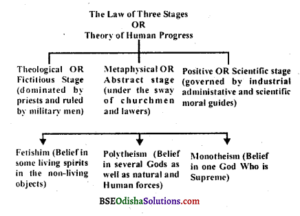
CHSE Odisha Class 11 Sociology Unit 5 Sociology, Methods and Techniques Short Answer Questions Q 2
The Theological or Fictitious stage:
The theological stage is the first and it characterised the world prior to 1300. Here all theoretical conceptions, whether general or special bear a supernatural impress. At this level of thinking there is a marked lack of logical and orderly thinking. Overall the theological thinking implies belief in super natural power.

Metaphysical or Abstract Stage: The metaphysical stage started about 1300 A.D. and was short lived roughly till 1800. It forms a link and is mongrel and transitional. It is almost an extension of theological thinking. It corresponds very roughly to the middle Ages and Renaissance.

It was under the sway of churchmen and lawyers. This stage was characterised by Defence. Here mind pre-supposes abstract forces. ‘Meta’ means beyond and physical means material world.

Supernatural being is replaced by supernatural force. This is in form of essences, ideas and forms. Rationalism started growing instead of imagination.

The Positive or Scientific stage: Finally in 1800 the world entered the positivistic stage. The positive stage represents the scientific way of thinking. Positive thought ushers in an industrial age.

The positive or scientific knowledge is based upon facts and these facts are gathered by observation and experience. All phenomena are seen as subject to natural laws that can be investigated by observations and experimentation.

Question 3.
What is The Theological or Fictitious stage?
Answer:
The theological stage is the first and it characterised the world prior to 1300. Here all theoretical conceptions, whether General or special bear a supernatural impress.

At this level of thinking there is a marked lack of logical and orderly thinking. Overall the theological thinking implies belief in super natural power.

This type of thinking is found among the primitive races. In theological stage, all natural phenomena and social events were explained in terms of super natural forces and deities, which ultimately explaining everything as the product of God’s will. This stage is dominated by priests and ruled by military men.

Human mind is dominated by sentiments, feelings and emotions. Every phenomenon was believed to be the result of immediate actions of super-natural beings. Explanations take the form of myths concerning spirits and super natural beings.

Man seeks the essential nature of all beings, first and final causes, origins and purposes of all effects and the overriding belief that all things are caused by super natural beings. Theology means discourse in religion. Religion dominates in this state of development.

This state is characterised by conquest. The theological—military society was basically dying. Priests were endowed with intellectual and spiritual power, while military exercised temporal authority.

It has three sub-stages:
Fetishism:
‘Fetish’ means inanimate and ‘is’m’ means philosophy. This is a philosophy which believes that super natural power dwells in inanimate object. Fetishism as a form of religion started which admitted of no priesthood.

When everything in nature is thought to be imbued with life analogous to our own, pieces of wood, stone, skull etc. are believed to be the dwelling place of super natural powers, as these objects are believed to possess divine power.

But too many fetishes created confusion for people. Hence they started believing in several gods. Thus arose polytheism.

Polytheism:
‘Poly’ means many. So the belief in many Gods is called polytheism. Human being received variety or diversity of natural phenomena. Each phenomenon was kept under the disposal of one God.

One God was believed to be in charge of one particular natural phenomenon. In polytheism, there is an unrestrained imagination person the world with innumerable Gods and spirits.

People created the class of priests to get the goodwill and the blessings of these gods. The presence of too many gods also created for them mental contradictions. Finally they developed the idea of one God, i.e. monotheism.

Monotheism:
It means belief in one single God. He is all in all. He controls everything in this world. He is the maker of human destiny. Monotheism is the climax of the theological stage of thinking.

The monotheistic thinking symbolizes the victory of human intellect and reason over non-intellectual and irrational thinking. Slowly feelings and imaginations started giving place to thinking and rationality.

In monotheism a simplification of many gods into one God takes place, largely in the service of awakening reason, which qualifies and exercises constraint upon the imagination.

In theological stage, soldiers, kings, priests etc. were given respect in the society. Everything was considered in terms of family welfare. Love and affection bonded the members of a family together.

In this stage social organisation is predominantly of a military nature. It is the military power which provides the basis of social stability and conquest which enlarges the bounds of social life.

Intellectual phase Material phase Type of social unit Type of Order Prevailing sentiment
Theological phase Military The Family Domestic Order Attachment & Affection
Mcta-physical Phase Legalistic The State Collective Order Veberation (Awe or Respect)
Positive Phase Industrial Race(Humanity) Universal Order Benevolence

(a) Progress is observable in all aspects of society: physical, moral, intellectual and political.
(b) The intellectual is the most important. History is dominated by the development of ideas leading to changes in other areas.
(c) Auguste Comte says on the “Co-relations” between basic intellectual stages and stages of material development, types of social units, types of social order and sentiments.

Question 4.
What is Metaphysical or Abstract Stage?
Answer:
The metaphysical stage started about 1300 A.D. and was short lived roughly till 1800. It forms a link and is mongrel and transitional. It is almost an extension of theological thinking. It corresponds very roughly to the middle Ages and Renaissance.

It was under the sway of churchmen and lawyers. This stage was characterised by Defence. Here mind pre-supposes abstract forces. ‘Meta’ means beyond and physical means material world.

Supernatural being is replaced by supernatural force. This is in form of essences, ideas and forms. Rationalism started growing instead of imagination.

Rationalism states that God does not stand directly behind every phenomenon. Pure reasoning insists that God is an Abstract being. Under metaphysical thinking it is believed that an abstract power or force guides and determines the events in the world.

Metaphysical thinking discards belief in concrete God. It is characterised by the dominance of “ratiocination.”

In metaphysical stage speculative thought is unchecked by any other principle. Human body was considered to be the spark of divinity. This kind of thinking corresponded with the legal type of society; and law, lawyers and churchmen dominated the society; Law remained under the control of the state.

CHSE Odisha Class 11 Sociology Unit 5 Sociology, Methods and Techniques Short Answer Questions

Question 5.
What is The Positive or Scientific stage?
Answer:
Finally in 1800 the world entered the positivistic stage. The positive stage represents the scientific way of thinking. Positive thought ushers in an industrial age.

The positive or scientific knowledge is based upon facts and these facts are gathered by observation and experience. All phenomena are seen as subject to natural laws that can be investigated by observations and experimentation.

The drawn of the 19th Century marked the beginning of the positive stage in which observation predominates over imagination. All theoretical concepts have become positive.

The concept of God is totally vanished from human mind. Human mind tries to establish cause and affect relationship. Mind is actually in search of final and ultimate cause.

The scientific thinking is thoroughly rational and there is no place for any belief or superstition in it. This stage is governed by industrial administrators and scientific moral guides. At this stage of thought, men reject all supposed explanations in terms either of Gods or essences as useless.

They cease to seek ‘original causes’ or ‘final ends’. This stage is dominated by the entrepreneurs, technologists etc. Unit of society was confined to the mankind as a whole, vision of mind was broad and there is no parochial feeling. Kindness, sympathy etc to the cause of the humanity prevailed.

This is the ultimate stage in a series of successive transformations. The new system is built upon the destruction of the old; with evolution, come progress and emancipation of human mind.

Human history is the history of a single man, Comte, because the progress of the man mind gives unity to the entire history of society. For Comte, all knowledge is inescapably human knowledge; a systematic ordering of propositions concerning our human experience of the world.

Corresponding to the three stages of mental progress; Comte identified two major types of societies. The theological-military society which was dying, the scientific-industrial society which was being born during his life time.

Flere the main stress is on the transformation of the material resources of the earth for human benefit and the production of material inventions. In this positive or scientific stage the great thought blends itself with great power.

Question 6.
Comte’s law of three stages have been criticized by different philosophers and sociologists. Discuss?
Answer:
According to Bogardus, Comte failed to postulate a fourth mode of thinking, i.e. socialized thinking, a system of thought which would emphasize the purpose of building the constructive, just and harmonious societies.

Bogardus also says, Comte however, should be credited with opening the way for rise of socialized thinking.

According to Prof. N.S. Timasheff, Comte’s law of three stages could not stand the test of facts. He opines, “Neither the later approaches (metaphysical and scientific) wholly supersedes the religious approach; rather there has been accumulation and often admixture of the three”.

C.E. Vaughan has said, “But its foundation is purely negative and destructive. It is powerless to construct and when credited with the ability to do so, it brings forth nothing but anarchy and bloodshed.”

CHSE Odisha Class 11 Sociology Unit 5 Sociology, Methods and Techniques Short Answer Questions

Question 7.
Discuss the Emile Durkheim Suicide and its stages?
Answer:
Suicide, written by French sociologist Emile Durkheim in 1897, was a groundbreaking book in the field of sociology. It was a case study of suicide, a publication unique for its time that provided an example of what the sociological monograph should look like.

In it, Durkheim explored the differing suicide rates among Protestants and Catholics, arguing that stronger social control among Catholics results in lower suicide rates.

He also found that suicide rates were higher among men than women, higher for those who are single than those who are married, higher for people without children than people with children, higher among soldiers than civilians, and higher at times of peace than in times of war.

Durkheim was the first to argue that the causes of suicide were to be found in social factors and not individual personalities. Observing that the rate of suicide varied with time and place, Durkheim looked for causes linked to these factors other than emotional stress.

He looked at the degree to which people feel integrated into the structure of society and their social surroundings as social factors producing suicide and argued that suicide rates are affected by the different social contexts in which they emerge. Durkheim also distinguished between three types of suicide:

Anomic Suicide: Anomic suicide happens when the disintegrating forces in the society make individuals feel lost or alone. Teenage suicide is usually cited as an example of this type of suicide, as is suicide committed by those who have been sexually abused as children or whose parents are alcoholics.

Altruistic Suicide: Altruistic suicide happens when there is excessive regulation of individuals by social forces. An example is someone who commits suicide for the sake of a religious or political cause, such as the hijackers of the airplanes that crashed into the World Trade Centre, the Pentagon, and a field in Pennsylvania on 9/11/01.

People who commit altruistic suicide subordinate themselves to collective expectations, even when death is the result.

Egoistic Suicide: Egoistic suicide happens when people feel totally detached from society. Ordinarily, people are integrated into society by work roles, ties to family and community, and other social bonds.

When these bonds are weakened through retirement or loss of family and friends, the likelihood of egoistic suicide increases. Elderly people who lose these ties are the most susceptible to egoistic suicide.

CHSE Odisha Class 11 Sociology Unit 5 Sociology, Methods and Techniques Short Answer Questions

Question 8.
What is the Concept of Sanskritisation?
Answer:
The term ‘sanskritisation ’ was conceived by M.N. Srinivas. It helps to describe the process of cultural mobility in the traditional social structure of India. Srinivas found empirical evidence for constructing sanskritisation in his study of religion and society among Coorgs in Mysore.

Caste system in theory is a closed system. Movement upwards or downwards within it is inadmissible, although there is some movement in practice. Despite this limitation of caste system, the concept of ‘sanskritisation’ helps to explain social change within the caste system.
The term ‘sanskritisation’ was conceived by M.N. Srinivas.

It helps to describe the process of cultural mobility in the traditional social structure of India. Srinivas found empirical evidence for constructing sanskritisation in his study of religion and society among Coorgs in Mysore.

He found that “lower castes, in order to raise their position in the caste hierarchy, adopted some customs of the Brahmins and gave up some of their own, considered to be impure by the higher castes.

For instance, they gave up meat-eating, consumption of liquor and animal sacrifice to their deities; they imitated the Brahmins in matters of dress, food and rituals. By doing this, within a generation or so, they could claim higher positions in the hierarchy of caste”. M.N. Srinivas, initially defined sanskritisation to denote Brahminisation.

Later on, he replaced it by sanskritisation. Brahminisation was limited in its scope and did not include other models, of caste mobility. His findings of Coorgs, thus, were of a specific kind and did not include the other non-Brahmin castes, which were twice-born. The concept of sanskritisation redefined by M.N. Srinivas runs as below:

Sanskritisation is the process by which a Tow’ Hindu caste or tribal or other group changes its customs, rituals, ideology and way of life in the direction of a ‘high’ and, frequently, ‘twice-born’ caste.

Generally, such changes are followed by a claim to a higher position in the caste hierarchy than that traditionally conceded to the claimant caste by the local community. The claim is usually made over a period of time, in fact, a generation or two, before the ‘arrival’ is conceded.

Sanskritisation, in fact, is the process of cultural and social mobility within the framework of caste. In this case, the source of social change lies within the caste system. In other words, the source of social change is indigenous.

In terms of general sociology it is a process of socialisation wherein the lower castes socialise themselves with the customs, rituals and ideology of the higher castes, i.e., the twice-born castes of Brahmins, Rajputs and Banias.

The scope of sanskritisation also extends beyond the cast system. It includes non-caste groups also, such as tribals. For social change, the caste of a local place makes its model of imitation. This imitation model could be any twice-born caste. Yogendra Singh applies the redefined concept of sanskritisation to the ‘varna’ system.

He says that the central idea of Sanskritisation is that of hierarchy in caste system, theoretically represented by varna. There are four names, viz., the Brahmin, the Kshatriya, the Vaishya and the Shudra in the same hierarchical order, and all individual castes or sub-castes, with the exception of the untouchables, can be classified on the basis of varna into a hierarchical order.

The untouchables have traditionally been outside the varna hierarchy and form the lowest rung of the caste stratification.

Question 9.
Discuss the Characteristics of Sanskritisation.
Answer:
When the concept of Sanskritisation emerged in sociological literature in 1952, it created much academic uproar among social anthropologists and sociologists.

It was agreed that the concept is useful to analyse social change among villagers, especially in terms of cultural change.

Both Indian and foreign social anthropologists reacted to the usefulness of the concept on the basis of whatever is available in sociological research material, we give below a few of the basic characteristics of Sanskritisation:

1. It is a cultural paradigm: Ideas, beliefs, traditions, rituals, and things of this kind constitute the culture of a caste. When there is a change in these aspects of social life, it is a change in cultural life. Thus, Sanskritisation is a cultural change among the lower castes and non-caste groups.

2. Sanskritisation is a change directed to twice-born castes: Though, initially, Sanskritisation meant Brahmiriisation, later on, Srinivas included other models of higher castes for imitation.

It was Milton Singer (1964) who had drawn the attention of Srinivas by saying that there existed not one or two models of Sanskritisation but three if not four.

He said that the local version of Sanskritic Hinduism may use the four labels Brahmin, Kshatriya, Vaishya, and Shudra but the defining content of these labels varies with locality and needs to be empirically determined for any particular locality.

For instance, a particular village may ‘ imitate Brahmins as their model of change but looking at the historicity and contextuality, another village may decide on Kshatriya or Vaishya as their model. Brahmins not in all cases are homogeneous. Nor are the Kshatriyas.

There are Brahmins, such as the Kashmiri, Bengali, and Saraswat who are non-vegetarians. Similarly, there is variation among the Kshatriyas and Vaishyas.

It is, therefore, the local history and the contexts which determine the Sanskritic model for the lower castes. However, the Shudras do not make any model for imitation.

3. Sanskritisation also applies to tribals or non-caste groups: In his refined definition, Srinivas has stated that Sanskritisation is not confined to Hindu castes only but it also occurs among tribal and semi-tribal groups, such as the Bhils of western India, the Gonds and Oraons of central India, and the Paradise of the Himalayas.

These tribal groups claim to attain the status of a caste, i.e., to become a Hindu.

4. Sanskritic values, ideology, and beliefs belong to Indian tradition: When Srinivas talks of Sanskritisation of the lower castes, he has in his view the caste-Hindu traditions. Hinduism draws heavily from its scriptures, such as Ramayana, Mahabharata, Upanishads, and Brahmanas.

The values and beliefs held in these scriptures become the content material for the imitation of the lower castes. The Brahmins, i.e., the priestly caste, naturally interpret the traditions and, therefore, become the model of imitation for the lower castes.

Surely, the acquisition of wealth and power makes a group or person belonging to a caste, important. But, only wealth and power do not enhance the status of a caste.

The improvement in the ritual status can only help the lower caste to improve their hierarchy in the caste system. The imitation of the customs and habits of the higher caste, therefore, goes a long way in imparting Sanskritic status to the lower caste, if the latter has wealth and power.

5. Sanskritisation, in other words, also means teetotalism: Srinivas, to be fair to him, has always refined and redefined his understanding of Sanskritisation.

At a later stage, he found that the lower castes in Sanskritisation have a tendency to move higher in the caste hierarchy, and in a generation or two they could improve their status in the caste hierarchy by adopting vegetarianism and teetotalism.

Empirically no researcher has reported that a lower caste has improved its rank in the hierarchy despite having three generations.

Though there is no improvement in the rank it must be said that the lower castes have taken to the prohibition of alcoholism and many of the evils which traditionally characterized their caste.

CHSE Odisha Class 11 Foundations of Education Unit 4 Method of Teaching Maths Questions and Answers

Odisha State Board CHSE Odisha Class 11 Foundations of Education Solutions Unit 4 Method of Teaching Maths Questions and Answers.

CONCOR Pivot Point Calculator

CHSE Odisha 11th Class Foundations of Education Unit 4 Method of Teaching Maths Questions and Answers

Long Questions With Answers

Question 1.
Discuss the Aims and Objectives of teaching Mathematics.
Answer:
The knowledge of mathematics is very essential for everybody. The most important aims and objectives of mathematics are discussed below.

To develop the thinking and reasoning, power of the child:
The power of thinking and reasoning is very much essential for an. individual to lead a disciplined and well-adjusted life. These powers can be developed by knowing mathematics.

To provide a suitable discipline to the mind:
Mathematics knowledge makes the mind of the learners disciplined which is essential for leading a healthy social life.

To develop an art of living:
Mathematics prepares children for economic, purposeful, productive, creative, and constructive life. The children learn an act of effective living.

To acquaint the learners with cultures:
Mathematics is the backbone of culture. So by studying mathematics an individual becomes acquainted with his own culture. So cultural development is possible.

To prepare the pupil for various professions:
The children are prepared to enter into various professions of engineering, cashiers, statisticians, accountants, auditors, bankers, etc.

To prepare the students for various higher educational centers:
Mathematics forms the basis of many educational courses and as engineering physical science etc.

To develop the habits of concentration, self-reliance, and discovery:
The habits of concentration, self-reliance, and power to discover new things, new laws, and principles in students are created by mathematics.

To create a love for hard work:
Mathematics as a subject needs consistent hard work. This has helped the student to undertake hard work for a longer period.

Try Once:

INDIGO Pivot Point Calculator

CHSE Odisha Class 11 Foundations of Education Unit 4 Method of Teaching Maths Questions and Answers

Question 2.
Discuss briefly the inductive-deductive method of teaching mathematics. Bring a difference between the inductive and deductive methods.
Answer:
“Inductive-deductive method is the combination of two separate method-inductive and deductive methods.
Inductive method:-
The inductive method is based on induction. Induction is proving a universal truth or theorem by showing that if it is true of any particular case, it is also true for the next case in the same serial order. In this method, we proceed from particular to general, from concrete cases to abstract cases, and from specific to general formulas. In adopting this method, the students are required not to accept the already, discovered formula without knowing the formula by adopting inductive reasoning.

Example No.1:-
The students may be asked to construct a few triangles of various sizes and shapes. They may be asked to measure and sum the angle in each case. Then the sum will come to be the same in all cases. i.e, the sum in all cases will come to be two right angles. Hence, the students may conclude through induction that the sum of these angles of a triangle is equal to two right angles.

Example No.2:- Suppose we find out the simple interest of Rs. 400/- in four years at 5% per annum. It will be equal to Rs.80/-

Or, S.I=\(\frac{400 \times 5 \times 4}{100}\)=80.00

Similarly, the simple interest Rs. 500/- in a year at 6% per annum will be 90.00.

Or, S.I=\(\frac{500 \times 6 \times 3}{100}\)=90.00

From the above, two examples the students can evolve a rule that,

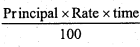
Simple Interest=

C:\Users\Shaheena\Desktop\Discuss briefly the inductive-deductive method of teaching mathematics Q2.png

S.I=\(\frac{\text { PRT }}{100}\)

Deductive Method :
The deduction is the chief generalized form. In this method, one follows deductive reasoning which is just the opposite of inductive reasoning. Abstract ideas are preceded by concrete experience. The students memorize the different formulas and then apply them to solve a particular problem.

Examples- If the teacher wants to teach the calculation of simple interest in the class the formula for calculating interest to the students.

i.e. S.L =\(\frac{\text { PRT }}{100}\)

Question 2.
Explain with examples the analytic and synthetic methods of teaching mathematics. What are the merits and demerits?
Answer:
Analytic Method:
Analytic means breaking up the problem in such a manner that it ultimately gets connected with some known. The method proceeds from known to known. The analysis is the process of unfolding the problem to know the hidden aspects. We have to begin with what is to be found out and then proceed to further steps and possibilities that may concern the unknown with the known, the desired result is found out.

Merits of Analytic Method:
The Analytic Method has the following merits.
It is a logical method that leaves no doubt and it convinces the learner. The steps are developed in a general manner. Each step has a reason and justification. It facilitates understanding and creates an urge to discover facts. As the students face questions is what a statement is into simple elements they grapple with the problem confidently and intelligently. He gains competencies and skills.

Demerits:

  • It is a lengthy method.
  • It is very difficult to acquire efficiency and speed.
  • It may not be applicable to all topics equally.

Example

If \(\frac{a}{b}=\frac{c}{d}\) prove that \(\frac{a c-2 b^2}{b}=\frac{c^2-2 b d}{d}\)

∴\(\frac{a c-2 b}{b}=\frac{c^2-2 b d}{d}\)

By cross multiplication

acd – 2b2d = be2 – 2b2d

Cancellation of the common quality -2b²d from both sides can further he canceled.
acd = bc2 will be true
If this is if ad = bc arranged in a more systematic form, ad = bc will be true.

\(\frac{\mathrm{a}}{\mathrm{b}}=\frac{\mathrm{c}}{\mathrm{d}}\) which is given is thus true.
So, we can say that,

\(\frac{\mathrm{ac}-\mathrm{b}^2}{\mathrm{~d}}=\frac{\mathrm{c}^2-2 \mathrm{bd}}{\mathrm{d}}\) is also true.

Synthetic Method :
The synthetic method is just the opposite of the analytic method. One has to proceed from known to unknown in this method. Synthesis implies the placing together of the parts to get the solution. One has to start from what is known as given and proceed toward the unknown part of the problem, thus, the unknown information becomes known and free. In practice, synthesis is complementary to analysis.

Merits :

  • This is a logical method.
  • It is short and elegant.
  • It glorifies memory.

Demerits :
It leaves a long number of doubts in minds of readers and offers no explanation for them. As the reader gets no satisfactory explanation for his doubts while solving the problem, he will be perplexed when faced with a need problem. He may not recall the steps of synthesis. There is no provision for a complete understanding of the method. Discovery and thinking have no place in this method. Memory work and homework are too heavy.

Example:
Let us take the same example.

\(\frac{a}{b}=\frac{c}{d}\) then prove that \(\frac{a-2 b^2}{b}=\frac{c^2-2 b d}{d}\)

We have to start with the given or known fact \(\frac{a}{b}=\frac{c}{d}\)

∴\(\frac{2 b}{c}\) be subtracted from both sides

∴\(\frac{a}{b}=\frac{2 b}{c}=\frac{c}{d}=\frac{2 b}{c}\)

Or, \(\frac{a c-2 b^2}{b c}=\frac{c^2-2 b d}{c d}\)

\(\frac{a-2 b^2}{b}=\frac{c^2-2 b d}{d}\)

(Cancelling from both sides)
Thus identity is proved.

CHSE Odisha Class 11 Foundations of Education Unit 4 Method of Teaching Maths Questions and Answers

Question 3.
Explain the problem-solving methods of teaching mathematics. What are the merits and demerits?
Answer:
The problem-solving method aims at presenting and repurposing the existence of problems in the teaching-learning situation. A problem is a sort of difficulty which has to be overcome to reach the goal. It may be a purely mental difficulty. The problem-solving methods aim at presenting the knowledge to be learned in the form of a problem.

It begins with a problematic situation and consists of continuous meaningful well-integrated activity. Mathematics is a subject of problems. Its teaching and learning depend on solving innumerable problems. Efficiency and ability in solving problems is a guarantee in learning this subject. The procedure of problem-solving is (almost like the project method. It can be taken the form of an inductive deductive method.

Steps to the situation :
Sensing the problem, interpreting, defining, and delimiting the problem. Gathering data in a systematic manner, organizing and evaluating the data, formulating tentative solutions, arriving at the true and correct solution, and verifying the results. It is a research-like method that involves scientific thinking as a process of learning.

How it is employed :
Suppose finding the volume of a cylinder is a problem before the class. Its formula is to be developed on the basis of the earlier formula for the volume of a thing while analyzing the problem it gets connected with the previous knowledge that the volume of any regular solid can be found by multiplying the area of its base with the height of the object.

The area of the base of the cylinder is found by the only known formula a new the results are checked. The solution to the problem and the result comes from the students. The teacher remains in the background and directs or guides the students from the position.

Merits of problem-solving method:
This method satisfies the laws of teaching. It involves reflective thinking. So it stimulates thinking and learning through self-effort, reasoning, and critical judgment in the students. It develops qualities of imitative and self-dependence in the students. It is a stimulating method, The problem is a challenge.

Once it is properly recognized it acts as a great motivating force and directs the students, attention, and activity. It serves individual differences. A student can solve any number of problems in a specific and make progress accordingly. It is especially suitable for mathematics which is a subject of problems. It develops desirable study habits in the students.

Limitations:
The process is purely literary. It only needs a mental solution. Life problems -need some physical activity also. All problems cannot be solved by this method. The method does not suit the students in lower classes. Teachers, the burden becomes heavy. Textbooks written in the traditional style do not help in the use of this method. There is an absence of suitable books for reference and guidance.

Question 4.
Discuss the steps in lesson planning.
Answer:
J.F. Herbert has suggested six important steps in planning a lesson. After his name, those steps are called “Herbartion” steps.
These six steps are:

  • Preparation
  • Introduction
  • Presentation
  • Recapitulation (comprehension)
  • Summarisation
  • Application

Preparation:
The teacher has to prepare himself and the students for the lesson. He has to formulate the objectives, select the content matters from the textbook, select the teaching aids and prepare the lesson accordingly.

Introduction:
The main purpose of the introduction is to motivate the pupils. The teacher has to test the previous knowledge of the students by asking some questions. Then the teacher can know the background knowledge is to be linked with the previous knowledge through the introduction. A teacher can introduce a reason by various means such as:-

  • asking question
  • showing pictures and models
  • citing an example
  • dramatization
  • quoting a dialogue

Presentation:
It is the most important step in the lesson. During this step, the teacher presents some new ideas to the pupils. Questioning discussion, demonstration of aids, active pupil participation, and blackboard work are some of the essential elements of the presentation. The objectives of the lesson determine the nature of the presentation.

Recapitulation:
The teacher should ascertain to what extent the students have understood the topic taught by him. To test their understanding and comprehension the teacher has to put some questions. On this topic, after the presentation is over, this will also help the teacher to know whether his teaching is effective or not.

Summarisation :
The teacher has to associate and generalize the subject matter taught in the lesson in forming a blackboard. Summary, a formula or a rule ‘or a skeleton chart of the important learning points. The step completes the presentation by providing the gist of the topic.

Application :
At this step, the students make use to acquire, knowledge in familiar situations. It tests the validity of the generalization, rule principles or formula arrived at by the pupils at the end of the topic. Through the application, the new knowledge acquired by the students is retained in their minds for a longer period.

CHSE Odisha Class 11 Foundations of Education Unit 4 Method of Teaching Maths Questions and Answers

Question 5.
Six aims and objectives of Mathematics:
Answer:
It develops the power of thinking and reasoning. It helps the child to solve mathematical problems. It develops the self-confidence and habit of concentration. To help the child to develop the power of expression, and appreciation. It enables the child to go through the transaction of coins. It helps the child to lead a career as an accountant, auditor, engineer, and scientist.

Question 6.
Analytic method:
Answer:

  • It proceeds from unknown to known.
  • It is a process of thinking.
  • It demands exploration.
  • It is a method for. thinkers and discoverers.
  • It develops originality.
  • It is informal, psychological, and based on heuristic lines.

Question 7.
Aids used in teaching mathematics:
Answer:
Visual aids:
Samples, umbrellas, stick-rounded things, dolls, toys, balloons, plates blackboard, models, etc.

Audio Aids:
Radio, gramophone, tape recorders, etc.

Audio-visual aids:
T.V. and films. Through these aids, subjects are taught by experts. These are effective aids in teaching mathematics.

Try:

CHSE Odisha Class 11 History Unit 1 Early Societies Long Answer Questions

Odisha State Board CHSE Odisha Class 11 History Solutions Unit 1 Early Societies Long Answer Questions.

CHSE Odisha 11th Class History Unit 1 Early Societies Long Answer Questions

Long Questions With Answers

Question 1.
Describe the classification of early humans.
Answer:
The remains of early humans have been classified into different species. These are often distinguished from one another on the basis of differences in bone structure. For instance, species of early humans are differentiated in terms of their skull size and distinctive jaws. These characteristics may have evolved due to what has been called the positive feedback mechanism.

For example, bipedaliSm enabled hands to be freed for carrying infants or objects. In turn, as hands were used more and more, upright walking gradually became more efficient. Apart from the advantage of freeing hands for various uses, far less energy is consumed while walking as compared to the movement of a quadruped.

However, the advantage in terms of saving energy is reversed while running. There is indirect evidence of bipedalism as early as 3.6 mya. This comes from the fossilised hominid footprints at Laetoli, Tanzania. Fossil limb bones recovered from Hadar, Ethiopia provides more direct evidence of bipedalism.

With the onset of a phase of glaciation (or an Ice Age), when large parts of the earth were covered with snow, there were major changes in climate and vegetation. Due to the reduction in temperatures as well as rainfall, grassland areas expanded at the expense of forests, leading to the gradual extinction of the early forms of Australopithecus (that were adapted to forests) and the replacement by species that were better adapted to the drier conditions.

Among these were the earliest representatives of the genus Homo. Homo is a Latin word, meaning ‘man’, although there were women as well. Scientists distinguish amongst several types of Homo. The names assigned to these species are derived from what is regarded as their typical characteristics.

So fossils are classified as Homo hails (the toolmaker), Homo erectus (the upright man), and Homo sapiens (the wise or thinking man). Fossils of Homo habilis have been discovered at Omo in Ethiopia and at Olduvai Gorge in Tanzania. The earliest fossils of Homo erectus have been found both in Africa and Asia: Koobi Fora, west Turkana, Kenya, Modjokerto and Sangiran, Java.

As the finds in Asia belong to a later date than those in Africa, it is likely that hominids migrated from East Africa to southern aid northern Africa, to southern and north-eastern Asia, and perhaps to Europe, sometime between 2 and 1.5 mya. This species survived for nearly a million years.

In some instances, the names of fossils are derived from the places where the first fossils of a particular type were found. So fossils found in Heidelberg, a city in Germany, were called Homo heidelbergensis, while those found in the Neander valley were categorised as Homo neanderthalensis. The earliest fossils from Europe are of Homo heidelbergensis and Homo neanderthalensis.

Both belong to the species of archaic (that is, old) Homo sapiens. The fossils of Homo heidelbergensis (0.8-0.1 mya) have a wide distribution, having been found in Africa, Asia and Europe. The Neanderthals occupied Europe and western and Central Asia from roughly 130,000 to 35,000 years ago. They disappeared abruptly in Western Europe around 35,000 years ago.

In general, compared with Australopithecus, Homo have a larger brain, jaws with a reduced outward protrusion and smaller teeth. An increase in brain size is associated with more intelligence and better memory. The changes in the jaws and teeth were probably related to differences in dietary habits.

CHSE Odisha Class 11 History Unit 1 Early Societies Long Answer Questions

Question 2.
How early did humans obtain their food?
Answer:
Early humans would have obtained food in a number of ways, such as gathering, hunting, scavenging and fishing. The gathering would involve collecting plant foods such as seeds, nuts, berries, fruits and tubers. That gathering was practised is generally assumed rather than conclusively established, as there is very little direct evidence for it.

While we get a fair amount of fossil bones, fossilised plant remains are relatively rare. The only other way of getting information about plant intake would be if plant remains were accidentally burnt. This process results in carbonisation. In this form, organic matter is preserved for a long span of time. However, so far archaeologists have not found much evidence of carbonised seeds for this very early period.

In recent years, the term hunting has been under discussion by scholars. Increasingly, it is being suggested that the early hominids scavenged or foraged for meat and marrow from the carcasses of animals that had died naturally or had been killed by other predators. It is equally possible that small mammals such as rodents, birds (and their eggs), reptiles and even insects (such as termites) were eaten by early hominids.

Hunting probably began later – about 5000 years ago. The earliest clear evidence for the deliberate, planned hunting and butchery of large mammals comes from two sites: Boxgrove in southern England (500,000 years ago) and Schoningen in Germany (400,000 years ago) Fishing was also important, as is evident from the discovery of fish bones at different sites.

Fishing was also important, as is evident from the discovery of fish bones at different sites. From about 3 5,000 years ago, there is evidence of planned hunting from some European sites. Some sites, such as (Dolni Vestontee) in the Czech Republic, which was near a river, seem to have been deliberately chosen by early people.

Herds of migratory animals such as reindeer and horses probably crossed the river during their autumn and spring migrations and were killed on a large scale. The choice of such sites indicates that people knew about the movement of these animals and also about the means of killing large numbers of animals quickly.

Question 3.
How early did humans make their tools?
Answer:
Birds are known to make objects to assist them with feeding, hygiene and social encounters and while foraging for food some chimpanzees use tools that they have made. However, there are some features of human tool-making that are not known among apes. As we have seen certain anatomical and neurological (related to the nervous system) adaptations have led to the skilled use of hands, probably due to the important role of tools in human lives.

Moreover, the ways in which humans use and make tools often require greater memory and complex organisational skills, both of which are absent in apes. The earliest evidence for the making and use of stone tools comes from sites in Ethiopia and Kenya. It is likely that the earliest stone tool makers were the Australopithecus.

As in the case of other activities, we do not know whether tool-making was done by men or women or both. It is possible that stone toolmakers were both women and men. Women in particular may have made and used tools to obtain food for themselves as well as to sustain their children after weaning.

About 35,000 years ago, improvements in the techniques for killing animals are evident from the appearance of new kinds of tools such as spear-throwers and the bow and arrow. The meat thus obtained was probably by drying, smoking and storage. Thus, food processed by removing the bones followed and could be stored for later consumption.

There were other changes, such as the trapping of fur-bearing animals (to use the fur’ for clothing) and the invention of sewing needles. The earliest evidence of sewn clothing comes from about 21,000 years ago. Besides, with the introduction of the punch blade technique to make small chisel-like tools, it was now possible to make engravings on bone, antler, ivory or wood.

CHSE Odisha Class 11 History Unit 1 Early Societies Long Answer Questions

Question 4.
What was the way people communicates in early times?
Answer:
Among living beings, it is humans alone that have a language. There are several views on language development:

  • that hominid language involved gestures or hand movements
  • that spoken language was preceded, by vocal but non-verbal communication such as singing or humming
  • that human speech probably began with calls like the ones that have been observed among primates.

Humans may have possessed a small number of speech sounds in the initial stage. Gradually, these may have developed into language. It has been suggested that the brain of Homo habilis had certain features which would have made it possible for them to speak. Thus, language may have developed as early as 2 mya.

The evolution of the vocal tract was equally important. This occurred around 2000 years ago. It is more specifically associated with modem humans. A third suggestion is that language developed around the same time as art, that is, around 40,000-35,000 years ago. The development of spoken language has been seen as closely connected with art since both are media for communication.

Hundreds of paintings of animals (done between 30,000 and 12,000 years ago) have been discovered in the caves of Lascaux and Chauvet, both in France and Altamira, in Spain. These include depictions of bison, horses, ibex, deer, mammoths, rhinos, lions, bears, panthers, hyenas and owls. More questions have been raised than answered regarding these paintings.

For example, why do some areas of caves have paintings and not others? Why were some animals painted and not others? Why were men painted both individually and in groups, whereas women were depicted only in groups? Why were men painted near animals but never women? Why were groups of animals painted in the sections of caves where sounds carried well? Several explanations have been offered.

One is that because of the importance of hunting, the paintings of animals were associated with ritual and magic. The act of painting could have been a ritual to ensure a successful hunt. Another explanation offered is that these caves were possibly meeting places for small groups of people or locations for group activities.

These groups could share hunting techniques and knowledge, while paintings and engravings served as the media for passing information from one generation to the next. The above account of early societies has been based on archaeological evidence. Clearly, there is much that we still do not know. As mentioned at the beginning of this chapter, hunter-gatherer societies exist even today.

Question 5.
Who is known as the hunter-gather society in early times?
Answer:
African pastoral group about its initial contact in 1870 with the Kung an, a hunter-gatherer society living in the Kalahari desert:
When we first came into this area, all we saw were strange footprints in the sand. We wondered what kind of people these were. They were very afraid of us and would hide whenever we came around.

We found their villages, but they were always empty because as soon as they saw strangers coming, they would scatter and hide in the bush. We said: ‘Oh, this is good; these people are afraid of us, they are weak and we can easily rule over them.’ So we just ruled them. There was no killing or fighting. You will read more about encounters with hunter-gatherers in Themes 8 and 10.

CHSE Odisha Class 11 History Unit 1 Early Societies Long Answer Questions

Question 6.
Who are the Hadza?
Answer:
The Hadza are a small group of hunters and gatherers, living in the vicinity of Lake Eyasi, a salt, rift-valley lake. The country of the eastern Hadza, dry, rocky savanna, dominated by thorn scrub and acacia trees is rich in wild foods. Animals are exceptionally numerous and were certainly commoner at the beginning of the century.

Elephants, rhinoceros, buffalo, giraffes, zebra, waterbuck, gazelle, warthog, baboon, lion, leopards, and hyenas are all common, as are smaller animals such as porcupines, hares, jackals, tortoises and many others. All of these animals, apart from the elephant, are hunted and eaten by the Hadza.

The amount of meat that could be regularly eaten without endangering the future of the game is probably greater than anywhere else in the world were hunters and gatherers live or have lived in the recent past. Vegetable food – roots, berries, the fruit of the baobab tree, etc. – though not often obvious to the casual observer, is always abundant even at the height of the dry season in a year of drought.

The type of vegetable food available is different in the six-month wet season from the dry season but there is no period of shortage. The honey and grubs of seven species of wild bees are eaten supplies of these vary from season to season and from year to year. Sources of water are widely distributed over the country in the wet season but are very few in the dry season.

The Hadza consider that about 5-6 kilometres are the maximum distance over which water can reasonably be carried and camps are normally sited within a kilometre of a water course. Part of the country consists of open grass plains but the Hadza never build camps there. Camps are invariably sited among trees or rocks and, by preference, among both.

The eastern Hadza assert no rights over land and its resources. Any individual may live wherever he likes and may hunt animals, collect roots, berries, and honey and draw water anywhere in Hadza country without any sort of restriction. In spite of the exceptional numbers of game animals in their area, the Hadza rely mainly on the wild vegetable matter for their food.

Probably as much as 80 per cent of their food by weight is vegetable, while meat and honey together account for the remaining 20 per cent. Camps are commonly small and widely dispersed in the wet season, large and concentrated near the few available sources of water in the dry season. There is never any shortage of food even in times of drought.

Question 7.
Discuss the Hunter-Gatherer Societies from the present to the past.
Answer:
As our knowledge of present-day hunter-gatherers increased through studies by anthropologists, a question that began to be posed was whether the information about living hunters and gatherers could be used to understand past societies. Currently, there are two opposing views on this issue.

On one side are scholars who have directly applied specific data from present-day hunter-gatherer societies to interpret the archaeological remains of the past. For example, some archaeologists have suggested that the hominids, sites, dating to 2 mya, along the margins of Lake Turkana could have been dry season camps of early humans, because such a practice has been observed among the Hadza and the Kung San.

On the other side are scholars who feel that ethnographic data cannot be used for understanding past societies as the two are totally different. For instance, present-day hunter-gatherer societies pursue several other economic activities along with hunting and gathering. These include engaging in exchange and trade in minor forest produce or working as paid labourers in the fields of neighbouring farmers.

Moreover, these societies are totally marginalised in all senses -geographically, politically and socially. The conditions in which they live are very different from those of early humans. Another problem is that there is a tremendous variation amongst living hunter-gatherer societies. There are conflicting data on many issues such as the relative importance of hunting and gathering, group sizes, or the movement from place to place.

Also, there is little consensus regarding the division of labour in food procurement. Although today generally women gather and men hunt, there are societies where both women and men hunt and gather and make tools. In any case, the important role of women in contributing to the food supply in such societies cannot be denied.

It is perhaps this factor that ensures a relatively equal role for both women and men in present-day hunter-gatherer societies, although there are variations. While this may be the case today, it is difficult to make any such inference from the past.

CHSE Odisha Class 11 History Unit 1 Early Societies Long Answer Questions

Question 8.
How farming has started in early times?
Answer:
For several million years, humans lived by hunting wild animals and gathering wild plants. Then, between 10,000 and 4,500 years ago, people in different parts of the world learnt to domesticate certain plants and animals. This led to the development of farming and pastoralism as a way of life. The shift from foraging to fanning was a major turning point in human history.

Why did this change take place at this point in time? The last ice age came to an end about 130 years ago and with that warmer, wetter conditions prevailed. As a result, conditions were favourable for the growth of grasses such as wild barley and wheat. At the same time, as open forests and grasslands expanded, the population of certain animal species such as wild sheep, goats, cattle, pigs and donkeys increased.

What we find is that human societies began to gradually prefer areas that had an abundance of wild grasses and animals. Now relatively large, permanent communities occupied such areas for most parts of the year. With some areas being clearly preferred, pressure may have built up to increase the food supply. This may Have triggered the process of domestication of certain plants and animals.

It is likely that a combination of factors which included climatic change, population pressure, a greater reliance on and knowledge of a few species of plants (such as wheat, barley, rice and millet) and animals (such as sheep, goat, cattle, donkey and pig) played a role in this transformation.

One such area Where farming and pastoralism began around 10,00t) years ago was the Fertile Crescent, extending from the Mediterranean coast to the Zagros mountains in Iran. With the introduction of agriculture, more people began to stay in one place for even longer periods than they had done before. Thus permanent houses began to be built of mud, mud bricks and even stone. These are some of the earliest villages known to archaeologists.

Farming and pastoralism led to the introduction of many other changes such as the making of pots in which to store grain and other produce and to cook food. Besides, new kinds of stone tools came into use. Other new tools such as the plough were used in agriculture. Gradually, people became familiar with metals such as copper and tin. The wheel, important for both pot making and transportation, came into use.

Question 9.
Discuss Mesopotamia and its Geography.
Answer:
Iraq is left of diverse environments. In the northeast lie green, undulating plains, gradually rising to tree-covered mountain ranges with clear streams and wildflowers, with enough rainfall to grow crops. Here, agriculture began between 7000 and 6000 BCE. In the north, there is a stretch of upland called a steppe, where animal herding offers people a better livelihood than agriculture – after the winter rains, sheep and goats feed on the grasses and low shrubs that grow here.

To the east, tributaries of the Tigris provide routes of communication into the mountains of Iran. The south is a desert – and this is where the first cities and writing emerged (see below). This desert could support cities because the rivers Euphrates and Tigris, which rise in the northern mountains, carry loads of silt (fine mud).

When they flood or when their water is let out onto the fields, fertile silt is deposited. After the Euphrates has entered the desert, its water flows out into small channels. These channels flood their banks and, in the past, functioned as irrigation canals: water could be let into the fields of wheat, barley, peas or lentils when necessary.

Of all ancient systems, that of the Roman Empire (Theme 3) included, it was the agriculture of southern Mesopotamia that was the most productive, even though the region did not have sufficient rainfall to grow crops. Not only agriculture but Mesopotamian sheep and goats also grazed on the steppe, the northeastern plains and the mountain slopes (that is, on tracts too high for the rivers to flood and fertilise).

Produced meat, milk and wool in abundance, Further, fish was available in rivers and date palms gave fruit in summer. Let us not, however, make the mistake of thinking that cities grew simply because of rural prosperity. We shall discuss other factors by and by, but first, let us be clear about city life.

CHSE Odisha Class 11 History Unit 1 Early Societies Long Answer Questions

Question 10.
How the development of writing takes place in Mesopotamia civilizations?
Answer:
All societies have languages in which certain spoken sounds convey certain meanings. This is verbal communication. Writing too is verbal communication – but in a different way. When we talk about writing or a script, we mean that spoken sounds are represented in visible signs. The first Mesopotamian tablets, written around 3200 BCE, contained picture-like signs and numbers.

These were about 5,000 lists of oxen, fish, bread loaves, etc. lists of goods that were brought into or distributed from the temples of Uruk, a city in the south. Clearly, writing began when society needed to keep records of transactions because in city life transactions occurred at different times and involved many people and a variety of goods.

Mesopotamians wrote on tablets of clay. A scribe would wet clay and pat it into a size he could hold comfortably in one hand. He would carefully smoothen its surfaces. With the sharp end of the agreed cut obliquely, he would press wedge-shaped cuneiform signs onto the smoothened surface while it was still moist.

Once dried in the sun, the clay would harden and tablets would be almost as indestructible as pottery. When a written record of, say, the delivery of pieces of metal had ceased to be relevant, the tablet was thrown away. Once the surface dried, signs could not be pressed onto a tablet: so each transaction, however minor, required a separate written tablet.

This is why tablets occur by the hundreds at Mesopotamian sites. And it is because of this wealth of sources that we know so much more about Mesopotamia than we do about contemporary India. By 2600 BCE or so, the letters became cuneiform and the language was Sumerian.

The writing was now used not only for keeping records, but also for making dictionaries, giving legal validity to land transfers, narrating the deeds of kings, and announcing the changes a king had made in the customary laws of the land. Sumerian, the earliest known language of Mesopotamia, was gradually replaced after 2400 BCE by the Akkadian language. Cuneiform writing in the Akkadian language continued in use until the first century CE, that is, for more than 2,000 years.

Question 11.
Discuss the temples and kings in Mesopotamia as a civilization.
Answer:
Early settlers (their origins are unknown) began to build and rebuild temples at selected spots in their villages. The earliest known temple was a small shrine made of unbaked bricks. Temples were the residences of various gods of the Moon God of Ur, or of manna the Goddess of Love and War.

Constructed in brick, temples became larger over time, with Several rooms around open courtyards. Some of the early ones were possibly not unlike the ordinary house for the temple was the house of a god. But temples always had their outer walls going in and out at regular intervals, which no ordinary building ever did.

The god was the focus of worship to his or her people and brought grain, curd and fish (the floors of some early temples had thick layers of fish bones). The god was also the theoretical owner of the agricultural fields, the fisheries, and the herds of the local community. In time, the processing of produce (for example, oil pressing, grain grinding, spinning, and the weaving of woollen cloth) was also done in the temple.

The organiser of production at a level above the household, employer of merchants and keeper of written records of distributions and allotments of grain, plough animals, bread, beer, fish, etc., the temple gradually developed its activities and became the main urban institution.

CHSE Odisha Class 11 History Unit 1 Early Societies Long Answer Questions

Question 12.
What is a family system in Mesopotamia civilization?
Answer:
In Mesopotamian society, the nuclear family was the norm, although a married son and his family often resided with his parents. The father was the head ofthe family. We know a little about the procedures for marriage. A declaration was made about the willingness to marry, and the bride’s parents gave their consent to the marriage.

Then a gift was given by the groom’s people to the bride’s people. When the wedding took place, gifts were exchanged by both parties, who ate together and made offerings in a temple. When her mother-in-law came to fetch her, the bride was given her share of the inheritance by her father. The father’s house, herds, fields, etc., were inherited by the sons.

Abstract Archaeologists have made attempts to reconstruct the lives of early people to find out about the shelters in which they lived, the food they ate by gathering plant produce and hunting animals, and the ways in which they expressed themselves. Other important developments include the use of fire and of language.

And, finally, you will see whether the lives of people who live by hunting and gathering today can help us to understand the past. The second theme deals with some of the earliest cities of Mesopotamia, present-day Iraq. These cities developed around temples and were centres of long-distance trade.

Archaeological evidence remains of old settlements and an abundance of written material are used to reconstruct the lives of the different people who lived there craftspeople, scribes, labourers, priests, kings and queens. You will notice how pastoral people played an important role in some of these towns.

A question to think about is whether the many activities that went on in cities would have been possible if the writing had not developed. You may wonder how people who for millions of years had lived in forests, in caves or in temporary shelters began to eventually live in villages and cities.

Well, the story is a long one and is related to several developments that took place at least 5,000 years before the establishment ofthe first cities. One ofthe most far-reaching changes was the gradual shift from nomadic life to settled agriculture, which began around 10,000 years ago. As you will see in Theme 1, prior to the adoption of agriculture, people gathered plants to produce as a source of food.

Slowly, they learnt more about different kinds of plants – where they grew, the seasons when they bore fruit and so on. From this, they learnt to grow plants. In West Asia, wheat and barley, peas and various kinds of pulses were grown. In East and Southeast Asia, the crops that grew easily were millet and rice. Millet was also grown in Africa.

Around the same time, people learnt how to domesticate animals such as sheep, goats, cattle, pigs and donkeys. Plant fibres such as cotton and flax and animal fibres such as wool were now woven into cloth. Somewhat later, about 5,000 years ago, domesticated animals such as cattle and donkeys were harnessed to ploughs and carts.

These developments led to other changes as well. When people grew crops, they had to stay in the same place till the crops ripened. So, settled life became more common. And with that, people built more permanent structures in which to live. This was also the time when some communities learnt how to make earthen pots.

These were used to store grain and other produce, and to prepare and cook a variety of foods made from the new grains that were cultivated. In fact, a great deal of attention was given to processing foods to make them tasty and digestible. The way stone tools were made also changed.

While earlier methods of making tools continued, some tools and equipment were now smoothened and polished by an elaborate process of grinding. New equipment included mortars and pestles for preparing grain, as well as stone axes and hoes, which were used to clear land for cultivation, as well as for digging the earth to sow seeds.

In some areas, people learnt to tap the ores of metals such as copper and tin. Sometimes, copper ores were collected and used for their distinctive bluish-green colour. This prepared the way for the more extensive use of metal for jewellery and for tools subsequently. There was also a growing familiarity with other kinds of produce from distant lands (and seas).

This included wood, stones, including precious and semi-precious stones, metals and shells, and hardened volcanic lava. Clearly, people were going from place to place, carrying goods and ideas with them. With increasing trade, the growth of villages and towns, and the movements of people, in place of the small communities of early people there now grew small states.

While these changes took place slowly, over several thousand years, the pace quickened with the growth of the first cities. Also, the changes had far-reaching consequences. Some scholars have, described this as a revolution, as the lives of people were probably transformed beyond recognition.

Look out for continuities and changes as you explore these two contrasting themes in early history. Remember too, that we have selected only some examples of early societies for detailed study. There were other kinds of early societies, including farming communities and pastoral peoples. And there were other peoples who were hunter-gatherers as well as city dwellers, apart from the examples selected.

Peopling Of The World

When

Where

Who

5-1 Sub-Saharan Africa Australopithecus, early Homo, Homo erectus
1 mya-40,000 years ago Africa, Asia and Europe in mid-latitudes Homo erectus, archaic Homo sapiens, Neanderthals, Homo sapiens sapiens /modern humans
45,000 years ago Australia Modern Humans
40,000 years ago to present Europe in high latitudes and Asia- Pacific islands
North and South America in deserts, rainforests
Late Neanderthals, modern humans


The Earliest Fossils Of Modern Humans
Where When (Years Ago)
Ethiopia
Omo Kibish
195,000-160,000
South Africa
Border Cave
Die Kelders
KJasiersRiver Mouth
120,000-50,000
Morocco
Dar es Saltan
70,000-50,000
Israel
QafzehSkhul
100,000-80,000
Australia
Lake Mungo
  45,000-35,000
Borneo
Niah Cave
40,000
France
Cro-Magnon,
near Les Eyzles
35,000

What is a family system in Mesopotamia civilization Q12

What is a family system in Mesopotamia civilization Q12 1.2

              Timeline 1(mya)

36-24 mya Primates
Monkeys in Asia and Africa
24 mya (Superfamily) Hominoids;
Gibbons, Asian orang-utan and African apes (gorilla, chimpanzee and bonobo or ‘pygmy’ chimpanzee)
6.4 mya Branching out of hominoids and hominids
5.6 mya Australopithecus
2.6-2.5 Earliest stone tools
2.5-2.0 Cooling and drying of Africa, resulting in a decrease in woodlands and an increase in grasslands
2.5-2.0 mya Homo
2.2 mya Homohabilis
1.8 mya Homo erectus
1.3 mya Extinction of Australopithecus
0.8 mya ‘Archatic’ sapiens, Homo heidelbergensis
0.19-0.16 mya Homo sapiens sapiens (modem humans)


                                                                     Timeline 2 (years ago)
The earliest evidence of burials 300,00
Extinction of Homo erectus 200,000
Development of voice box 200,000
Archaic Homo sapiens skull in the Narmada valley, India 200,000-130,000
The emergence of modem humans 195,000-160,000
Emergence of Neanderthals 130,000
The earliest evidence of hearths 125,000
Extinction of Neanderthals 35,000
The earliest evidence of figures made of fired clay 27,000
The invention of sewing needles 21,000

Writing and City Life:
City life began in Mesopotamia, the land between the Euphrates and the Tigris rivers that is now part of the Republic of Iraq Mesopotamian civilisation is “known for its prosperity, city life, its voluminous and rich literature and Us mathematics and astronomy. Mesopotamia’s writing system and literature spread to the eastern Mediterranean, northern Syria, and Turkey after 2000 BCE, so the kingdoms of that entire region were writing to one another, arid to the Pharaoh of Egypt, in the language and script of Mesopotamia.

Here we shall explore the connection between city life and writing, and then look at some outcomes of a sustained tradition of writing. At the beginning of recorded history, the land, mainly the urbanised south (see discussion below), was called Sumer and Akkad. After 2000 BCE, when Babylon became an important city, the term Babylonia was used for the southern region. From about 1100 BCE, when the Assyrians established their kingdom in the north, the, region became, known as Assyria.

The first known language of the land was Sumerian. It was gradually replaced by Akkadian around 2400 BCE when Akkadian speakers arrived. This language flourished till about Alexander’s-time (316 – 323 BCE)with some regional changes occurring. From 1400 BCE, Aromatic also trickled in. This language, similar to Hebrew, became widely spoken after 1000 BCE. It is still spoken in parts of Iraq.

What is a family system in Mesopotamia civilization Q12 1.3
Excavation Mesopotamian Towns:
Today, Mesopotamian excavators have much higher standards of accuracy and care in recording than in the old days, so few dig huge areas the way Ur was excavated. Moreover, few archaeologists have the funds to employ large teams of excavators. Thus, the mode of obtaining data has changed. Take the small at Abu Salabikh, about 10 hectares in area in 2500 BCE with a population of less than 10,000.

The outlines of walls were first traced by scraping surfaces. This involves scraping off the top few millimetres of the mound with the sharp and wide end of a shovel or other tool. While the soil underneath was still slightly moist, the archaeologist could make out different colours, textures and lines of brick walls or pits or other features. A few houses that were discovered were excavated.

The archaeologists also sieved through tons of earth to recover plant and animal remains and in the process identified many species of plants and animals and found large quantities of charred fish bones that had been swept out onto the streets. Plant seeds and fibre remained after during cakes had been burned as fuel and thus kitchens were identified. Living rooms were those with fewer traces.

Because they’d found the teeth of very young pigs on the streets, archaeologists concluded that pigs must have roamed freely here as in any other Mesopotamian town. In fact, one house burial contained some pig bones – the dead person must have been given some park for his nourishment in the afterlife! The archaeologists also made microscopic studies of room floors to decide which rooms in a house were roofed (with poplar logs, palm leaves, straw, etc.) and which were open to the sky.

TIMELINE
C. 7000-6000 BCE Beginning of agriculture in the northern Mesopotamian plains.
C.5000 BCE The earliest temples in southern Mesopotamia were built.
C. 3000 BCE First writing in Mesopotamia
C. 3000 BCE Uruk develops into a huge city, increasing the use of bronze tools
C. 2700-2500 BCE Early kings, including, possibly, the legendary male Gilgamesh
C. 2600 BCE Development of the cuneiform script
C. 2400 BCE Replacement of Sumerian by Akkadian
C. 370 BCE Sargon, king of Akkad
C. 2000 BCE Spread of cuneiform writing to Syria, Turkey and Egypt; Mari and Babylon emerge as important urban centres
C. 1800 BCE Mathematical texts composed; Sumerian no longer spoken
C. 1100 BCE Establishment of the Assyrian kingdom
C. 1000 BCE Use of iron
720-610 BCE Assyrian empire
668 – 627 BCE Rule of Assurbanipal
331 BCE Alexander conquers Babylon
C. 1st Century CE Akkadian and cuneiform remain in use
1850s Decipherment of the cuneiform script

CHSE Odisha Class 11 Psychology Unit 4 Process of Thinking Objective Questions

Odisha State Board CHSE Odisha Class 11 Psychology Solutions Unit 4 Process of Thinking Objective Questions.

CHSE Odisha 11th Class Psychology Unit 4 Process of Thinking Objective Questions

Multiple Choice Questions With Answers

Question 1.
Drawing a mental picture in the absence of the object is called _______.
(a) Perception
(b) Illusion
(c) Hallucination
(d) Image
Answer:
(d) Image

Question 2.
Creativity is explored at _______.
(a) early age
(b) middle age
(c) late age
(d) right
Answer:
(a) early age

Question 3.
There is no test to measure creativity among _______.
(a) children
(b) adults
(c) illiterates
(d) educated persons
Answer:
(c) illiterates

Question 4.
Creativity is a branch of ________.
(a) Social Psychology
(b) General Psychology
(c) Industrial Psychology
(d) Personality Psychology
Answer:
(b) General Psychology

Question 5.
Creativity means _______.
(a) Autistic thinking
(b) Associative
Answer:
(b) Associative

CHSE Odisha Class 11 Psychology Unit 4 Process of Thinking Objective Questions

Question 6.
The pioneer of creativity research is _______.
(a) Yackson
(b) Wertheimer
(c) Guilford
(d) Torrence
Answer:
(d) Torrence

Question 7.
Creativity depends on _______.
(a) Originality
(b) Personality
(c) Learning Capacity
(d) Retention capacity
Answer:
(a) Originality

Question 8.
Creativity is otherwise known as _______.
(a) Imaginative thinking
(b) Insightful thinking
(c) Autistic thinking
(d) None of these
Answer:
(a) Imaginative thinking

Question 9.
Vigour research on creativity was started in the year _______.
(a) 1877
(b) 1945
(c) 1960
(d) 1918
Answer:
(d)1918

Question 10.
Creativity starts growing from the age of _______.
(a) 6 months
(b) 3 years
(c) 20 years
(d) 30 years
Answer:
(a) 6 months

Question 11.
Daydreams are _______.
(a) realistic
(b) unrealistic
(c) fantasies
(d) none of these
Answer:
(c) fantasies

Question 12.
Problem-solving seems an impossibility in the absence of _______.
(a) Verbal symbols
(b) Non-verbal symbols
(c) Sensory symbols
Answer:
(a) Verbal symbols

Question 13.
Problem-solving involves _______.
(a) Conditioning
(b) Trial and error
(c) Rigidity
Answer:
(b) Trial and error

Question 14.
Motivation gives problem-solving a _______.
(a) Set
(b) Meed
(c) Direction
(d) None of these
Answer:
(c) Direction

Question 15.
The solution to the problem becomes difficult when the person is emotionally _______.
(a) Upset
(b) Sound
(c) immature
(d) None of these
Answer:
(c) immature

CHSE Odisha Class 11 Psychology Unit 4 Process of Thinking Objective Questions

Question 16.
_______ stands in the way of a solution to a problem.
(a) flexibility
(b) rigidity
(c) partiality
(d) intelligence
Answer:
(b) rigidity

Question 17.
When in a problem-solving situation the solution to a problem occurs after dealing with the problem it is called ________.
(a) Foresight
(b) hindsight
(c) Insight
(d) None of these
Answer:
(b) hindsight

Question 18.
Problem-solving has been essentially regarded as a process of thinking in _______.
(a) function
(b) structure
(c) solution
(d) manipulation
Answer:
(d) manipulation

Question 19.
Every person’s thinking takes place in his own unique.
(a) environment
(b) background
(c) society
(d) status
Answer:
(a) environment

Question 20.
For the solution of problems, manipulation __________ is necessary.
(a) Ideas
(b) concepts
(c) percepts
(d) all of these
Answer:
(d) all of these

Question 21.
In thinking _________ trial and error is mostly involved.
(a) overt
(b) covert
(c) manual
Answer:
(b) covert

Question 22.
Language is unique to ________.
(a) human beings
(b) higher animals
(c) animals
(d) subhuman species
Answer:
(a) human beings

Question 23.
For communication _______ is essential.
(a) gesture
(b) language
(c) thought
(d) crying
Answer:
(b) language

Question 24.
Language and thought are ________.
(a) same
(b) different
(c) independent of each other
(d) overlap each other
Answer:
(b) different

Question 25.
Language is an important mode of _______.
(a) communication
(b) gesture
(c) silent talk
(d) overt activity
Answer:
(a) communication

CHSE Odisha Class 11 Psychology Unit 4 Process of Thinking Objective Questions

Question 26.
Thought is _______.
(a) Overt
(b) Covert
(c) External
(b) Verbal
Answer:
(a) Overt

Question 27.
Language has _______ contents.
(a) two
(b) three
(c) four
(d) five
Answer:
(b) three

Question 28.
Motive is a ________.
(a) desire
(b) impulse
(c) behaviour
(d) general trait
Answer:
(a) desire

Question 29.
Edwards’s personal preference schedule assesses,
(a) one single motive
(b) many motives
(c) many desires
(d) strength of motives
Answer:
(d) strength of motives

Question 30.
Animals stop behaving when they _______.
(a) sleep
(b) rest
(c) pause
(d) die
Answer:
(d) die

Question 31.
When there is a drive-in level of activity the strength of the drive is supposed to _______.
(a) decrease
(b) increase
(c) remains constant
(d) none of these
Answer:
(b) increase

Question 32.
Drive is a _______state.
(a) physiological
(b) social
(c) personal
(d) all of these
Answer:
(a) physiological

Question 33.
Organic drives are also known as drives ___________.
(a) physiological
(b) biological
(c) social
(d) all these
Answer:
(a) physiological

Question 34.
___________ refers to the motive to keep contact with people.
(a) curiosity
(b) gregariousness
(c) assertiveness
Answer:
(b) gregariousness

Question 35.
Activity method measures the __________of motive.
(a) type
(b) strength
(c) nature
(d) all these
Answer:
(b) strength

CHSE Odisha Class 11 Psychology Unit 4 Process of Thinking Objective Questions

Question 36.
The desire to explore refers to the motive of ___________.
(a) approval
(b) achievement
(c) affiliation
(d) curiosity
Answer:
(d) curiosity

Question 37.
Though ___________method one chooses between two or more incentives.
(a) activity method
(b) method of choice
(c) method of preference
(d) all these
Answer:
(c) method of preference

Question 38.
__________acts as a motivation to perform.
(a) curiosity
(b) knowledge of result
(c) approval
Answer:
(b) knowledge of result

Question 39.
___________stressed the idea of psychic determinism in unconscious motivation.
(a) Jung
(b) Freud
(c) Adler
(d) None of these
Answer:
(a) Jung

Question 40.
Motivation is related to the _________ of human behaviour.
(a) What
(b) How
(c) Why
(d) all these
Answer:
(c) Why

Question 41.
Factors of motivation can be categorised under ______ and ______ head.
(a) need
(b) drive
(c) physiological
(d) social
(e) incentive
Answer:
(d) social

Question 42.
In motivational cycle _______steps are invoked.
(a) four
(b) three
(c) two
(d) five
Answer:
(b) three

Question 43.
The goal is the______ point of a motivational cycle.
(a) beginning
(b) middle
(c) end
(d) none of these
Answer:
(c) end

Question 44.
The importance of motivation for learning follows from ________.
(a) law of exercise
(b) law of belongingness
(c) law of effect
(d) law of readiness
Answer:
(c) law of effect

Question 45.
The famous experiment on knowledge of results was conducted by ________.
(a) Hull
(b) Thorndike
(c) Watson
(d) Leeper
Answer:
(b) Thorndike

CHSE Odisha Class 11 Psychology Unit 4 Process of Thinking Objective Questions

Question 46.
Motivation is _______ for learning.
(a) useless
(b) indispensable
(c) unnecessary
Answer:
(b) indispensable

Question 47.
Level of aspiration is also known as ________.
(a) goal discrepancy behaviour
(b) attainment discrepancy behaviour
(c) goal setting behaviour
(d) all the above
Answer:
(c) goal setting behaviour

Question 48.
Morgan offers a theory of motivation which is basically _______.
(a) Psychological
(b) Sociological
(c) Physiological
(d) None of these
Answer:
(c) Physiological

Question 49.
The physiological theory of motivation has been advanced by _______.
(a) Hilgard
(b) Young
(c) Morgan
(d) Murray
Answer:
(c) Morgan

Question 50.
Hunger, thirst and sex are known as _______drives.
(a) basic
(b) secondary
(c) psychological
Answer:
(a) basic

Question 51.
The self-actualisation theory of motivation is also called the _______ theory of motivation.
(a) physiological
(b) psychoanalytic
(c) hierarchical
(d) achievement
Answer:
(c) hierarchical

Question 52.
The self-actualisation of the theory of motivation was advanced by _______.
(a) Leeper
(b) Lindsey
(c) Maslow
(d) Young
Answer:
(c) Maslow

Question 53.
Curiosity is a _______ drive.
(a) Psychological
(b) Organic
(c) social
(d) Personal
Answer:
(a) Psychological

Question 54.
Need for aggression is inevitable for self _______.
(a) Actualisation
(b) Preservation
(c) Sufficiency
(d) None of those
Answer:
(b) Preservation

Question 55.
Social approval motive is measured by the _______.
(a) T.A.T. method
(b) Questionnaire technique
(c) Maslow Crowne social desirability scale.
Answer:
(c) Maslow Crowne social desirability scale.

CHSE Odisha Class 11 Psychology Unit 4 Process of Thinking Objective Questions

Question 56.
Level of activity is _______ related to the strength of motive.
(a) positively
(b) negatively
(c) neutrally
(d) none of these
Answer:
(a) positively

Question 57.
P.T. Young conducted an experiment on the method of preference using _______.
(a) monkeys
(b) cats
(c) rats
(d) human beings
Answer:
(c)rats

Question 58.
The constancy of the internal environment is maintained by _______.
(a) mobilisation of behaviour
(b) homeostasis
(c) drive
Answer:
(b) homeostasis

Question 59.
Social motives are called _______ motives.
(a) primary
(b) secondary
(c) essential
(d) none of these
Answer:
(b) secondary

Question 60.
A socially approved person shows greater sensitivity and respect to _______.
(a) personal interest
(b) society
(c) fulfilment of basic needs
Answer:
(b) society

Question 61.
Many different activities may have a _______motivation.
(a) specific
(b) common
(c) different
Answer:
(b) common

Question 62.
Post-hypnotic suggestion provides a good example of _______ motivation.
(a) conscious
(b) unconscious
(c) social
(d) biological
Answer:
(b) unconscious

Question 63.
The motive to keep contact with others is called _______.
(a) self-assertiveness
(b) gregariousness
(c) mastery
(d) dependency.
Answer:
(b) gregariousness

Question 64.
_______ is among the Arapesh, Zuni, Hopi and other groups.
(a) self-assertiveness
(b) gregariousness
(c) mastery
(d) dependency
Answer:
(a) self-assertiveness

Question 65.
The urge to achieve is expressed in _______.
(a) need for self-actualisation
(b) assertiveness
(c) need for achivement .
Answer:
(c) need for achievement

CHSE Odisha Class 11 Psychology Unit 4 Process of Thinking Objective Questions

Question 66.
Gregariousness is due to _______.
(a) social conditioning
(b) inherited traits
(c) biological factors
Answer:
(a) social conditioning

Question 67.
Both thrive and incentive factors in mobilising one’s _______.
(a) resources
(b) ability
(c) need
(d) all the above
Answer:
(d) all the above

Question 68.
Some organic, needs can be made extremely great by removing of certain _______.
(a) duct glands
(b) ductless glands
(c) sex glands
(d) none of these
Answer:
(b) ductless glands

Question 69.
The obstruction box has been standardised by _______.
(a) Warden and his associates
(b) Weiner ardstellar
(c) HoffinanandWed
(d) Nissen
Answer:
(a) Warden and his associates

Question 70.
The delayed reward of even 15 seconds reduces the incentive value considerably as viewed by _______.
(a) Warden
(b) Hamilton
(c) Skinner
(d) Hull
Answer:
(a) Warden

Question 71.
Perhaps the clearest picture of the uncomplicated effect of punishment is obtained by experiments with the _______.
(a) obstruction box
(b) Skinner box
(c) Maize box
(d) Problem box
Answer:
(b) Skinner box

Question 72.
Sherrington’s work on the integrative action of the nervous system is his discovery of
(a) reactive inhibition
(b) reciprocal inhibition
(c) response inhibition
(d) stimulus inhibition
Answer:
(b) reciprocal inhibition

Question 73.
A challenging frustration-aggression hypothesis was put forward by group _______ of investigators.
(a) Yale
(b) Swiss
(c) German
(d) Harvard
Answer:
(a) Yale

Question 74.
An electric grill is a very convenient form of _______.
(a) Stimulator
(b) Obstructor
(c) Reactor
(d) Respirator
Answer:
(b) Obstructor

Question 75.
Anger is a ______ emotion.
(a) Positive
(b) Negative
(c) Neutral
Answer:
(b) Negative

CHSE Odisha Class 11 Psychology Unit 4 Process of Thinking Objective Questions

Question 76.
Fear is a ______emotion.
(a) Positive
(b) Negative
(c) Neutral
Answer:
(b) Negative

Question 77.
Love is a ______emotion.
(a) Positive
(b) Negative
(c) Neutral
Answer:
(a) Positive

Question 78.
The Russian Psychologist _______ found that involuntary finger movements were a valuable adjunct to the word association method of the detection.
(a) Pavlov
(b) Luria
(c) Luchins
(d) Chappella
Answer:
(a) Pavlov

Question 79.
Cannon’s theory of emotion was mainly concerned with _______.
(a) Endocrine glands
(b) Blood pressure
(c) Sensitivity to the environmental stimulus
Answer:
(b) Blood pressure

Question 80.
The emergency theory of emotion is also called _______.
(a) James Lange’s theory
(b) Cannon-Bard Theory
(c) Hypothalamic theory
(d) Activation theory
Answer:
(d) Activation theory

Question 81.
The Cannon-Bard theory is different from _______.
(a) Activation theory
(b) Emergency theory
(c) Hypothalamic theory
Answer:
(b) Emergency theory

Question 82.
At the time of emotion secretion from glands are _______.
(a) Reduced
(b) Stopped
(c) Accelerated
(d) As usual
Answer:
(a) Reduced

Question 83.
________have a major role to play during emotional situations.
(a) rods and cones
(b) ear
(c) glands
(d) hands and muscles
Answer:
(c) glands

Question 84.
During the strong emotional experience, the physiological changes that occur in the human body are mainly due to _______.
(a) Sudden rise in blood pressure
(b) Sudden rise in a heartbeat.
(c) Impulses from the autonomic nervous system
(d) Impulses coming from sex glands.
Answer:
(c) Impulses from the autonomic nervous system

Question 85.
Watson conducted an experiment on a baby named to ______ demonstrate how fear develops.
(a) Aalinc
(b) Albert
(c) Aiers
(d) Alps
Answer:
(c) Aiers

CHSE Odisha Class 11 Psychology Unit 4 Process of Thinking Objective Questions

Question 86.
To demonstrate how the emotion of fear develops an experiment on a baby named Albert was conducted by ______.
(a) Bridges
(b) Watson
(c) Williams
(d) Jersild
Answer:
(b) Watson

Question 87.
A severe crisis situation is successfully dealt with by people because of the secretion of ______ to blood.
(a) Pituitrin
(b) Thyroxine
(c) Proactive
(d) Sex hormones
Answer:
(b) Thyroxine

Question 88.
________is associated with emotion.
(a) Frontal cortex
(b) Cerebellum
(c) Hypothalamus
Answer:
(b) Cerebellum

Question 89.
In anger, excessive secretion of _______is found.
(a)Thyroxine
(b) Adrenalin
(c)Putitarin
Answer:
(c)Putitarin

Question 90.
Sympathetic activation causes ________.
(a) a decrease in the heart rate
(b) an increase in the heart rats
(c) a decrease in pulse rate
(d) decrease in blood pressure
Answer:
(b) an increase in the heart rats

Question 91.
During states of emotional stress skin resistance to electric current.
(a) increases
(b) decreases
(c) no change in the earlier resistance
(d) creates a feeling of discomfort
Answer:
(b) decreases

Question 92.
According to the emergency theory of emotion, the function of emotion is to ________.
(a) reduce anxiety
(b) provide body relief
(c) increase emergency action
(d) all these
Answer:
(b) provide body relief

Question 93.
The hypothalamus which controls emotional behaviour is located ________.
(a) in the brain stem
(b) in the cerebral cortex
(c) at the base of the brain
(d) in the medulla
Answer:
(c) at the base of the brain

Question 94.
Fear stimulus initiates physiological reactions in the ________.
(a) central nervous system
(b) reticular activating system
(c) spinal cord
(d) sympathetic nervous system
Answer:
(d) sympathetic nervous system

Question 95.
Which of the following is connected with emotional behaviour?
(a) Pons
(b) Occipital lobe
(c) Hypothalamus
(d) Reticular activating system
Answer:
(d) Reticular activating system

CHSE Odisha Class 11 Psychology Unit 4 Process of Thinking Objective Questions

Question 96.
Which of the following is not connected with emotional behaviour?
(a) Thalamus
(b) Hypothalamus
(c) Hindbrain
Answer:
(c) Hindbrain

Question 97.
Cannon Brad’s theory is related to ________.
(a) learning
(b) perception
(c) motivation
(d) emotion
Answer:
(c) motivation

Question 98.
The James-Lange theory is in relevance with ________.
(a) personality
(b) motivation
(c) emotion
(d) sensation
Answer:
(d) sensation

Question 99.
The motivational theory of Leoper is a theory of ________.
(a) emotion
(b) motive
(c) thinking
(d) sensation
Answer:
(c) thinking

Question 100.
That the infant is bom with one basic emotion, a general excitement is the view of ________.
(a) Watson
(b) Morgan
(c) Darwin
(d) Bridges
Answer:
(a) Watson

Question 101.
________was one of the first scientists to investigate emotional expressions in infants.
(a) Watson
(b) Morgan
(c) Darwin
(d) Irwin
Answer:
(d) Irwin

Question 102.
By the age of 24 months, all emotions develop. This is held by ________.
(a) Darwin
(b) Watson
(c) Bridges
(d) all these
Answer:
(a) Darwin

Question 103.
Freedom, Loring and Martin have advanced a theory that emphasises the adaptive and survival value of infants.
(a) crying
(b) smiling
(c) jealousy
(d) anger
Answer:
(c) jealousy

Question 104.
Stranger anxiety and separation anxiety appear towards the end of the ________of life.
(a) eight months of life
(b) one year of life
(c) 24 months of life
Answer:
(c) 24 months of life

Question 105.
Fear of snakes is a product of psychological maturation. This is held by ________.
(a) Valentine
(b) Watson
(c) Donald Hebb
(d) Gewirtz
Answer:
(b) Watson

CHSE Odisha Class 11 Psychology Unit 4 Process of Thinking Objective Questions

Question 106.
________factors are important in determining the nature and importance of children’s fears.
(a) Cognitive
(b) Conative
(c) Affective
(d) All of these
Answer:
(b) Conative

Question 107.
Mother emotion with important social implications for social development is ________.
(a) Distress
(b) Zcalousy
(c) Sentiment
(d) Fear
Answer:
(d) Fear

Question 108.
________is a social phenomenon.
(a) Anger
(b) Laughter
(c) Distress
(d) All of these
Answer:
(a) Anger

Question 109.
In the development of emotion, _________ plays a major role.
(a) Maturation
(b) Intelligence
(c) Personality
(d) Organic factors
Answer:
(b) Intelligence

Question 110.
The galvanic skin response is measured with an apparatus called ________.
(a) Pupillo metrics
(b) Psychogalvanometer
(c) Kymograph
(d) All of these
Answer:
(a) Pupillo metrics

Question 111.
William James who developed the James Lange theory belongs to the ________school of psychology.
(a) Structural
(b) Functional
(c) Behaviouristic
(d) Cognitive
Answer:
(b) Functional

Question 112.
Smiling in response to a smile does not usually occur before the child is about ________ months old.
(a) one month
(b) two months
(c) five months
(d) six month
Answer:
(b) two months

Question 113.
Pleasure and displeasure of a person can be known from his _______.
(a) Physiological change
(b) facial expression
(c) blood pressure
Answer:
(b) facial expression

Question 114.
Emotion is expressed through ______.
(a) language
(b) gesture
(c) facial expression
(d) all of these
Answer:
(b) gesture

Question 115.
The activity of the heart in emotion is often studied by examining the shape of the curve obtained with an _______.
(a) electroencephalograph
(b) electric cardiograph
(c) electric strobophoto graph
(d) none of these
Answer:
(d) none of these

CHSE Odisha Class 11 Psychology Unit 4 Process of Thinking Objective Questions

Question 116.
The importance of postural reaction in emotion has been given by _______.
(a) James Lange’s theory
(b) Emergency theory
(c) Activation theory
(d) Opponent process theory
Answer:
(b) Emergency theory

Question 117.
Gastrointestinal functions are often measured by means of ballons into the ______.
(a) stomach
(b) intestine
(c) stomach or intestine
Answer:
(a) stomach

Question 118.
Whether a person is emotionally aroused or not can be known by measuring his ______.
(a) Physiological changes
(b) Psychological changes
(c) Facial expression
(d) All the above
Answer:
(b) Psychological changes

Question 119.
A can differentiate emotion from nonemotional states.
(a) Kymograph
(b)Neumograph
(c) Lie detector
(d) Pupilometrics
Answer:
(d) Pupilometrics

Question 120.
Excessive discharge of adrenalin during emotional states increases the level of _______.
(a) Blood pressure
(b) Blood sugar
(c) Heart Action
(d) All the above
Answer:
(d) All the above

Question 121.
James Lange’s theory is also known as ______.
(a) thalamic theory
(b) hypothalamic
(c) emergency theory
(d) none of these
Answer:
(d) none of these

CHSE Odisha Class 11 Psychology Unit 4 Process of Thinking Objective Questions

Question 122.
The lie detector was devised by _______.
(a) Frans Halls
(b) Good enough
(c) Davis
(d) Leonarde Keeler
Answer:
(d) Leonarde Keeler

True Or False Type Questions With Answers

Question 1.
Imagination is a controlled association while thinking is a free association. (True/False)
Answer:
False

Question 2.
Thinking always involves a problem. (True/False)
Answer:
True

Question 3.
Thinking is not possible without images. (True/False)
Answer:
True

Question 4.
Creativity is not found in idiots. (True/False)
Answer:
True

Question 5.
Deaf is equally creative. (True/False)
Answer:
True

CHSE Odisha Class 11 Psychology Unit 4 Process of Thinking Objective Questions

Question 6.
Physical handicap has nothing to do with creativity. (True/False)
Answer:
True

Question 7.
Blinds are more creative than normals. (True/False)
Answer:
True

Question 8.
Physical handicaps stand in the way of creativity. (True/False)
Answer:
False

Question 9.
A creative individual is equally creative in all fields. (True /False)
Answer:
False

Question 10.
Creativity starts growing from birth. (True/False)
Answer:
False

Question 11.
Reasoning at the human level begins in early childhood. (True /False)
Answer:
True

Question 12.
The reasoning is not found in animals. (True/False)
Answer:
False

Question 13.
Reasoning first appears in lower animals like rats. (True/False)
Answer:
True

Question 14.
Reasoning combined with past experience helps in solving a problem. (True/False)
Answer:
True

Question 15.
Multiple choice test in a sense is a set of generalising abilities. (True/False)
Answer:
True

CHSE Odisha Class 11 Psychology Unit 4 Process of Thinking Objective Questions

Question 16.
Maier has developed a reasoning test for children. (True/False)
Answer:
True

Question 17.
Maier has developed a reasoning test for rats. (True /False)
Answer:
False

Question 18.
Nerve has developed a multiple-choice apparatus for use with human subjects. (True/False)
Answer:
True

Question 19.
Proper direction helps to reason. (True/False)
Answer:
True

Question 20.
Thinking is called sub-vocal talking. (True/False)
Answer:
True

Question 21.
Language is unique in human beings. (True/False)
Answer:
True

Question 22.
Language has no role in the socialization process. (True/False)
Answer:
False

Question 23.
Language is not required for the transmission of culture and heritage. (True/False)
Answer:
False

Question 24.
The acquisition of language is required for concept formation. (True/False)
Answer:
True

Question 25.
A language is a primary tool of communication. (True/False)
Answer:
True

CHSE Odisha Class 11 Psychology Unit 4 Process of Thinking Objective Questions

Question 26.
Biological motives are inborn. (True/ False)
Answer:
True

Question 27.
Drive and incentives are emotional factors as distinguished from ability. (True / False)
Answer:
True

Question 28.
Me Dougall and Freud both treated motivation in terms of energy. (True/False)
Answer:
True

Question 29.
The importance of motivation for learning follows from the law of exercise. (True/False)
Answer:
False

Question 30.
The barrier makes the motive stronger. (True/False)
Answer:
False

Question 31.
Knowledge of results brings improvement in learning. (True/False)
Answer:
True

Question 32.
Level aspiration is improved by failure and lowered by success. (True/False)
Answer:
False

Question 33.
The level of aspiration is also known as goal discrepancy behaviour. (True/False)
Answer:
True

Question 34.
The level of aspiration is indispensable for learning. (True/False)
Answer:
True

Question 35.
The level of aspiration acts as a drive or motivator. (True/ False)
Answer:
True

CHSE Odisha Class 11 Psychology Unit 4 Process of Thinking Objective Questions

Question 36.
The physiological theory of motivation has been advanced by Morgan. (True/False)
Answer:
True

Question 37.
Hunger, sex and thirst are organic drives. (True/False)
Answer:
True

Question 38.
The Law of effect directs human behaviour in a particular direction. (True/False)
Answer:
True

Question 39.
The level of aspiration is otherwise known as goal-setting behaviour. (True/False)
Answer:
True

Question 40.
The hierarchical theory of motivation is also known as the self-actualisation theory of motivation. (True/False)
Answer:
True

Question 41.
The self-actualisation theory of motivation was advanced by Wolfe. (True/False)
Answer:
False

Question 42.
Curiosity is a physical drive. (True/False)
Answer:
False

Question 43.
The need for aggression is inevitable for self-preservation. (True/False)
Answer:
True

Question 44.
Gregariousness is an inborn need. (True/False)
Answer:
False

Question 45.
Gregariousness develops out of social conditioning. (True/False)
Answer:
True

CHSE Odisha Class 11 Psychology Unit 4 Process of Thinking Objective Questions

Question 46.
As the human child grows his physiologically motivated behaviours are socialised. (True/False)
Answer:
True

Question 47.
The socialisation of motives takes place because of social approval and conditioning. (True/False)
Answer:
True

Question 48.
Social approval motive is measured by the Socio-Economic Status Scale. (True/False)
Answer:
False

Question 49.
Social approval is measured by Maslow’s crown social desirability scale. (True/False)
Answer:
True

Question 50.
Social approval motive is very much desirable for sound personality development.(True/False)
Answer:
True

Question 51.
PT. Young conducted an experiment On the method of preference using cats. (True/False)
Answer:
False

Question 52.
Seasonal breeding, the cycle of feeding, elimination and seasonal changes in the migration of birds is observed by the laboratory observation method. (True/False)
Answer:
False

Question 53.
Homeostasis refers to the restoration of physiological balance and equilibrium. (True/ False)
Answer:
True

Question 54.
Organic drives are also known as biological drives. (True/False)
Answer:
True

Question 55.
The thirst drive is stronger than the hunger drive. (True/False)
Answer:
True

CHSE Odisha Class 11 Psychology Unit 4 Process of Thinking Objective Questions

Question 56.
Sleep is a basic need. (True/False)
Answer:
True

Question 57.
Sex is said to be a powerful personal drive. (True/False)
Answer:
False

Question 58.
Social motives are called secondary motives. (True/False)
Answer:
True

Question 59.
Two equally attractive goals produce conflict. (True/False)
Answer:
True

Question 60.
Slip of the tongue is an unconscious motivation. (True/False)
Answer:
True

Question 61.
An unconscious attitude is illustrated by Phobia whose origin is unknown to the person concerned. (True/False)
Answer:
True

Question 62.
Many of the motives which influence the behaviour of a particular individual significantly are unrecognised by the person himself. (True/False)
Answer:
True

Question 63.
Personal variation is found in different types of motivation. (True/False)
Answer:
True

Question 64.
Life goals have often their origin in early experiences. (True/False)
Answer:
True

Question 65.
Particular motives often characterise a given culture rather than the whole of mankind. (True/False)
Answer:
True

CHSE Odisha Class 11 Psychology Unit 4 Process of Thinking Objective Questions

Question 66.
All motives are free from childhood training. (True/False)
Answer:
False

Question 67.
The origin of some motives is found in childhood training. (True/False)
Answer:
True

Question 68.
All motives are acquired. (True/False)
Answer:
False

Question 69.
Drives and instincts are the same. (True/False)
Answer:
False

Question 70.
Knowledge of performance is a material incentive. (True/False)
Answer:
False

Question 71.
Many different activities may have common motivations. (True/False)
Answer:
True

Question 72.
Post-hypnotic suggestion provides a good example of Unconscious motivation. (True/ False)
Answer:
True

Question 73.
Social motives are found in all normal human beings. (True/False)
Answer:
True

Question 74.
We acquire hundreds of needs, few of which have very clear psychological roots. (True/False)
Answer:
True

Question 75.
The self-assertive motive is also known as the mastery motive. (True/False)
Answer:
True

Question 76.
The motive to keep contact with others is called assertiveness. (True/False)
Answer:
False

CHSE Odisha Class 11 Psychology Unit 4 Process of Thinking Objective Questions

Question 78.
Frigidity and impotence represent high tide in sexual drive. (True/False)
Answer:
False

Question 79.
Testosterone and androgenic hormone appear to play a key role in the sexual life of female animals. (True/False)
Answer:
True

Question 80.
The influence of social eating on the amount eaten is observed even in animals. (True/False)
Answer:
True

Question 81.
Habit and social customs account for most of our aversions to certain foods. (True/False)
Answer:
True

Question 82.
Hunger pangs, stomach contractions and related body activity, in general, depend upon blood chemistry. (True/False)
Answer:
True

Question 83.
Motivation is derived from the Latin word “Movere” which means to move. (True/False)
Answer:
True

Question 84.
Social motives are not always learned motives. (True/False)
Answer:
False

Question 85.
At birth and soon after almost all needs of the body are physiological in nature. (True/False)
Answer:
True

Question 86.
Gregariousness is due to social conditioning. (True/False)
Answer:
True

CHSE Odisha Class 11 Psychology Unit 4 Process of Thinking Objective Questions

Question 87.
Escape is motivated by the shock. (True/False)
Answer:
True

Question 88.
Hunger and thirst are equivalent in relation to milk as an incentive. (True/False)
Answer:
True

Question 89.
A manipulatory drive is most clearly manifested in the play of the human child. (True/False)
Answer:
True

Question 90.
According to James Lange’s theory of emotion. “We first see a bear, we are afraid and then (True/False)
Answer:
True

Question 91.
Emotion is also a kind of motivic. (True/False)
Answer:
True

Question 92.
Hypothalamus has no role in emotion. (True/False)
Answer:
False

Question 93.
Emotion is an acute disturbance of the body. (True/False )
Answer:
True

Question 94.
Anger is a positive emotional parent. (True/False)
Answer:
False

Question 95.
Joy is a positive emotion. (True/False)
Answer:
True

Question 96.
The Ameti can Psychologist Luna found that voluntary finger movements were a valuable adjunct to the word association method of lie detection. (True/False)
Answer:
True

CHSE Odisha Class 11 Psychology Unit 4 Process of Thinking Objective Questions

Question 97.
The level of activation increases when the person is guilty. (True/False)
Answer:
True

Question 98.
Lie detection puts a level of activation to work. (True/False)
Answer:
True

Question 99.
The thalamic theory of emotion is also called the emergency theory of emotion. (True/False)
Answer:
True

Question 100.
Cannon-Bard theory and emergency theory of emotion are different from each other. (True/False)
Answer:
False

Question 101.
James Lange’s theory and emergency theory are the same. (True/False)
Answer:
False

Question 102.
William James is a founder of the functional school of Psychology. (True/False)
Answer:
True

Question 103.
According to lo Mc Dougall feeling and emotion have only ascending roles in the field of motivation. (True/False)
Answer:
True

Question 104.
Instincts and emotions are the same. (True/False)
Answer:
False

Question 105.
Shcrrington’s experiments with cats and Cannon’s experiments with dogs prove that total separation of the Viscera from the CNS does not alter emotional behaviour. (True/False)
Answer:
True

Question 106.
The thalamic theory differs from the J.L. theory chiefly in its emphasis on the independence of emotional experiences and emotional behaviour. (True/False)
Answer:
True

CHSE Odisha Class 11 Psychology Unit 4 Process of Thinking Objective Questions

Question 107.
The emergency theory emphasises the role of the hypothalamus in originating emotional behaviour. (True/False)
Answer:
True

Question 108.
Emotional behaviour is essentially disorganised. (True/False)
Answer:
True

Question 109.
The autonomous nervous system controls emotion. (True/False)
Answer:
True

Question 110
Anger is an innate emotion. (True/False)
Answer:
False

Question 111.
The basis of emotional behaviour is general excitement. (True/False)
Answer:
True

Question 112.
General excitement is inherited. (True/False)
Answer:
True

Question 113.
From delight, joy develops. (True/False)
Answer:
True

Question 114.
Fear increases with the development of language. (True/False)
Answer:
True

Question 115.
Fear for human beings is more found during childhood. (True/False)
Answer:
False

Question 116.
Fear can be eliminated by behaviour therapy. (True/False)
Answer:
True

CHSE Odisha Class 11 Psychology Unit 4 Process of Thinking Objective Questions

Question 117.
Fear can be eliminated by conditioning techniques. (True/False)
Answer:
True

Question 118.
A large number of fears occur due to social imitation. Fear can be removed by unlearning. (True/False)
Answer:
True

Question 119.
Fear can be removed by unlearning. (True/False)
Answer:
True

Question 120.
Anger can be treated by removing the irritating factors and substituting a different goal. (True/False)
Answer:
True

Question 121.
Fear is otherwise known as a temper tantrum. (True/False)
Answer:
False

Question 122.
Jealousy develops at the age of five months. (True/False)
Answer:
False

Question 123.
Fear grows from distress. (True/False)
Answer:
False

Question 124.
Affection develops by the age of two years. (True/False)
Answer:
True

Question 125.
There is only three innate emotions, fear, anger, and love. (True/False)
Answer:
False

Question 126.
Bridges maintained that the infant is bom with one basic emotion, a general excitement. (True/False)
Answer:
True

CHSE Odisha Class 11 Psychology Unit 4 Process of Thinking Objective Questions

Question 127.
Watson and Morgan theorised that there are only three basic emotions. (True/False)
Answer:
True

Question 128.
Bridges viewed that by the age of 24 months all emotions are developed. (True/False)
Answer:
True

Question 129.
A theory that emphasises the adaptive and survival value of infant smiling has been advanced by Frccpair, Loring and Valentine. (True/False)
Answer:
False

Question 130.
Two fears such as stranger anxiety and separation anxiety appear towards the end of the first year of life. (True/False)
Answer:
True

Question 131.
Morgan and Ricciuti’s study shows the developmental course of stranger and separation anxiety. (True/False)
Answer:
True

Question 132.
Donald Iiebb argued that fear of snakes in a product of psychological maturation rather than of learning. (True/False)
Answer:
True

Question 133.
Watson’s view that fear is an innate response to loud noises or the sudden loss of support is no longer accepted. (True/False)
Answer:
False

Question 134.
Cognitive factors are important in determining the nature and importance of children’s fears. (True/False)
Answer:
True

Question 135.
How much a child smiles is determined by genetic factors. (True/False)
Answer:
False

Question 136.
Emotional development indicated a pattern of increasing differentiation from a generalised excitement into progressively more precise emotional reactions. (True/
False)
Answer:
True

CHSE Odisha Class 11 Psychology Unit 4 Process of Thinking Objective Questions

Question 137.
Smillinglikecryingmayhaveasurvivalvaluetothechild. (True/False)
Answer:
True

Question 138.
Younger children show a fear of concrete objects while older children fear more abstract things. (True/False)
Answer:
True

Question 139.
Disgust is a positive emotion. (True/ False)
Answer:
False

Question 140.
Certain parts of the limbic system are intimately linked with emotional behaviour. (True/False)
Answer:
True

Question 141.
Maturation and learning are inextricably related to emotional behaviour. (True/False)
Answer:
True

Question 142.
The septal-damaged animals are generally preservative and compulsive in their behaviour. (True/False)
Answer:
True

Question 143.
Parts of the cerebral cot ex, the septal region, the ventral medial nucleus and the pyriform cortex function as brakes. (True/False)
Answer:
True

Question 144.
The back portion of the hypothalamus, the septal region of the brain helps in suppressing primitive emotional reactions. (True/False)
Answer:
True

Question 145.
When the septal area is destroyed, the organism underacts emotionally. (True/False)
Answer:
False

Question 146.
The cerebral cortex has some power to execute visceral activity which is commonly associated with emotional responses. (True/False)
Answer:
False

CHSE Odisha Class 11 Psychology Unit 4 Process of Thinking Objective Questions

Question 147.
William James who developed the J-L theory of emotion belongs to the structural school of psychology. (True/False)
Answer:
False

Question 148.
The term emotion has been derived from the Greek word E- Mover. (True/False)
Answer:
False

Question 149.
Emotions involve internal changes and disturbances in the autonomic nervous system, ductless glands and visceral organs. (True/False)
Answer:
True

Question 150.
At birth, the new bom baby shows undifferentiated, diffused and general excitement. (True/False)
Answer:
True

Question 151.
Watson conducted a study on a six-month baby Albert to demonstrate how fear response develops. (True/False)
Answer:
False

Question 152.
According to Brides emotional development has a genetic sequence. (True/False)
Answer:
True

Question 153.
Symbolic fears are otherwise known as phobias. (True/False)
Answer:
True

Question 154.
Leonarde Keelar devised the lie detector. (True/False)
Answer:
True

Question 155.
The lie detector detects emotional reactions in response to questions. (True/False)
Answer:
True

Question 156.
Many chronic gastrointestinal disorders are precipitated by chronic emotional states. (True/False)
Answer:
True

CHSE Odisha Class 11 Psychology Unit 4 Process of Thinking Objective Questions

Question 157.
Psychosomatic, disorders are related to the emotional states of people. (True/False)
Answer:
True

Question 158.
Prolonged emotional upsets may contribute to organic disorder. (True/False)
Answer:
True

CHSE Odisha Class 11 Sociology Unit 5 Sociology, Methods and Techniques Long Answer Questions

Odisha State Board CHSE Odisha Class 11 Sociology Solutions Unit 5 Sociology, Methods and Techniques Long Answer Questions.

CHSE Odisha 11th Class Sociology Unit 5 Sociology, Methods and Techniques Long Answer Questions

Long Type questions and answers

Question 1.
Discuss different Criticism on Srinivas?
Answer:
It must be admitted that Srinivas has made a serious attempt to analyse social change not only in villages but in the wider society at large. Concepts are not theories they are only formats of a theory.

There is a possibility of a format to suffer from several weaknesses. Response of Srinivas’ concept of Sanskritisation has been much encouraging, not with standing its drawbacks.

For instance, in 1965, the University of Chicago organised a seminar on ‘Social Change in India’. The seminar was important in the sense that it was attended by Srinivas himself and a number of social anthropologists, such as Bernard S. Cohen, David G. Mandelbaum, McKim Marriott, Owen M. Lynch, Milton Singer and a few others.

All these had rich experience of working in Indian villages. Sanskritisation was discussed thoroughly in this conference. Besides, some of the Indian sociologists also conducted intensive field studies to verify the concept. The critique which we give below is drawn from all these comments:

Religion is suigeneris for Srinivas:
Whether we consider dominant caste, Sanskritisation on westernisation, in all these concepts the major thrust of Srinivas is caste. Caste is related to religion and, therefore, when Srinivas talks about caste he means religion.

His fundamental assumption is that caste has originated from religion. It is the Brahma who created four varnas out of the different parts of his body.

Religion and caste, therefore, for Srinivas, are the two sides of the same coin. Viewed from this perspective, the concept of Sanskritisation is the concept of religion.

And when he focuses on caste, he is concerned with hierarchy. K.L. Sharma (1986) rightly observes: Srinivas’s study of the role of religion among the Coorgs is clearly an extension of Radcliffe Brown’s functionalism. Religion is sui generis for Srinivas.

Caste and religion are intertwined. Hence religion becomes the basis of caste hierarchy (emphasis ours). The weakness of the concept of Sanskritisation is that it is only concerned with the culture.

It would not be wrong to say that Srinivas is concerned only with the cultural and normative criteria which bring change in rural society. The economic and political parameters of change have largely been overlooked by him.

Hierarchy is supreme:
The concept of sanskritisation is based on hierarchy. The idea in the process of sanskritisation is that the lower castes might rise to higher caste by imitating the sanskritic rights of the twice-born.

Such a social change is hierarchical. When today, in contemporary India, democratisation has become a new value, hierarchical transformation is increasingly becoming weak.

Parvathamma brings out this weakness of sanskritisation when she observes: In all the writings of Srinivas, the Brahmin non-Brahmin values are juxtapose, hierarchy remains basic to Srinivas.

Social tensions and contradictions by-passed:
For Srinivas, the idea of Indian society is that of caste society. lie altogether forgets that Indian society is a plural society; it does not discriminate individuals on the basis of caste.

By giving the concept of sanskritisation he very rigidly adheres to caste model of Indian society. K.L. Sharma comments harshly on this weakness of Srinivas.

A scholar of the eminence Srinivas does not take cognizance, perhaps inadvertently, of the continuity of ‘social formation’ of Indian society, and prefers to adhere to caste model of Indian society. He refers to ‘rural caste’ and ‘urban caste’, like some American scholars, such as Rosen and Marriott.

Caste and class, theoretically speaking, are principles of social status determination, hence not concerned with ‘rural’ or ‘urban’ people as such. ‘Rural’ and ‘urban’ are patterns of living and not principles of ranking (emphasis ours).

Sanskritisation may lead to interclass hostility:
Yogendra Singh has yet another weakness in the concept of Sanskritisation given by Srinivas. His guess is that sometimes Sanskritisation may manifest suppressed inter-class hostility. In support of his guess Yogendra Singh refers to the observation made by Harold Gould.

One of the prime motives behind Sanskritisation is this factor of repressed hostility which manifests itself not in the form of rejecting the caste system but in the form its victims trying to seize control of it and, thereby, expiate their frustrations on the same battlefield where they acquired them.

Only then can there be a sense of satisfaction in something achieved, i.e., tangible, concrete, and relevant to past experience. Not only Yogendra Singh but Srinivas himself has admitted that Sanskritisation subsumes many meanings. Some of the meanings are mutually antagonistic.

Sanskritisation is a limited concept:
Surely, one of the weaknesses of Sanskritisation is its limited usefulness. It refers only to social change in the caste hierarchy: Caste hierarchy is basically ritual-cultural hierarchy. But beyond caste, i.e., in secular hierarchy Sanskritisation ceases of exist. In any case the concept is not comprehensive enough in explaining social change.

It is a process confined too little tradition only: Admittedly,” Sanskritisation is a process of social change. Theoretically, “Sanskritisation may represent changes in cultural structure, of the little as well as the great tradition: But most empirical observations of this process are confined to the little tradition”.

In other words, changes in the great tradition, i.e., in epics like Puranas can be made by a comprehensive cultural renaissance that can be effected at the local level.

And, therefore, Sanskritisation though wider in scope remains restricted to a few castes found in a specific region. For instance, if there is a movement of Sanskritisation among the potters, it does not necessarily mean that the movement would spread among the potters at national level. Obviously, a caste varies from place to place, region to region.

Sanskritisation sometimes is a protest against the normative structure:
There are empirical observations in some parts of rural India that the lower castes have rebelled against the Sanskritic values of the higher castes. Such protests have resulted out of the democratic values given by education, party ideology and idiom of equality.

Emphasising this point Yogendra Singh observes:
Looked at from an ideal-typical value frame, Sanskritisation is a form of protest against the normative structure and principles laid down by the great tradition.

It, amongst to a rejection of the Hindu theory of karma which integrates the various levels of role institutionalisation supposed to be ascribed by birth, is thus a process of usurpation of a position higher in hierarchy as defined by the great tradition, by rejection of fundamental principle of hierarchy (great tradition).

The protest against sanskritisation thus gets manifested in the denial of the karmakanda practised by Brahmins. The ritual status of Brahmin in this process gets eroded.

Similarly, the former ruling class of Rajputs is also looked down by the rebels. And, therefore, it would be erroneous to understand that on all occasion’s sanskritisation is looked with favour.

Weakening dominant caste also lowers Sanskritisation:
The concept of dominant caste is a supplement to the concept of Sanskritisation. In modern India, the construct of dominant caste is fast becoming irrelevant. No more are Brahmins a dominant caste in many of the villages.

Dominance carries power, professional status and party association. Quite like the construct of dominant caste sanskritisation also suffers certain weaknesses. The developed villages now hardly consider dominant caste as their reference models for sanskritisation.

Power acquisition and political participation are more important than cultural status:
Milton Singer has brought out new empirical evidence (1968) to suggest that the contemporary upward mobile group has rejected sanskritisation for political participation. Singer, in this regard, refers to the studies of Owen Mr Lynch and William Rowe. Lynch conducted a study among the Jatav of Agra.

What is the view of Luynch While rejecting Srinivas? The concept of sanskritisation describes the social changes occurring in modem India in tenns of sanskritisation and westernisation.

The description is primarily in cultural and not in structural terms. Lynch argues that in place of sanskritisation the process of‘elite emulation’ applies well so far the Jatavas, i.e., Chamars are concerned.

He says that the Jatavas have given up claims to a ‘dominant’ status of Kshatriya and sanskritic cultural behaviour, and have become antagonist of castes and caste system; in effect, they have reversed their old position against the Adi-IIindu movement. The reasons for rejection of sanskritisation, i.e., caste culturology, as given by Lynch, are:

The change is due to the fact that sanskritisation is no longer as functional as is political participation for achieving a change in style of life and a rise in the Indian social system, now composed of both caste and class elements. The object of sanskritisation was ultimately to open and legitimise a place in the opportunity and power structures of the caste society.

The same object can now be better achieved by active political participation. It is no longer ascription based on caste status, but rather achievement based on citizenship status that, manifestly at least, is the recruitment principle for entrance into the power and opportunity structures. For Lynch, Rowe, Singer and others sanskritisation is basically a concept of social mobility.

Quite like these American scholars Y.B. Damle has also applied Merton’s reference group reference group theory to analyse social change in rural India. It is argued that sanskritisation is very limited in its scope, whereas reference group theory is quite comprehensive. Concluding bur description on sanskritisation it could be said that the nature of sanskritisation is definitely empirical.

It focuses on localised culture. It is concerned with the culture of the twist-born. Its weaknesses are several. The difficulty with the concept is that rural India is changing fast and the concept has not received any corresponding change. It is well known in theory that concepts commit their own suicide when they do not interact with the reality.

This is exactly what has happened with the concept of Sanskritisation. Some of the youngsters even belonging to the dalit castes raise their heads and say: Who cares for the twice-born? We have our own dignity. We have our legitimate rights. Who can deny it?

CHSE Odisha Class 11 Sociology Unit 5 Sociology, Methods and Techniques Long Answer Questions

Question 2.
What are the features of sanskritization?
Answer:
In the traditional society, the occupations practiced by castes, their diet, and the customs they observe determine their status in the hierarchy. Thus, practicing an occupation such as tanning, butchery puts a caste in a low position. Eating beef, fish and mutton is considered defiling. Offering animal sacrifices to deities is viewed as a low practice than offering fruit and flowers.

As such, castes following these customs, diet habits, etc. adopt the life of the Brahmins to achieve a higher status in the caste hierarchy. This is moving of a low caste upwards in the social structure.

Srinivas termed this process as “Sanskritisation”. M.N. Srinivas first introduced the notion of Sanskritisation to explain the process of cultural mobility in India, in his book ‘Religion and Society among the Coorgs’.

In his study of the Coorgs, he found that the lower castes adopted some customs of the Brahmins and gave up some of their own, which were considered to be impure by the higher castes in order to raise their position in the caste hierarchy. For example, they gave up meat-eating, consumption of liquor and animal sacrifice to their deities.

They imitated the Brahmins in matter of food, dress and rituals. To denote this process of mobility Srinivas first used the term ‘Brahmanisation’.

Subsequently he replaced it by Sanskritisation. Srinivas preferred the term ‘Sanskritisation’ to ‘Brahmanisation’. Sanskritisation is a broader term, while Brahmanisation is a narrower term.

In fact, Brahmanisation is subsumed in the wider process of Sanskritisation. For instance, the Brahmins of the Vedic period consumed alcohol (soma), ate beef, and offered animal sacrifices. But these practices were given up by them in the poscyedic times, perhaps under the influence of Jainism and Buddhism.

Today, by and large, Brahmins are vegetarians and teetotalers; only the Kashmiri, Bengali and Saraswati Brahmins eat non-vegetarian food. Had the term ‘Brahmanisation’ been used, it would have been necessary to specify which particular Brahmin group was meant. In fact Srinivas has been “broadening his definition of Sanskritisation from time to time”.

Initially he described it as “the process of mobility of lower castes by adopting vegetarianism and teetotalism to move in the caste hierarchy in a generation or two”; Latter on, he redefined it as “a process by which a low caste or a tribe or other group changes its customs, rituals, ideology and way of life in the direction of a high twice-born caste”.

The second connotation of Sanskritisation is thus much broader because first Srinivas talked of imitation of mere food habits, rituals, religious practices but later on he talked of imitation of ideologies too (which include ideas of Karma, Dharma, Papa, a Punya, Moksha, etc). By means of these changes in customs and rituals the low caste or tribal people claim a higher position in the caste hierarchy (Srinivas 1952).

Srinivas has admitted that he emphasised unduly on the Brahminical model of Sanskritisation and ignored other models – Kshatriya, Vaishya and Sudra in his book on Coorgs. According to him, the lower castes also imitated the cultural ways of other higher castes such as Kshatriyas and Vaishyas, and the Sudras in various regions of the country.

Further, he says, dominant castes set the model for the majority of people living in rural areas including, occasionally, Brahmins. If the local dominant caste is Brahmin it will tend to transmit a Brahminical model, whereas if it is Kshatriya or Vaishya it will transmit Kshatriya or Vaishya model. Srinivas also says that small number of Brahmins or other high castes (Kshatriyas, Vaishyas) may gradually assimilate from the culture of locally dominant caste.

It is important to mention that the dominance of a caste is characterised by secular values. Thus, it appears that Brahmin and other higher castes imitate the cultural values of locally dominant castes which are secular in nature. On the other hand lower castes follow cultural ways of both ritually higher castes and dominant castes which include both sacred and secular values.

CHSE Odisha Class 11 Sociology Unit 5 Sociology, Methods and Techniques Long Answer Questions

Question 3.
What are the Features of Sanskritisation?
Answer:
The process of Sanskritisation is characterised by imitation, change of ideals, social mobility, social change etc. The concept ‘Sanskritisation’ has been integrated with economic and political domination, that is, the role of local dominant caste in the process of cultural transmission has been stressed.

Besides the castes, the process of Sanskritisation has been indicated in tribal communities like Bhils of Rajasthan, Gonds of Madhya Pradesh and other hilly tribes. By the process of Sanskritisation a tribal community tries to prove itself to be a part of Hindu society.

Sanskritisation occurred sooner or latter in those castes which enjoyed political and economic power but have not rated high in ritual ranking (that is, there was a gap between their ritual and politico-economic positions).

Economic betterment is not a necessary pre-condition to Sanskritisation, nor must economic development necessarily lead to Sanskritisation. However, sometimes a group may start by acquiring political power and this may lead to economic betterment and Sanskritisation.

Srinivas has given the example of untouchables of Rampura village in Mysore who have got increasingly sanskritised though their economic condition has remained almost unchanged.

The British rule provided impetus to the process of Sanskritisation but political independence has weakened the trend towards this change. The emphasis is now on the vertical mobility and not on the horizontal mobility. Describing social change in India in terms of Sanskritisation is to describe it primarily in cultural and not in structural terms.

Srinivas himself has conceded that Sanskritisation involves ‘positional change’ in the caste system without any structural change. Factors that have made Sanskritisation possible are industrialisation, occupational mobility, developed communication, spread of literacy, and western technology.

No wonder, the spread of Sanskrit theological ideas immersed under the British rule. The development of communications carried Sanskritisation to areas previously inaccessible and the spread of literacy carried it to groups very low in the caste hierarchy. M.N. Srinivas has specifically referred to one factor which has helped the spread of Sanskritisation among the low castes.

It is the separation of ritual acts from the accompanying mantras which facilitated the spread of Brahmanical rituals among all Hindu castes, including the untouchables. Furthermore, the political institution of parliamentary democracy has also contributed to the increased Sanskritisation, according to Srinivas.
Assessment:
The process of Sanskritisation indicates

  • a process of change
  • upward mobility or aspirations of lower castes to move upward in hierarchy and
  • attack on hierarchy and leveling of culture.

As regards attack on hierarchy, it is not only the lower castes but even the tribes and castes in the middle regions of the hierarchy which try to take over the customs and way of life of the higher castes. As regards the upward mobility, Yogendra Singh calls it ‘contextual specific’ connotation of Sanskritisation.

This is because it explains the process of cultural imitation by lower castes of upper castes, which could be Rajputs, Jats, Brahmins, Baniyas etc. In some places, tribes are reported to imitate the customs of the caste Hindus. As regards merely ‘the process of change’, Yogendra Singh calls it the ‘historical specific’ connotation of Sanskritisation.

In this sense, it refers to the process in the Indian history which led to changes in the status of various castes or its cultural patterns in different periods of history.

It is also indicative of an endogenous source of social change. So far as the religious aspect is concerned, the Hinduisation of tribals is an example of religious Sanskritisation.

In the social field, the low caste individuals are elevating their social status within the caste hierarchy. Coming to the role of Sanskritisation in economic field we observe that the members of SC & ST are entering into higher posts and are obtaining reservation in services. Last but not the least, the life styles of the lower castes have considerably improved.

The usefulness of the concept of Sanskritisation as a tool in the analysis of Indian society has been described by Srinivas himself as ‘greatly limited because of the complexity of the concept as well as its looseness”.

Certain deficiencies in the concept may be noted. Since the reference group is not always a caste but in many cases it is the local ‘dominant caste (which could be a Rajput, Bania, Jat etc).

The context of Sanskritisation varies not only in each model but also within the same model from region to region. Power and dominance have been integrated by Srinivas with the process of Sanskritisation. This introduces the structural element in the Sanskritisation model of social change. Srinivas has not made this explicit.

Srinivas’s model explains the process of social change only in India which is based on the caste system. It is not useful for other societies. Yogendra Singh maintains that Sanskritisation fails forecourt for many aspects of cultural changes in the past and contemporary India as it neglects the non-Sanskritic, traditions, which often are a localized form of the Sanskrit’ tradition.

McKim Marnot also found such phenomenon in his study of a village community in India. Sanskritisation is not a universal process. Srinivas accepts that in Hinduism the lower castes are taking to the norms and values of the higher castes. This fact may be true with reference to a particular community or region but it is not universal.

D.N. Majumdar has shown in his study of Mahana village, in U.P., that there is no tendency among the lower castes to adopt the customs and manners of higher Caste nor does it help in elevating the status of any caste. Majumdar has also shown that in the social stratification the movement among the castes is not vertical but horizontal.

As Majumdar says, there are more signs of the reverse process namely de- Sanskritisation in evidence all over the country. In de-Sanskritisation the members of higher caste abandon their dress and rituals, for example Kashmir. Pandits. According to him, the shrinkage of distance between castes is not due to Sanskritisation but its-reverse.

Sanskritisation has been a major process of cultural change in Indian history and it has occurred in every part of the Indian sub-continent (Srinivas). It can be said that the process of Sanskritisation has occurred in specific historical context and led to changes in the status of different castes. As says Prof. Y. Singh, this is the historical specific connotation.

In contextual specific sense, however, Sanskritisation denotes contemporaneous process of cultural imitation of upper castes by lower castes or sub-castes in different parts of India. The nature of this type of Sanskritisation is by no means uniform as the context on cultural norms or customs being imitated may vary from Sanskrit or Hindu traditional forms to tribal and even the Islamic patterns.

He notes how the tribal groups such as the Bhils Gonds and Oraons claim to be a caste through, the process of Sanskritisation and claim a place in the caste hierarchy. Consequently, he has been changing his definition from time to time.

The definition of Sanskritisation does not mean change in customs, ritual, ideology and way of life of a Tow’ Hindu caste or tribal in the direction of a high, frequently twice born caste.

Rather it means cross imitation of customs and way of life among different social groups. In other words, Sanskritisation is only an illustration of the operation of the ‘reference group’ process. A reference group is a group which is used as a standard to evaluate one’s attitudes, customs, rituals etc.

The influence of the reference group on the behaviour of a person or group depends on the prestige of that group in the given society. So long as the caste has prestige in the social groups it serves as a model. In the same way a ruling caste or group will also serve as a model when it commands prestige in the society.

As Srinivas himself has observed, “The best way of staking a claim to a higher position is to adopt the customs and way of life of a higher caste. Though over a long period of time, Brahminical rites and customs spread among the lower castes, in short run the locally dominant caste was imitated by the rest” even if it was not Brahmin.

Merton (1957) has written about the influence of reference group with respect to the norms and standards and by providing a frame for comparison. Non-members try to adopt the norms of the reference group and also develop the characteristic attitude of that group.
They also aspire to be the members of those groups. Theoretically, Sanskritisation is an ideological borrowing process.

It as a process only refers to changes in cultural attributes of a caste and not a structural change. It might be used as the means available to lower castes for status mobility in a closed system of stratification. But this status mobility during post-colonial phase may be better explained in terms of modernisation as it already gathered momentum having the status mobility.

Sanskritisation, to quote Y. Singh, is psychologically or even structurally, & a kin to modernisation in so far as the motive forces to challenge the deprivations by Great Traditions are stronger.

As Srinivas himself points out, the Varna hierarchy is clear and immutable. It is evident that Sanskritisation reinforces and consolidates the immutable Varna hierarchy rather than dislodges it or modifies it.

Thus, Sanskritisation is not a process by which structural changes in Hindu Society can become possible. Sanskritisation as a concept is irrelevant to explain cultural and, status mobility in independent India. There is greater homogeneity in the cultural values of the members of all castes exposed to the process of modernisation.

CHSE Odisha Class 11 Sociology Unit 5 Sociology, Methods and Techniques Long Answer Questions

Question 4.
What is research, purpose of research, scientific research, research and theory? What is research?
Answer:
The unique characteristic of human mind is the curiosity to know about the universe. Innumerable questions arise in our mind about our environment, planet and the universe.

Most of these questions starting with what, why, how and soon. For example, what are stars? why day and night alternate? How is rain formed and why the mode of life and activities of human beings vary from place to place?

Whenever such questions arise we seek answer to them or we try to find out solutions to them. Seeking answers to questions and finding solutions to the problems have been the basis of human progress. A systematic search for an answer to a question or a solution to a problem is called research.

Actually research is simply the process of arriving as dependable solution to a problem through the planned and systematic collection, analysis and interpretation of a data. Research is the most important process for advancing knowledge for promoting progress and to enable man to relate more effectively to his environment to accomplish his purpose and to solve his conflicts.

Although it is not the only way, it is one of the most effective ways of solving problems. The term research consist of two words,’ Re’+’Search’. “Re” means again and again and “Search” means to find out something. The following is the process; Observes collection of data Person phenomena conclusions Again and again Analysis of data.

Therefore, the research is a process of which a person observes the phenomena again and again and collects the data and on the basis of data he draws some conclusions.

Research seeks to find out explanations to unexplained phenomena to clarify the doubtful propositions and to correct the misconceived facts. It simply means a search for facts, answer to questions and solutions to problems. The search for facts may be made through either

  1. arbitrary (unscientific) method or
  2. scientific method.

Characteristic of Research The above definitions reveal the following characteristics of research.

  • Research is a systematic and critical investigation to a phenomenon.
  • It aims at interpreting and explaining a phenomenon.
  • It adopts scientific method.
  • It is based on empirical evidences and observable experience.
  • It develops generalizations, principles or theories.
  • It directed towards finding answer to the questions and solutions to the problems.

Question 5.
What is the Purpose of Research?
Answer:
The purposes or objectives of research are varied. They are Research extends knowledge of human beings social life, environment. Research reveals the mysteries of nature. Research establishes generalizations and general laws and contributes to theory building in various fields of knowledge. Research verifies and tests existing facts and theory.

Research helps us to improve our knowledge and ability to handle situations. General laws developed through research may enable us to make reliable predictions of events. Research aims to analyze inter-relationship between variables and to derive causal explanations, which help us to better understanding of the world in which we live.

Research aims to finding solutions to the problem, e.g: socio-economic problems, health problems, organizational and human relational problems and so on.

Research also aims at developing new tools, concepts and theories for better understanding to unknown phenomena. Research helps national planning board to focus our national development. It enables the planners to evaluate alternative strategies, ongoing programs and evaluation, etc., Research provides functional data for rational decision making and formulation of strategies and policies.

CHSE Odisha Class 11 Sociology Unit 5 Sociology, Methods and Techniques Long Answer Questions

Question 6.
Discuss different types and methods of social research?
Answer:
Types of Research:
The purpose of research is to discover answer to questions through application of scientific procedures. Research always starts from a question like why, what, how etc,. The nature of questions varies the type research procedure and methods and procedure also varies. Research may be classified crudely, according to its major intent or the method.

According to the intent, research may be classified as pure research (basic research), applied research, exploratory research, descriptive study, action research etc,. According to the method of study, research may be classified as experimental research, analytical study, historical research and survey.

The above classification is not a watertight demarcation. It is just a narration to understand the different approaches to research The different types of research are not sharply distinguishable from one another. There may be overlapping between one type and other.

Pure (Basic) Research and Applied Research:
The reason for asking research questions are of two general kinds; intellectual and practical. Intellectual questions are based on the desire to know or understand for the satisfaction of knowing or understanding. Practical questions based on the desire to do something better or more efficiently. The investigation to which these two types questions lead, sometimes labeled “pure” or basic and applied research.

Pure Research:
Pure research is focused to collect knowledge without any intention to apply it. It is purely intellectual in character. It is also known as basic or fundamental research.

Intellectual curiosity is the only motivational factor behind it. It is not necessarily problem oriented. It aims at extension of knowledge. It may lead to either discovery of a new theory or refinement of an existing theory.

The development of various sciences owes much too pure research. The findings of pure research enrich the store house of knowledge. Pure research lays the foundation for applied research.

The findings of pure research formed the basis for innumerable scientific and technological inventions like steam engine, auto mobiles and telecommunication etc, which have revloutionalized and enriched our human life.

Basic research had many definitions, most of them unsatisfying in one way or another. It can even authoritatively been said that an adequate or operational definition of basic research is not possible (Kidd-1959). In many cases basic research is done to test theory to test relations among phenomena in order to understand the phenomena, with little or to thought of application of the results to practical problems (Kerlinger – 1972).

The best example is that to Michael Faraday. He said research in electricity, with out knowing that, it would be useful. He did continuous search to find out the truth or knowledge. Knowledge for knowledge sake only.

Contributions of Pure Research:
Pure research of solutions to many practical problems by developing principles. Pure research helps to find out the critical factors in practical problems. Pure research provides many alternative solutions and thus enables us to choose best solutions.

Applied Research:
Applied research is focused up on a real life problem requiring an action or policy decision. It tries to find out practical and immediate result. It is thus problem oriented and action directed.

According to Kerlinger (1979) applied research is research directed towards the solution of specified practical problems. Julian Simon has pointed out that applied social sciences help in making policy decision.

Applied research methods are sometimes more sophisticated than any methods used in pure research (offers: 1950). There is vast scope for applied research in the fields of technology, management, commerce, economics and other social sciences. Innumerable problems are face in these areas.

They need empirical study for finding solutions. The immediate purpose of an applied research is to find solutions to practical problems. It may incidentally contribute to the development of theoretical knowledge by leading to the discovering of new facts or testing of a theory or to conceptual clarity.

Contributions of Applied Research:
Applied Research can contribute new facts. It uncovers new facts which enrich the concerned body of knowledge. Applied research can put theory to the test.

It offers an opportunity to test the validity of existing theory. Applied research may aid in conceptual clarification. Many concepts are vague. E.g. small farmer, social responsibility, social structure etc.

Applied research aid conceptual clarity. Applied research may integrate previously existing theories. A practical problem has many facts. It cannot be solved by the application of abstract principles from a single science. The solution of a practical problem may require some integration of the theories and principles of various disciplines.

Relation between Pure and Applied Research:
The distinction between pure and applied research is not absolute. Both are not contradictory but are complementary. Pure research may have significant potential for its application to the solution of a practical problem and applied research may end up with making a scientific contribution to the development of the theoretical knowledge.

The terms ‘pure’ and ‘applied just represent the polar of a continuum. Morry said “research studies have differing degree of purity and ‘applicability’, depending on whether their purpose is solely to advance knowledge in a field or to solve some financial problem.

Action Research:
Conventional social scientific research is concerned to analyse and explain phenomena. The role of research is detached, in order to minimize disturbance of the phenomena under investigation. In action research, research is jointed with action. Researcher became participants in planned policy initiatives. It is an action programme launched foe solving a problem or for improving an existing situation.

Government institutions and voluntary agencies undertake action programmes for achieving specific goals or objectives. Social welfare programmes human resource development programmes, research for improving the qualities of life in factories an offices etc, are some examples of action research programme.

Types of Action Research:
R covar categorize action research into five types.
Classical design:
Research and action are separated and independent. The connection between research and action is not purposely sought. It may occur by chance.

Interdependence of action and research:
Action is carried out by an agency not connected with a research institution. Research on action may be entrusted to an independent research body; For example government may launch a development programme and a university social scientist may be welcomed to study the on-going programme.

Evaluate research built into an action programme:
In this case, research is dependent upon action, and the action people define the scope of the research.

Action for research:
In this type research is joined with action. Researcher became participants in planned policy initiatives.

CHSE Odisha Class 11 Sociology Unit 5 Sociology, Methods and Techniques Long Answer Questions

Question 7.
What is Observation method?
Answer:
Observation Method
Observation is one of the cheaper and more effective techniques of data collection. Observation, in simple terms, is defined as watching the things with some purpose in view.

However, in research activity the term has a wider meaning than simple watching. Observation, is a systematic and deliberate study through eye of spontaneous occurrence at the time, they occur.

Observation may serve a variety of research purposes, it may be used to explore the given area of subject matter or to gain insight into the research problem and provide a basis for development of hypotheses.

Observation may also be used as the primary technique of data collection in descriptive studies and also in the experimental studies designed for testing casual hypotheses.

Observation many times is a perception. Observation has mainly three components-Sensation, attention and perception. The accuracy of observation depends on knowledge and experience. Generally, the intellectual, physical and moral conditions are very important in observation.

General characteristics of observation method

  • It is a physical and mental activity.
  • It is selective and purposeful.
  • It is ai scientific tool of research.
  • It is a direct study of the situation or phenomenon.
  • It tries to establish cause and effect relationship in the observed phenomenon.

Question 8.
Discuss the process and types of observation?
Answer:
Observation is one of the cheaper and more effective techniques of data collection. Observation, in simple terms, is defined as watching the things with some purpose in view. However, in research activity the term has a wider meaning than simple watching. Observation, is a systematic and deliberate study through eye of spontaneous occurrence at the time, they occur.

Observation may serve a variety of research purposes, it may be used to explore the given area of subject matter or to gain insight in to the research problem and provide a basis for development of hypotheses.

Observation may also be used as the primary technique of data collection in descriptive studies and also in the experimental studies designed for testing casual hypotheses.

Observation many times is a perception. Observation has mainly three components-Sensation, attention and perception. The accuracy of observation depends on knowledge and experience. Generally, the intellectual, physical and moral conditions are very important in observation.

PROCESS OF OBSERVATION
There are five sequential steps in the observation method:

  • Preparation and training.
  • 2. Entry into the study environment.
  • 3. Initial interaction.
  • 4. Observation and training.
  • 5. Termination of fieldwork.

Aids in observation process:
In order to make the process of observation effective and reduce the faults, of the observer, a researcher may use a range of tools for systematising and recording data.

Diaries, field notes, maps, checklists, cameras, audio, video tape recorders, maps, analogy, checklist, sociometric scales, mechanical devices are the major tools adopted by the researcher to make the observation process as accurate as possible.

Types of Observation:
Observation, which is the most classical method of scientific enquiry, may take many forms. With reference to investigators role, it may be classified into:
Participant observation:
In this observation, the observer is a part of the phenomenon or group which is observed and he acts as both an observer and a participant. The persons who are observed group should not be aware of the researcher’s purpose.

Then only their behaviour will be natural. The observer can understand the emotional reactions of the observe group, and get a deeper insight of their experiences.

Non-Participant observation:
In this type of observation, the researcher does not actually participate in the activities of the group to be studied. There is no emotional involvement on the part of the observer. Observer would be simply present in the group to note down the behaviour of the respondents.

Controlled observation:
This type of observation is found quite useful in either in the laboratory or in the field. This involves standardization of the fields like psychology and sociology; Controlled observation is carried out observational techniques and exercise of maximum control over extrinsic and intrinsic variables

Uncontrolled observation:
If the observation takes place in the natural settings, it may be termed as uncontrolled observation. The main aim of this observation is get spontaneous picture of life. This does not involve control over any extrinsic or intrinsic variables.

Direct observation:
In this type of observation, the event or the behaviour of the person is observed as it occurs. This method is flexible and allows the observer to see and record subtle aspects of events and behaviour as they occur.

Indirect observation:
This does not involve the physical presence of the observer, and the recording is done by mechanical, photographic or electronic devices. This method is less flexible than direct observation. In other words, the behaviour of the person is not observed, rather its effects are observed.

CHSE Odisha Class 11 Sociology Unit 5 Sociology, Methods and Techniques Long Answer Questions

Question 9.
What are the Advantages of observation method?
Answer:
Observation is one of the cheaper and more effective techniques of data collection. Observation, in simple terms, is defined as watching the things with some purpose in view.

However, in research activity the term has a wider meaning than simple watching. Observation, is a systematic and deliberate study through eye of spontaneous occurrence at the time, they occur.

Observation may serve a variety of research purposes, it may be used to explore the given area of subject matter or to gain insight in to the research problem and provide a basis for development of hypotheses.

Observation may also be used as the primary technique of data collection in descriptive studies and also in the experimental studies designed for testing casual hypotheses. Observation many times is a perception.

Observation has mainly three components-Sensation, attention and perception. The accuracy of observation depends on knowledge and experience. Generally, the intellectual, physical and moral conditions are very important in observation.

  • It is the most direct means of studying a wide variety of phenomena based on actual and first-hand experience.
  • It enables the observer to code and record behaviour at the time of its occurrence.
  • The behavior of human beings can be best studied. It is the basis for formulating hypothesis.
  • Data collected under this method is more accurate and reliable, as it is based on the first hand perception of the eyes.

CHSE Odisha Class 11 Sociology Unit 1 Sociology & Its Relationship Objective Questions

Odisha State Board CHSE Odisha Class 11 Sociology Solutions Unit 1 Sociology & Its Relationship Objective Questions.

CHSE Odisha 11th Class Sociology Unit 1 Sociology & Its Relationship Objective Questions

Multiple Choice Type Questions

Question 1.
Which of the following defines sociology in the following manner?“Sociology is a science of social phenomena subject to natural and invariable laws, the discovery to which is the object at investigation”.
(i) Maclver
(ii) Auguste Comte
(iii) Alex Inkles
(iv) II. M. Johnson
Answer:
(ii) Auguste Comte

Question 2.
Which of the following country auguste Comte belong to?
(i) England
(ii) France
(iii) Italy
(iv) Germany
Answer:
(ii) France

Question 3.
Who of the following is not a supporter of synthetic school of thought?
(i) Emile Durkheim
(ii) F. Tonnies
(iii) L.T.IIobhouse
(iv) P. A. Sorokin
Answer:
(ii) F. Tonnies

Question 4.
“Sociology is the study of human interactions and interrelations, their conditions and consequences” who of the following gives the above definition of Sociology?
(i) Augueste Comte
(ii) Morris Ginsberg
(iii) Aristotle
(iv) Tonies
Answer:
(ii) Morris Ginsberg

Question 5.
Who of the following is the father of Sociology?
(i) Auguste Comte
(ii) EmileDuikheim
(iii) Spencer
(iv) Karl Marx
Answer:
(i) Auguste Comte

CHSE Odisha Class 11 Sociology Unit 1 Sociology & Its Relationship Objective Questions

Question 6.
In which year the term sociology was coined?
(i) 1947
(ii) 1885
(iii) 1839
(iv) 1939
Answer:
(iii) 1839

Question 7.
Which of the following social philosophers named sociology as “Social Physics”?
(i) Auguste
(ii) Maclver
(iii) Pareto
(iv) Spencer
Answer:
(i) Auguste

Question 8.
Who of the following is not a supporter off or malistic school of thought?
(i) George Simmel
(ii) Max weber
(iii) Sorokin
(iv) Small
Answer:
(iii) Sorokin

Question 9.
The society has passed through three stages of its developments Theological, Metaphysical and the positive. This view was held by_______.
(i) Aristotle
(ii) AugusteComte
(iii) Sorokin
(iv) Max Weber
Answer:
(ii) Auguste Comte

Question 10.
Who was proposed the theory of organic analogy?
(i) Spencer
(ii) Comite
(iii) H.M. Johnson
(iv) George Simmel
Answer:
(i) Spencer

CHSE Odisha Class 11 Sociology Unit 1 Sociology & Its Relationship Objective Questions

Question 11.
The organic theory of society seems to establish that:
(i) Society is like a living organism.
(ii) Society is unlike living organism
(iii) Like human beings society has no subsidiary organs.
Answer:
(i) Society is like a living organism.

Question 12.
Who proposed the theory of organic analogy?
(i) Auguste Comte
(ii) Darwin
(iii) Durkheim
(iv) Spencer
Answer:
(iv) Spencer

Question 13.
Who said the society is a web of social relationship?
(i) Giddings
(ii) Maclver
(iii) Giddings
(iv) Colley
Answer:
(ii) Maclver

Question 14.
Whose definition society is a consciousness of the kind?
(i) Davis
(ii) Maclver
(iii) Weber
(iv) Giddings
Answer:
(iv) Giddings

Question 15.
Who propounded the theory of suicide?
(i) Durkheim
(ii) Spencer
(iii) Comte
(iv) Maclver
Answer:
(i) Durkheim

CHSE Odisha Class 11 Sociology Unit 1 Sociology & Its Relationship Objective Questions

Question 16.
Who said “where there is life, there is society”?
(i) Maclver and Page
(ii) Comte
(iii) Aristotle
(iv) Weber
Answer:
(i) Maclver and Page

Question 17.
Who said man is a social animal?
(i) Weber
(ii) Davis
(iii) Plato
(iv) Aristotle
Answer:
(iv) Aristotle

Question 18.
Who said that sociology attempts an interpretative understanding of human behaviour?
(i) Weber
(ii) Comte
(iii) Cooley
(iv) Ogburn
Answer:
(i) Weber

Question 19.
Who propounded the law of three stages of social development?
(i) Maclver
(ii) Spencer
(iii) Durkheim
(iv) Auguste Comte
Answer:
(iv) Auguste Comte

Question 20.
Who wrote the book positive philosophy?
(i) F. Tonnies
(ii) W.F. Ogburn
(iii) Spenncer
(iv) Auguste Comte
Answer:
(iv) Auguste Comte

CHSE Odisha Class 11 Sociology Unit 1 Sociology & Its Relationship Objective Questions

Question 21 .
Who says sociology and anthropology as twin sisters.
(i) Peter Worsley
(ii) A. Toynbee
(iii) M. Duverger
(iv) A. L. Kroeber
Answer:
(iv) A. L. Kroeber

Question 22.
The suicide caused by breakdown of social norms is called as__________.
(i) Anomic suicide
(ii) Egoistic suicide
(iii) Altruistic suicide
Answer:
(i) Anomic suicide

Question 23.
When one sacrifices one’s life for the group it is called __________.
(i) Altruistic suicide
(ii) Fatalistic suicide
(iii) Anomic suicide
Answer:
(i) Altruistic suicide

Question 24.
Who says history is the past sociology and sociology is present history.
(i) Peter Worsley
(ii) M. Duverger
(iii) A. L. Kroeber
(iv) G E. Haward
Answer:
(iv) G E. Haward

Question 25.
Who defines sociology is about social relationships, the network of social relationship society.
(i) Maclver and Page
(ii) M. Ginsberg
(iii) Auguste Comte
(iv) K. Davis
Answer:
(i) Maclver and Page

CHSE Odisha Class 11 Sociology Unit 1 Sociology & Its Relationship Objective Questions

Question 26.
The stage in which observation predominates over imagination and all theological concepts become scientific, we call it as______.
(i) Metaphysical stage
(ii) Positive stage
(iii) Theological stage
Answer:
(ii) Positive stage

Question 27.
Who says “Historically Sociology has its main roots in politics and philosophy of history”.
(i) Morris Ginsberg
(ii) Plato
(iii) Aristotle
(iv) Kautilya
Answer:
(i) Morris Ginsberg

True or False Type Questions

Question 1.
Sociology is a social science.
Answer:
True

Question 2.
Sociology first originated in India.
Answer:
False

Question 3.
Auguste Comte is regarded as the father of sociology.
Answer:
True

Question 4.
Comte regards sociology as the science of social institutions.
Answer:
False

Question 5.
The term sociology was coined in the year 1930.
Answer:
False

Question 6.
The term sociology has been derived from the Latin word ‘Socious’ and Greek word ‘Logos’.
Answer:
True

CHSE Odisha Class 11 Sociology Unit 1 Sociology & Its Relationship Objective Questions

Question 7.
Sociology is a national science.
Answer:
False

Question 8.
Sociology is an abstract science.
Answer:
True

Question 9.
Alex-Ankles opines sociology is the science that deals with social groups.
Answer:
False

Question 10.
H. M. Johnson opines sociology is the: science that deals with social groups.
Answer:
True

Question 11.
The formalistic school of thought is led by Max Weber.
Answer:
False

Question 12.
The formalistic school of thought is led by German sociologist Simmel.
Answer:
True

Question 13.
Sociology is applied science.
Answer:
False

Question 14.
Sociology is a pure science.
Answer:
True

CHSE Odisha Class 11 Sociology Unit 1 Sociology & Its Relationship Objective Questions

Question 15.
Tonnies, Small and Weber are the supporters of a synthetic school.
Answer:
False

Question 16.
Tonnies, Small and Weber are the support of formalistic school.
Answer:
True

Question 17.
About the scope of sociology there are one school of thought.
Answer:
False

Question 18.
About the scope of sociology there are two school of thought.
Answer:
True

Question 19.
Formalistic school conscious sociology as a synthesis of social sciences.
Answer:
False

Question 20.
Synthetic school conscious sociology as a synthesis of social science.
Answer:
True

Question 21.
Formalistic school opines the scope of sociology is very wide.
Answer:
False

Question 22.
Formalistic school opines the scope of sociology is limited.
Answer:
True

Question 23.
Synthetic school considers sociology as a pure and independent science.
Answer:
False

CHSE Odisha Class 11 Sociology Unit 1 Sociology & Its Relationship Objective Questions

Question 24.
Formalistic shcool considers as a pure and independent science.
Answer:
True

Question 25.
Oswald Spengler wrote the book “A study of history”.
Answer:
False

Question 26.
Oswald Spengler wrote the book “Decline of the west”.
Answer:
True

Question 27.
Durkheim, Sorokin and Ginsberg are the supporters of formalistic school of thought.
Answer:
True

Question 28.
Evan Pritchard says “sociology and social anthropology are one and same”.
Answer:
False

Question 29.
Hoebed says “Sociology and social anthropology are one and same”.
Answer:
True

Question 30.
Formalistic school considers the subject matter of sociology include social relationship.
Answer:
False

Question 31.
Fonnalistic school rethought considers the subject matter of sociology include forms of social relationship.
Answer:
True

Question 32.
A Toymbee remarks that “History is a past sociology and sociology is the present history”.
Answer:
False

CHSE Odisha Class 11 Sociology Unit 1 Sociology & Its Relationship Objective Questions

Question 33.
GE. Haward remarks that history is the past sociology and sociology is present history.
Answer:
True

Answer In One Sentence

Question 1.
When was the term sociology coined?
Answer:
Sociology was coined by Auguste Comte (1798-1857) the French philosopher and sociologist in the year 1833.

Question 2.
What is the etymological meaning of sociology?
Answer:
The term sociology has been derived from the Latin word societies or socius meaning society or associate and the Greek word Logos meaning theory or study of science. Etymologically them sociology means the science or theory of human society or of human association.

Question 3.
Who is the father of sociology?
Answer:
The famous french philosopher and sociologist Auguste Comte is the father of sociology.

Question 4.
Who introduced the term sociology for the first time?
Answer:
The famous French philosopher ” Auguste Comte introduced the term sociology for the first time in 1839.

Question 5.
Give a definition of sociology?
Answer:
Sociology is about social relationships the network of social relationship we call society.

CHSE Odisha Class 11 Sociology Unit 1 Sociology & Its Relationship Objective Questions

Question 6.
Write the definition of sociology of Max Weber is?
Answer:
ThedefinitionofsociologyofMax Weber is as the science which attempts the interpretative understanding of social action in order thereby to arrive at a causal explanation of its course and effects.

Question 7.
Write Johnson’s definition of sociology?
Answer:
II. M. Johnson opines that sociology is the science that deals with social groups.

Question 8.
About sociology what is comte definition.
Answer:
Auguste Comte defines sociology is the science of social phenomena subject to natural and invariable laws the discovery as which is the subject of investigation.

Question 9.
Write M. Jone’s definition of sociology?
Answer:
M. Jones define “sociology as the study of man-in-relationship-to men”.

Question 10.
Why is sociology called a pure science?
Answer:
Sociology does make use of scientific methods in the study of its subject matter and it therefore entitled to be called a science.

Question 11.
Write Kingsley Davis definition of sociology?
Answer:
KingsleyDavissays that sociology is a general science of society.

CHSE Odisha Class 11 Sociology Unit 1 Sociology & Its Relationship Objective Questions

Question 12.
Write any five sociologists name.
Answer:
(1 ) Maclver and Page
(2) Gillin and Gillin
(3) M. Gonsberg
(4) II. M. Johnson
(5) K. Davis

Question 13.
Write Ginsberg’s definition of sociology?
Answer:
MorrisGinsbergdefines sociology in the following way. In the broadest since, sociology is the study of human interactions and interrelations, their conditions and consequence.

Question 14.
Write Small’s definition of sociology.
Answer:
Small defines sociology as the science of social relations.

Question 15.
Write Park’s definition of sociology?
Answer:
Park regards sociology as the / science of collective behaviour.

Question 16.
Is sociology a generalising science?
Answer:
Sociology tries to find out the general laws or principles about human interaction and association about the nature form. Content and structure of human groups and societies. It does not study each and every event that takes place in society. It is not possible also. It tries to make generalisation or the basis of the study of some selected events.

CHSE Odisha Class 11 Sociology Unit 1 Sociology & Its Relationship Objective Questions

Question 17.
Write II. Fairchilad’s definition of sociology.
Answer:
H. Fairchild defines sociology as the study of man and his human environment on their relations to each other.

Question 18.
Write Ogburn and Nimkoft definition of sociology.
Answer:
Ogburn and Nimkoft defines sociology as the scientific study of social life.

Question 19.
Why sociology is called an abstract science?
Answer:
This does not mean that sociology is an art and not a science. Nor does not mean it is unnecessarily complicated and unduly difficult. It only means that sociology is not interested in concrete manifestations of human events. It is more concerned with the forms of human events and their patterns.

Question 20.
How many schools of thought are there regarding the scope of sociology?
Answer:
There are two important schools of the thought regarding the scope of sociology is
(1) formalistic school
(2) Synthetic school.

Question 21.
Write any two characteristics of sociology.
Answer:
(1) Sociology has now emerged into an independent science.
(2) Sociology belongs to the family of social science and not to the family of physical sciences.

Question 22.
Write Eli. Gidding is definition of sociology.
Answer:
F.H. Gidding defines sociology as the scinece of social phenomena

Question 23.
What is the formalistic school?
Answer:
The sociologists who belong to the formalistic school of belief that sociology, deals with various forms of human or social relations. They regard sociology is a pure and independent branch of knowledge, distinct from all other social sciences.

Question 24.
Who are the supporters of formalistic school?
Answer:
The German sociologist George Simmel, AlfredVierkandt, Leopold Van Wiese, Max Weber, Albion’Small and Ferdinard Tonnies are the supports of formalistic school.

Question 25.
What is the nature of sociology?
Answer:
Sociology does frame laws and attempts to predict. Its approach is both categorical and abstract. It is empirical rational and pure. It embrances all most all our social behaviour. It tries to discover laws that the generally applicable regardless of variation or culture.

CHSE Odisha Class 11 Sociology Unit 1 Sociology & Its Relationship Objective Questions

Question 26.
What are main points of arguments of the scholars who oppose sociology as a science?
Answer:
Those who oppose sociology as a science the scholar argues that it lacks universal theory, measurement experimentation objective and predictive ability.

Question 27.
What is the synthetic school.
Answer:
The synthetic school of thought, holds the view that sociology is the synthesis of all social sciences; sociology is the science of sciences. It embraces all social services known its scope.

Question 28.
Who are the supporters of the synthetic school?
Answer:
The supporters of the synthetic school are Emile – Durkhiem, L.T. Hobhouse, P.A. Sorokin, Morris Ginsberg and other have been the chief supporters of synthetic school.

Question 29.
Write Alex Inkeles’s definition of sociology.
Answer:
Alenlnkeles says sociology is the study of systems of social action and of their interrelations.

Question 30.
Who leds the specialistic school?
Answer:
German sociologist, George Simmel, Vier Kandt, Max Weber and other sociologist leds the specialistic school.

CHSE Odisha Class 11 Sociology Unit 1 Sociology & Its Relationship Objective Questions

Question 31.
What is Vicrkandt views on the scope of sociology?
Answer:
Vierkandt mentions that sociology is an independent social science or a special branch of knowledge.

Question 32.
What is Durkhiem’s definition of sociology?
Answer:
Emile Durkhiem regards “sociology as the science of social institution”.

Question 33.
What are the Hobhouse view on scope of sociology?
Answer:
According to Hobhouse on English Sociologist sociology should be a synthesis of numerous social sciences. It should other sciences in its scope.

Question 34.
What are the main points of arguments in forwards of sociology as a science?
Answer:
The supporters of sociology claim that it is a science and find the methods and qualities of science in its observation generalisation, accurate measurement prediction and objectivity which are common to all sciences are found in sociology.

Question 35.
What are P. Sorokins views on the scope of sociology?
Answer:
According to P. Sorokinsociology should aim at studying the relationship that exists between the differents aspects of social phenomena and between social and non-social phenomena. It should study the general features of social phenomena as well.

Question 36.
What is Small’s views regarding the scope of sociology?
Answer:
Small insists that sociology should continue itself to the study of forms of social processes.

CHSE Odisha Class 11 Sociology Unit 1 Sociology & Its Relationship Objective Questions

Question 37.
Mention any four sociolgist in India.
Answer:
(1) M. N. Srinivas
(2) P. N. Prabhu
(3) K. M. Kapadia
(4) Mrs. Iravati Karve.

Question 38.
Who is the four-founding fathers?
Answer:
Auguste Comte, Herbert Spencer, Max Weber and Emile Durkheim.

Question 39.
Who introduced the term sociology for the first time?
Answer:
Auguste Comte introduced the term sociology from the first time.

Question 40.
What is a psychology?
Answer:
Social psychology is to sociology and psychology as Bio-chemistry is to Biologyandchemistry. Psychology is the positive science of human experience and behaviour.

Question 41.
Write any four sociologist in the world.
Answer:
Karl Marx, Raster F. Ward, George Simmel, Small.

Question 42.
What is economics?
Answer:
Economics deals with the economic activities of man. According to Prof. Lionel Robbins, Economics the science of human behaviour on its relations with ends and scare means which have alternative uses.

Question 43.
What is Anthropology?
Answer:
Anthropology is a general science like sociology.

Question 44.
Write any two political sociologist?
Answer:
F. G Wison and GE.C. Catlin.

CHSE Odisha Class 11 Sociology Unit 1 Sociology & Its Relationship Objective Questions

Question 45.
Write any one relationship between sociology and economics.
Answer:
Economics is in fact, but one branch of the comprehensive science of sociology.

Question 46.
What is History?
Answer:
History is the reconstruction of man’s post.

Question 47.
Write any two historical sociologists.
Answer:
Arnold Toynbee and Oswald Spengler.

Question 48.
What is political science?
Answer:
Political science deals with the political activities of man in studies of Social groups organised under the sovereignty of the state.

Question 49.
What is the opinion of Prof. Giddings concerning the relationship of sociology with other social sciences?
Answer:
According to Prof. Giddings sociology is not the sole science not the mother of other social sciences but only their common sister.

Question 50.
Write any two Anthropologists.
Answer:
Kroeber and Robert Redfield.

CHSE Odisha Class 11 History Unit 1 Early Societies Objective & Short Answer Type Questions

Odisha State Board CHSE Odisha Class 11 History Solutions Unit 1 Early Societies Objective & Short Answer Type Questions.

CHSE Odisha 11th Class History Unit 1 Early Societies Objective & Short Answer Type Questions

Multiple Choice Questions With Answers

Question 1.
Where we found the use of glass bottles?
(a) Rome
(b) Egypt
(c) Greece
(d) Sudan
Answer:
(b) Egypt

Question 2.
Where we found the first cultivation of wheat and barley?
(a) Rome
(b) Egypt
(c) Grece
(d) Sudan
Answer:
(c) Grece

Question 3.
Where we found early agricultural settlements?
(a) Rome
(b) Egypt
(c) Baluchistan
(d) Grece
Answer:
(c) Baluchistan

Question 4.
In which year Charles Darwin’s on the origin of species was published?
(a) 24th November 1859
(b) 24th November 1858
(c) 24th November 1856
(d) 24th November 1850
Answer:
(a) 24th November 1859

Question 5.
Who made the excavations at Olduvai and Laetoli?
(a) Mary Leakey
(b) Mary
(c) Leakey
(d) None
Answer:
(a) Mary Leakey

CHSE Odisha Class 11 History Unit 1 Early Societies Objective & Short Answer Type Questions

Question 6.
The name Aulstalopithecus comes from a _______word ‘austral’ meaning southern.
(a) Latin
(b) Greek
(c) French
(d) English
Answer:
(a) Latin

Question 7.
A Greek word ‘Pilhekos’ mean:
(a) Ape
(b) Monkey
(c) Human
(d) Dogs
Answer:
(a) Ape

Question 8.
Order the early humans as fortune :
(a) Homahabilis
(b) Homeerctus
(c) Homo
(d) Australopithecus
(a) CABD
(b) ABCD
(c) ACBD
(d) ACDB
Answer:
(a) CABD

Question 9.
The earliest evidence of burials is found to be a custom _______year ago.
(a) 300,000
(b) 30,000
(c) 30,00,000
(d) 40,00,00
Answer:
(a) 300,000

Question 10.
Development of voice box:
(a) 2,000
(b) 400,000
(c) 30,00,00
(d) 200
Answer:
(b) 400,000

CHSE Odisha Class 11 History Unit 1 Early Societies Objective & Short Answer Type Questions

Question Question11.
The invention of early sewing needles _________ years ago.
(a) 21,000
(b) 20,000
(c) 30,000
(d) 22,000
Answer:
(a) 21,000

Question 12.
Early agriculture was found in Mesopotamian plains around:
(a) 7,000-6,000 BCE
(b) 7,000-8,000 BCE
(c) 3,200 BCE
(d) 32,000 BCE
Answer:
(a) 7,000-6,000 BCE

Question 13.
Mesopotamia is situated between two rivers.
(a) Euphrates and Tigres
(b) Nile and Tigres
(c) Meso and Euphrates
(d) None of the above
Answer:
(a) Euphrates and Tigres

Question 14.
Where the Hebrew language was usually spoken:
(a) Iraq
(b) Rome
(c) Greece
(d) England
Answer:
(a) Iraq

Question 15.
In which country early use of fire is found?
(a) China
(b) Italy
(c) Greece
(d) India
Answer:
(a) China

CHSE Odisha Class 11 History Unit 1 Early Societies Objective & Short Answer Type Questions

Question 16.
The first cultivation of beans goes to:
(a) Australia
(b) America
(c) China
(d) India
Answer:
(b) America

Question 17.
When earliest stone tools were found to exist?
(a) 2.6 – 2.5 mya
(b) 2.5 – 2.6 mya
(c) 2.2 mya
(d) 1.3 mya
Answer:
(a) 2.6 – 2.5 mya

Question 18.
Where Lazaret cave is situated:
(a) France
(b) Italy
(c) China
(d) Greece
Answer:
(a) France

Question 19.
The earliest fossils of Homo Erectus have been found:
(a) Africa
(b) Asia
(c) Both Africa artel Asia
(d) None
Answer:
(c) Both Africa artel Asia

Question 20.
Early humans are different from each other on the basis.
(a) Faces
(b) Places
(c) Bone structure
(d) Skulls
Answer:
(c) Bone structure

CHSE Odisha Class 11 History Unit 1 Early Societies Objective & Short Answer Type Questions

Question 21.
Homo sapiens are found in different parts of _________.
(a) Greece
(b) Africa
(c) Asia
(d) America
Answer:
(b) Africa

True And False Type Questions With Answers

Question 1.
Discoveries of human fossils, store foals, and cave paintings help us to understand early human history.
Answer:
True

Question 2.
The Olduvai Gorge was first discovered by a German butterfly collector.
Answer:
True

Question 3.
Hazards are the food collection.
Answer:
False

Question 4.
Hazards are a small group of hunters.
Answer:
True

Question 5.
The evolution of the vocal font was around 2,00,00 years ago.
Answer:
False

CHSE Odisha Class 11 History Unit 1 Early Societies Objective & Short Answer Type Questions

Question 6.
The evolution of the vocal font was around 2,00,000 years ago.
Answer:
True

Question 7.
The development of language is closely related to art.
Answer:
True

Question 8.
Altamira is a cave site in Greece.
Answer:
False

Question 9.
Altamira is a cave site in Spain.
Answer:
True

Question 10.
Animal paintings are discovered in the caves of Lascaux and Chauvet.
Answer:
True

CHSE Odisha Class 11 History Unit 1 Early Societies Objective & Short Answer Type Questions

Question 11.
Lascaux and Chauvet are in Greek.
Answer:
False

Question 12.
Lascaux and Chauvet are in France and Spain.
Answer:
True

Question 13.
Hadza is known as hunter.
Answer:
True

Question 14.
The last ice age came around about 130 years ago.
Answer:
True

Question 15.
Assyrian king acknowledged the southern region of Babylonia as the center of high culture.
Answer:
True

Question 16.
Homo habits have been discovered in Africa
Answer:
False

CHSE Odisha Class 11 History Unit 1 Early Societies Objective & Short Answer Type Questions

Question 17.
Homa habits have been discovered at Omo in Ethiopia and at Olduvai Gorge in Tanzania
Answer:
True

Short-Answer Type Questions

Question 1.
Where pieces of baked clay and burnt bone were found?
Answer:
Pieces of baked clay and burnt bone along with stone tools dated between 1.4 and 1 mya have been found at Chesowanja, Kenya, and Swartkrans South Africa.

Question 2.
Describe the punch blade technique.
Answer:
The top of a large pebble is removed using a hammerstone. This produces a flat surface called the striking platform. This is then struck using a hammer and a punch, made at bone or antler. This leads to the production of blades that can be used as knives or modified to serve as chisels or burins which could be used to engrave bone, antler, ivory, or wood.

Question 3.
Who first discovered the cave painting at Atamira?
Answer:
Marcelino Sanz de saultuela a local landowner and an amateur archeologist by his daughter, Maria in November 1879 first brought painting at Altamira.

Question 4.
Who are Hominoids?
Answer:
Hominoids are different from monkeys in ways. They have a larger bodies and do not have a tail. There is a longer period of infant development and dependency among hominoids. They belong to the family of Hominoids.

CHSE Odisha Class 11 History Unit 1 Early Societies Objective & Short Answer Type Questions

Question 5.
Write the characteristics- of hominoids.
Answer:
Hominoids include a large brain size, upright posture, bipedal locomotion, and specialization of the hand.

Question 6.
What is the major difference between Australopithecus and Homo?
Answer:
They are different in brain size, jaws, and teeth. The former has a smaller brain size, heavier jaws, and larger teeth than the latter.

Question 7.
What archaeologists believed about Homos?
Answer:
They suggest that early hominoids such as Homo abilities probably consumed most of the food where they found it, slept in different places, and spent much of their time in trees.

Question 8.
Where did Hadza live?
Answer:
Hadza’s are a group of hunters and gathers living in the vicinity of lake Eyasi, a salt, rift valley lake.

Question 9.
What is ethnography?
Answer:
It is the study of contemporary either groups. It includes an examination of their modes of livelihood, technology, gender roles, rituals, political institutions, and social customs.

Question 10.
Why Mesopotamia is important to Europeans?
Answer:
Mesopotamia was important to Europeans because of references to it in the old testament. The first part of the Bible. For instance, the Book of Geneses of the old testament refers to ‘ Shimar’ meaning summer, as the land of brick built city.

CHSE Odisha Class 11 History Unit 1 Early Societies Objective & Short Answer Type Questions

Question 11.
Which story of Bible is similar to the story of the Mesopotamian tradition of Ziusudra or Uthapishtiom?
Answer:
The story of Noah who was sent by God with a huge boat to look a pair each of all species of animals and birds on board the ark and survived in the flood.

Question 12.
What are the things Mesopotamians traded?
Answer:
They could have traded their abundant textiles and agricultural produce for wood, copper, tin, silver, gold, shell, and various stores from Turkey and Iran or across the Gulf.

Question 13.
When did spoken language emerge?
Answer:
It has been suggested that the brain of Homo habilis had certain features which would have made it possible for them to speak. Thus language may have developed as early as 2 mya.

Question 14.
What are Fossils?
Answer:
Fossils are the remain or impressions of a very old plant, animal, or human which have turned into stone. These are often embedded in rock and are thus preserved for millions of years.

Question 15.
Who are primates?
Answer:
Primates are a subgroup of a larger group of mammals. They include monkeys, apes, and humans. They have body hair, a relatively long gestation period following birth, mammary, glands, different types of teeth, and the ability to maintain a constant body temperature.

CHSE Odisha Class 11 Psychology Unit 4 Process of Thinking Short Answer Questions

Odisha State Board CHSE Odisha Class 11 Psychology Solutions Unit 4 Process of Thinking Short Answer Questions.

CHSE Odisha 11th Class Psychology Unit 4 Process of Thinking Short Answer Questions

Short Type Questions With Answers

Question 1.
Tools of thinking.
Answer:
Percept: The object or stimulus which is perceived is called the percept.
Images: Images are mental pictures of actual sensory experiences.

Question 2.
Creative thinking.
Answer:
Creative thinking refers to the ability for original thinking. Cognitive activity directed towards some creative work refer to creative thinking.

Question 3.
Stages of creative thinking.
Answer:
The common stage of creative thinking. They are:
(a) perception
(b) incubation
(c) inspiration or illumination
(d) evaluation
(e) verification or revision.
Trench experienced these stages of thinking.

Question 4.
Incubation.
Answer:
In this stage of creative thinking, there is almost a complete absence of overt activity. The unconscious process may be at work during incubation.

CHSE Odisha Class 11 Psychology Unit 4 Process of Thinking Short Answer Questions

Question 5.
Language.
Answer:
Language is the best medium of thinking. Language provides the most useful and common kinds of symbols in human behavior.

Question 6.
Rigidity.
Answer:
Rigidity cements new ideas and thoughts helpful for problem-solving. Lyman and Anderson have suggested the following eight rules to prevent rigidity in thinking.

Question 7.
Images.
Answer:
Images are mental pictures of actual sensory experiences. It represents the percept in its absence.

Question 8.
Sensory motor period.
Answer:
The sensory-motor period is the period that starts before the language development of the child. Piaget distinguished between two major stages in cognitive development.

Question 9.
Conflict motive.
Answer:
When the ‘O’ has to choose between two equally attractive goals, he faces the problem of conflict the lie is in conflict as he is unable to decide which goal to pursue both have equal attraction.

Question 10.
Need for power.
Answer:
Some people are heard saying, “I don’t need any power.” Though, power by itself is a motive. It may help in achieving other motives easily.

Question 11.
Need for achievement.
Answer:
Achievement motivation is the need or desire to achieve something. It is a strong motive.

CHSE Odisha Class 11 Psychology Unit 4 Process of Thinking Short Answer Questions

Question 12.
Need for approval.
Answer:
Man is a social animal. For any social organism need for approval is a must.

Question 13.
Activity method.
Answer:
In this method, the activity of the ‘O’ is observed by introducing a drive. It is two types:

  • field observation
  • laboratory observation

Question 14.
Need for aggression.
Answer:
Aggression is a hostile response to any stimulus. The motive of aggression may be expressed due to the imitation of aggressive models.

Question 15.
Need for recognition.
Answer:
The urge to process status in society is a commonly observed need found by human beings. Every human being wants his merit abilities to be recognized in society.

Question 16.
Hunger.
Answer:
Hunger occupies the most prominent position among all the biological drives and obviously, most of the studies have been done on hunger drive. Hunger is concluded by Ruch.

Question 17.
Thirst.
Answer:
Thirst is also a periodic drive. The strength of thirst is also greater than hunger drive.

Question 18.
Biological motive.
Answer:
Organic drives are known as physiological or biological drives as the physiological state of the organism drives him to action. The biological drive is innate.

CHSE Odisha Class 11 Psychology Unit 4 Process of Thinking Short Answer Questions

Question 19.
Jealousy.
Answer:
Jealousy is an outgrowth of anger. It is an attitude of resentment directed towards other people only. It is a negative motion.

Question 20.
Causes of anger
Answer:
The cause of anger is interference or restriction of any type or it may be due to frustration. This frustration may be due to personal, physical, or social causes.

Question 21.
Joy, pleasure, delight.
Answer:
All these are positive emotions and they generally belong to joy. Such emotions always give pleasure to the individual.

Question 22.
Pre-operational period.
Answer:
The preparational period extends from two to seven years. The first part of this stage is also known as the pre-conceptual period. It is characterized by the use of language and symbolic function. Pre-conceptual refers to the beginning of symbolization in thinking. It is the period prior to the use of symbols in thinking or the preparatory stage for the same.

Question 23.
Language.
Answer:
Language is the best medium of thinking. Language provides the most useful and common kind of symbols in human behavior. Most of the thinking is the modem age is done by verbal symbols, which are expressed through language. Though in thinking some amount of language is involved a certain amount of thinking. It serves to communicate ideas from one person to another.

Question 24.
Creative thinking.
Answer:
Creative thinking refers to the ability for original thinking. In other words, cognitive activity directed towards some creative work refers to creative thinking. Creative thinkers are great boons to society. Creative thinking is a must for the progress and prosperity of any country. In creative thinking, there is general freedom from rigid thought patterns.

Question 25.
Past experience.
Answer:
The positive transfer effect facilitates problem-solving a great deal. Acquisitions of the past in similar situations are generalized in the present situation. This makes it easier to solve the problem. Certain problems do require finding new strategies and new concepts for solutions. It has been found that new problems can be solved completely by past learning.

CHSE Odisha Class 11 Psychology Unit 4 Process of Thinking Short Answer Questions

Question 26.
Frustration and stress.
Answer:
Several studies have been conducted on the adverse effect of frustration and stress on problem-solving behavior. A study by Monson (1954) indicates that initially, the frustrated group showed a greater gain them control, apparently being highly motivated to succeed this time having failed the block tapping test. Cowen( 1959) has found that when people don’t feel that. Subjects who had shown the most frustration in the block tapping test did most poorly on the difficult problem. Reynolds shows that stress operates as a hindrance to problem-solving.

Question 27.
Rigidity.
Answer:
Run over the elements of the problem in rapid succession several times until a pattern emerges which encompasses all these elements simultaneously. Suspend judgment – Don’t jump to conclusions. Produce a second solution after the first. Rigidity cements new ideas and thoughts helpful for problem-solving.

Question 28.
Thirst.
Answer:
Like hunger, thirst is also a periodic drive. The strength of thirst is also greater than hunger drive. The necessity of thirst for survival is greater than food. According to Cannon’s theory, he has treated the thirst. This is highlighted.

Question 29.
External expressions of emotions.
Answer:

  • Facial expression:
    The face is the most expressive organ of the human body.
  • Postural reaction:
    Different emotions arouse different postures.
  • Vocal expressions:
    Voice is a powerful organ of indicating different types of emotions experienced.
  • Scholrberg found a high correlation in the judgments of different observers found that in several pictures.
  • It is thus said to be the barometer of emotion.

CHSE Odisha Class 11 Psychology Unit 4 Process of Thinking Short Answer Questions

Question 30.
Obstruction method.
Answer:
The last form of counterbalancing motives is the obstruction method. In this method of putting on obstruction, the persistence of a particular drive is measured. The Columbia obstruction apparatus has been extensively used by the warden. He found the crossing of an electric grill. It is the strongest obstruction.

Question 31.
The contrast of motives.
Answer:
In this method, one motive is contrasted with another at a time. Hunger-sex, sex-thirst, thirst hunger, thirst-maternity drive, and soon. In another study, Elliot noticed that motivation suddenly changed with the change in goal. Seymour and stein trained the animal to a given food. This method is used to measure mostly animal drives.

Question 32.
Conflict of motives.
Answer:
When the ‘O’ has to choose between two equally attractive goals, he faces the problem of conflict the lie is in conflict as he is unable to decide which goal to pursue as both have equal attraction and strength in fulfilling his motive. A person who lives both fish and meat, when asked to select only one of these preparations faces conflict. In our day-to-day life, we face conflict. A dog is trained to bark in a circle.

Question 33.
Hunger.
Answer:
Hunger occupies the most prominent position among all the biological drives been on hunger drive. The survival of the ‘O’ depends upon the satisfaction of hunger need. Ehrlich suggests that the most significant physiological factor is the regulation of hunger. The importance of hunger drive in human beings has been proved by many classic studies. From several studies on hunger drives, the role of environment and training is strong.

Question 34.
Method of preference.
Answer:
The method of preference makes to choose between two or more incentives that arouse one and the same drive. Two incentives are given at a time and it is observed which one of the two is preferred by the organism. If the driver is hungry, the incentives may be different types of food. P.T. Young made an experiment by this method using rats. The motive is one but the incentives are many.

CHSE Odisha Class 11 Psychology Unit 4 Process of Thinking Short Answer Questions

Question 35.
Role of motivation in learning.
Answer:
The importance of motivation in learning follows from the law of effects. Thorndike has shown that there is a close relationship between learning and motivation. Motivation is indispensable for learning. Pavlov’s conditioning technique. When a student is motivated by praise and verbal reward he quickly improves in his learning.

Question 36.
Role of the hypothalamus in emotion.
Answer:
The hypothalamus plays a significant role in emotional behavior. This is substantiated by various experimental studies on animals. Removal of the hypothalamus in cats and dogs brings a full stop to all emotional expressions. Observations show that when the hypothalamus is seriously impaired by accident or the like, occurs that is there is no emotional reaction. Drugs like sodium amytal and metrazol have a specific effect on the hypothalamus producing significant changes in the emotional behavior of human beings and arid animals.

Question 37.
Cannon-Bord Theory of Emotion.
Answer:
Cannon formulated his own theory of emotion which is called the Thalamic or emergency theory of emotion. Modem physiological views of emotion may be said to start with Cannon. He was the first to develop a broad and integrated physiological picture of emotion. Cannons conducted a series of experiments. The Thalamic theory differs from the James Lange theory chiefly units emphasis upon the independence of emotional experiences.

Question 38.
Jealousy.
Answer:
Jealousy is an outgrowth of anger. It is an attitude of resentment directed towards other people only while anger can be directed toward people, self, and others. It is a negative emotion. The arousal of jealousy depends upon training and the treatment that one gets from others. Child-rearing practices have got a lot to do with the development of jealousy.

CHSE Odisha Class 11 History Unit 5 Objective Questions

Odisha State Board CHSE Odisha Class 11 History Solutions Unit 5 Objective Questions.

CHSE Odisha 11th Class History Unit Unit 5 Objective Questions

Multiple Choice Questions With Answers

Question 1.
Who did describe the 19th century as the age of Nationalism?
(a) Kant
(b) Hegel
(c) Edmund Burke
(d) Winston Churchill
Answer:
(c) Edmund Burke

Question 2.
Who did clamor – ‘revenge of Sedan’?
(a) Italians
(b) French
(c) English
(d) Americans
Answer:
(b) French

Question 3.
Who was the king of Germany during World War 1?
(a) William I
(b) William II
(c) Alexander I
(d) Alexander II
Answer:
(b) William II

Question 4.
Which three countries did from the Tripple Alliance?
(a) France, Russia, and Britain
(b) May, France, and Britain
(c) Austria, Germany, and Italy
(d) Austria, Britain, and Russia
Answer:
(c) Austria, Germany, and Italy

Question 5.
With which treaty did the Balkan war come to end?
(a) Treaty of Prague
(b) Treaty of Versailles
(c) Frankfurt Treaty
(d) Treaty of Bucharest
Answer:
(d) Treaty of Bucharest

CHSE Odisha Class 11 History Unit 5 Objective Questions

Question 6.
When was Archduke Francis Ferdinand killed?
(a) 1914, June 24
(b) 1914, June 28
(c) 1914, July 24
(d) 1914, July 28
Answer:
(b) 1914, June 28

Question 7.
When did the U.S.A. join the First World War?
(a) 1914
(b) 1915
(c) 1916
(d) 1917
Answer:
(d) 1917

Question 8.
Who was known as Kaiser?
(a) Emperor of Russia
(b) Emperor of Germany
(c) Emperor of Austria
(d) Emperor of Italy
Answer:
(b) Emperor of Germany

Question 9.
Name of the Tsar who was killed by the nihilists?
(a) Alexander I
(b) Alexander II
(c) Alexander II
(d) Nicholas II
Answer:
(b) Alexander II

Question 10.
Who was Rasputin?
(a) A Siberian monk
(b) War minister ofRussia
(c) Prince ofRussia
(d) A famous clergy of France
Answer:
(a) A Siberian monk

Question 11.
By which name the national parliament ofRussia was known?
(a) Diet
(b) Duma
(c) Congress
(d) Senate
Answer:
(b) Duma

Question 12.
When was the war between Russia and Japan fought?
(a) 1902
(b) 1905
(c) 1908
(d) 1911
Answer:
(b) 1905

Question 13.
Where was Karl Marx born?
(a) England
(b) Russia
(c) Germany
(d) France
Answer:
(c) Germany

Question 14.
Who did give the slogan ‘Peace, Land and Bread’?
(a) Bolsheviks
(b) Mensheviks
(c) Women Workers
(d) Socialists
Answer:
(a) Bolsheviks

Question 15.
Who did edit the magazine ‘Iskra’?
(a) Karim Marx
(b) Joseph Stalin
(c) Leon Trotsky
(d) Lenin
Answer:
(d) Lenin

CHSE Odisha Class 11 History Unit 5 Objective Questions

Question 16.
Which treaty did Lenin sign with Germany in 1918?
(a) Treaty of Paris
(b) Treaty of Brest-Litovsk
(c) Treaty of Bucharest
(d) Treaty of Praque
Answer:
(b) Treaty of Brest-Litovsk

Question 17.
Who found Nazi Party in Germany?
(a) Mussolini
(b) Hitler
(c) William II
(d) General Franco
Answer:
(b) Hitler

Question 18.
Which place was occupied by Japan in 1931?
(a) Manchuria
(b) Siberia
(c) Abyssinia
(d) Czechoslovakia
Answer:
(a) Manchuria

Question 19.
Which country did commit aggression upon Ethiopia in 1935?
(a) Italy
(b) Japan
(c) France
(d) Russia
Answer:
(a) Italy

Question 20.
Name the two countries to adopt the policy of Appeasement during Second World War.
(a) Austria and Russia
(b) U.S.A. and Britain
(c) Britain and France
(d) Itlay and Japan
Answer:
(c) Britain and France

Question 21.
When did Hitler attack Poland?
(a) 1937
(b) 1938
(c) 1939
(d) 1940
Answer:
(c) 1939

Question 22.
Where did Churchill and Stalin meet for the first time in 1943?
(a) Talta Conference
(b) London Conference
(c) Potsdam Conference
(d) Teheran Conference
Answer:
(d) Teheran Conference

Question 23.
Who did enunciate the ‘Doctrine of Containment?
(a) Geroge F. Kennan
(b) Harry S. Trumon
(c) Harriman
(d) Roosevelt
Answer:
(a) Geroge F. Kennan

Question 24.
Which country took leadership in the formation of NATO?
(a) France
(b) Russia
(c) Britain
(d) America
Answer:
(d) America

Question 25.
Which crisis led to the Sino- Vietnamese War of 1979?
(a) Korean Crisis.
(b) Congo Crisis
(c) Kampuchean Crisis
(d) Suez Crisis
Answer:
(c) Kampuchean Crisis

CHSE Odisha Class 11 History Unit 5 Objective Questions

Question 26.
When did Bush and Boris Yeltsin declare an end to the Cold War?
(a) 1990
(b) 1991
(c) 1992
(d) 1993
Answer:
(c) 1992

Question 27.
Which year did see the birth of the U.N.O?
(a) 1944
(b) 1945
(c) 1946
(d) 1947
Answer:
(b) 1945

Question 28.
How many countries did represent UNO at the time of its formation?
(a) 50
(b) 51
(c) 52
(d) 53
Answer:
(b) 51

Question 29.
In which conference the ‘Veto’ formula of the UNO voting structure was accepted?
(a) Yalta Conference
(b) Teheran Conference
(c) Moscow Conference
(d) Bretton Woods Conference
Answer:
(a) Yalta Conference

Question 30.
How many members are there in the Security Council of UNO?
(a) 12
(b) 13 7
(c) 14
(d) 15
Answer:
(d) 15

Question 31.
Which of the following languages is not an official language of the United Nations?
(a) Arabic
(b) Chinese.
(c) English
(d) Hindi
Answer:
D

Question 32.
Where is the headquarters of the International Court of Justice situated?
(a) London
(b) Newyork
(c) Haque
(d) Delhi
Answer:
(c) Haque

Question 33.
By which body the Secretary General of the UNO Secretariat is appointed?
(a) The General Assembly
(b) The Trusteeship Council
(c) The Economic and Social Council
(d) The International Court of Justice
Answer:
(a) The General Assembly

CHSE Odisha Class 11 History Unit 5 Objective Questions

Question 34.
Who was the Secretary-General of UNO in the year 1946?
(a) Kurt Waldheim
(b) U Thant
(c) Dag Hammarskjold
(d) Trygve Lie
Answer:
(d) Trygve Lie

True And False Type Questions With Answers

Question 1.
World War -1 fought on all three fronts land, air, and water.
Answer:
True

Question 2.
World War began in 1918.
Answer:
False

Question 3.
World War began in 1914.
Answer:
True

Question 4.
World War ended in 1918.
Answer:
True

Question 5.
Taylor has written a book “History of Modem Wars” which describes the World War.
Answer:
True

CHSE Odisha Class 11 History Unit 5 Objective Questions

Question 6.
The first cause of the great war aggressive nationalism.
Answer:
True

Question 7.
Russian Revolution started in 1918.
Answer:
False

Question 8.
Russian Revolution started in 1917.
Answer:
True

Question 9
Russians called the true revolution in the name of February and October.
Answer:
True

Question 10.
The roots of the Russian Revolution lie deeply embedded in the history of Russia.
Answer:
True

Question 11.
Russia called their king Kaiser.
Answer:
False

Question 12.
Russain called their king a Tsar.
Answer:
True

Question 13.
German emperor was known as Kaiser.
Answer:
True

Question 14.
Tsar controlled nearly 98 percent of the National Wealth and Income of Russia.
Answer:
True

Question 15.
The place of Paris in the French Revolution was taken by Petrograd in the Russian Revolution.
Answer:
True

CHSE Odisha Class 11 History Unit 5 Objective Questions

Question 16.
The first milestone on the road to Second World War was the Manchurian crisis of 1931.
Answer:
False

Question 17.
France, Italy, and England, and they’re allied formed the ‘Allied Camp’.
Answer:
False

Question 18.
France, England, and their allies formed the Allied Camp.
Answer:
True

Question 19.
Hitler’s attack on Poland forced England and France to retaliate.
Answer:
True

Question 20.
After First World War Benito Mussolini took charge of leadership after First World War.
Answer:
True

Question 21.
The Soviet Union signed the Warsaw Pact with other communist nations.
Answer:
True

Question 22.
Hitler’s attack of Poland forced England and France to retaliate.
Answer:
True

Question 23.
Under the leadership of England, the NATO alliance was formed.
Answer:
False

Question 24.
Under the leadership of the United States, the NATO alliance was formed.
Answer:
True

Question 25.
Mikhail Gorbachev wanted to bring an end to the Cold War.
Answer:
True

CHSE Odisha Class 11 History Unit 5 Objective Questions

Question 26.
UN is based on the principle of sovereign equality of all its members.
Answer:
True

Question 27.
The United Nations Organisation has six primary organs.
Answer:
True

Question 28.
The United Nations Organisation came into being on October, 24,1946.
Answer:
False

Question 29.
The United Nations Organisation came into being on October, 24,1945.
Answer:
True

Question 30.
The primary rights of the UN are human rights.
Answer:
False

CHSE Odisha Class 11 History Unit 5 Objective Questions

Question 31.
The primary rights of the UN are Human rights.
Answer:
False

Question 32.
The primary right of the UN is Human rights and Fundamental freedoms.
Answer:
True